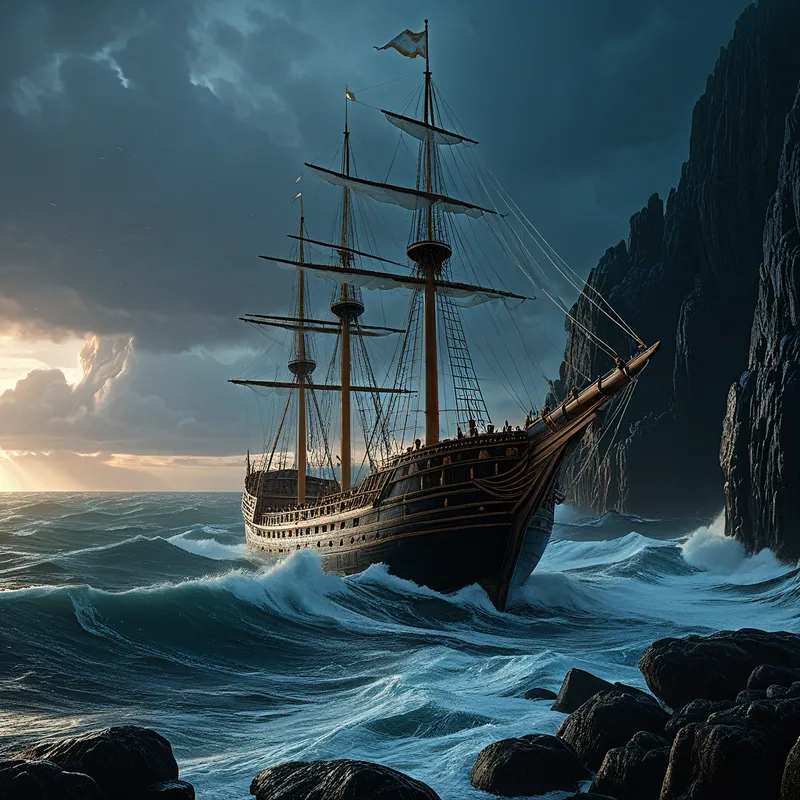
The Argo Myth Meaning & Symbolism
A band of heroes, a sentient ship, and a quest for a golden prize. The Argo's voyage is the soul's journey toward wholeness through peril and transformation.
The Tale of The Argo
Hear now the tale of the first ship, the ship with a voice, and the men who became more than men by sailing her. It begins not with a hero, but with a crime. In the shadowed halls of Iolcus, a king’s ambition choked the rightful heir, a boy named [Jason](/myths/jason “Myth from Greek culture.”/). Cast out, he grew to manhood under the stern sky of the centaur Chiron, his muscles forged by mountain winds, his mind shaped by stories of a throne stolen.
He returned, a stranger wearing one sandal, and the usurper king Pelias trembled at the omen. “What would you do,” the king asked, masking fear with cunning, “if a man destined to kill you stood before you?” And Jason, young and blazing with the fire of destiny, spoke his doom: “I would send him to fetch the [Golden Fleece](/myths/golden-fleece “Myth from Greek culture.”/).” Thus, the trap was set. A quest for a phantom, a prize guarded by a dragon in the land of Colchis, at [the world](/myths/the-world “Myth from Tarot culture.”/)’s bloody edge.
But the gods breathe life into impossible things. Under the guidance of Athena herself, the master-builder Argus laid keel. Timber from the prophetic grove of Dodona was hewn, and from it spoke a plank, a voice in the hull—the ship Argo was alive. She would be their companion, their guide, their wooden soul.
And what a soul she carried! Not one hero, but fifty, a constellation of demigods and legends: the mighty [Heracles](/myths/heracles “Myth from Greek culture.”/), whose shadow was a mountain; the divine singer [Orpheus](/myths/orpheus “Myth from Global/Universal culture.”/), who could soothe stones with his lyre; the winged sons of the North Wind, Zetes and Calais; the keen-eyed Lynceus, who could see through [the earth](/myths/the-earth “Myth from Hindu culture.”/). They were [the Argonauts](/myths/the-argonauts “Myth from Greek culture.”/), bound by oath to the Argo and to Jason’s fate.
Their voyage was the map of nightmare and wonder. They drank from strange shores and fought earth-born men who sprouted from dragon’s teeth. They heard [the Sirens](/myths/the-sirens “Myth from Greek culture.”/)’ lethal song, which Orpheus drowned with a sweeter, more desperate music. They survived the Symplegades, the Clashing Rocks, only by the breath of the gods and the Argo’s own swiftness, her stern clipped as the stone jaws snapped shut behind her.
In Colchis, they found not an end, but a deeper [labyrinth](/myths/labyrinth “Myth from Various culture.”/). The Fleece hung in a sacred grove, watched by a sleepless dragon. The king, Aeëtes, set impossible labors: yoke fire-breathing bulls, sow a field with dragon’s teeth, fight the armed men who would rise from them. Here, Jason’s heroic strength faltered. Salvation came not from muscle, but from cunning and the fierce, foreign magic of the king’s daughter, [Medea](/myths/medea “Myth from Greek culture.”/). Her potions shielded him, her spells lulled [the dragon](/myths/the-dragon “Myth from Chinese culture.”/). With her, he stole the Fleece, a shimmering cascade of gold in the dark wood, and fled, his victory forever twined with betrayal and a woman’s broken heart.
The return was a ghost-road, a flight haunted by the wrath of a robbed father. They sailed up great rivers, carried the Argo on their shoulders across deserts, a wooden burden on their backs. They passed through the realm of the dead, heard whispers from the shore. The Argo, weary but true, bore them home, not to a clean [triumph](/myths/triumph “Myth from Roman culture.”/), but to a kingdom stained by the aftermath of their journey. The Fleece was won. The ship, her voice now silent with completed purpose, was dedicated to the gods. The crew scattered to their own tragic destinies, forever changed, forever bound by the memory of the voyage that made them a single, breathing entity.
Cultural Origins & Context
The saga of the Argo is one of the oldest and most layered in the Greek tradition, predating even the tales of Achilles and [Odysseus](/myths/odysseus “Myth from Greek culture.”/). Its roots are in the oral epic tradition, a sprawling narrative cycle that was likely sung and reshaped by bards for centuries before being crystallized in literary form by poets like Apollonius of Rhodes in his Argonautica. This was not a state-sponsored myth but a pan-Hellenic story of exploration, reflecting the Greek world’s expansion across the Black Sea. Colchis was a real place, a land of mystery and wealth at the edge of the known world.
The function of the myth was multifaceted. On one level, it was a foundational “road map” of heroic genealogy, connecting the families and city-states of Greece through the shared lineage of the Argonauts. On another, it was a narrative of limits tested and exceeded. The Argo was the first ship, representing humanity’s daring to leave the sight of shore, to venture into the chaos of the open sea—the unconscious of the ancient world. It modeled the ideal of the hetairoi, the band of companions bound by mutual oath and shared peril, which was the bedrock of ancient Greek social and military life. The voyage served as a cultural crucible, defining what it meant to be a hero: not just strength, but cunning, endurance, and the ability to integrate foreign, even dangerous, aid (embodied by Medea) to achieve a collective goal.
Symbolic Architecture
The Argo is more than a [vessel](/symbols/vessel “Symbol: A container or structure that holds, transports, or protects something essential, representing the self, emotions, or life journey.”/); it is [the vessel](/myths/the-vessel “Myth from Alchemical culture.”/) of [the Self](/myths/the-self “Myth from Jungian culture.”/) in its nascent, journeying form. It is the psychic [structure](/symbols/structure “Symbol: Structure in dreams often symbolizes stability, organization, and the framework of one’s life, reflecting how one perceives their environment and personal life.”/) we build to contain our disparate parts and sail into the unknown of our own potential.
The ship is the crafted psyche, the Argo the first ego-complex sturdy enough to embark on the soul’s great voyage.
Jason is not the solitary [hero](/symbols/hero “Symbol: A hero embodies strength, courage, and the ability to overcome significant challenges.”/). He is the conscious ego, the designated [leader](/symbols/leader “Symbol: A leader signifies authority, responsibility, and guidance; representing aspirations for achievement or fear of following.”/), but he is incomplete. His [quest](/symbols/quest “Symbol: A quest symbolizes a journey or search for purpose, fulfillment, or knowledge, often representing life’s challenges and adventures.”/), [the Golden Fleece](/myths/the-golden-fleece “Myth from Greek culture.”/), symbolizes the ultimate prize of psychic [integration](/symbols/integration “Symbol: The process of unifying disparate parts of the self or experience into a cohesive whole, often representing psychological wholeness or resolution of internal conflict.”/)—the aurum philosophicum or the lost kingship of the Self. It is a numinous, almost unreachable goal that promises wholeness and [authority](/symbols/authority “Symbol: A symbol representing power structures, rules, and control, often reflecting one’s relationship with societal or personal governance.”/). The [crew](/symbols/crew “Symbol: A crew often symbolizes collaboration, teamwork, and collective purpose, suggesting a need for shared goals and support from others in one’s journey.”/) of fifty represents the multitude of latent talents, instincts, ancestral memories, and archetypal forces (the “50 heroes”) within the individual. The mighty Heracles is raw instinctual power; Orpheus is the transcendent function that can harmonize [chaos](/symbols/chaos “Symbol: In Arts & Music, chaos represents raw creative potential, uncontrolled expression, and the breakdown of order to forge new artistic forms.”/); the Boreads are the [spirit](/symbols/spirit “Symbol: Spirit symbolizes the essence of life, vitality, and the spiritual journey of the individual.”/) of [intuition](/symbols/intuition “Symbol: The immediate, non-rational understanding of truth or insight, often described as a ‘gut feeling’ or inner knowing that bypasses conscious reasoning.”/) and change. Alone, each is a fragment. Housed within the Argo—the coherent, living structure of a purposeful [life](/symbols/life “Symbol: The symbol of ‘Life’ represents a journey of growth, interconnectedness, and existential meaning, encompassing both the joys and challenges that define human experience.”/)—they become a [crew](/symbols/crew “Symbol: A crew often symbolizes collaboration, teamwork, and collective purpose, suggesting a need for shared goals and support from others in one’s journey.”/).
The voyage itself charts the perilous [path](/symbols/path “Symbol: The ‘path’ symbolizes a journey, choices, and the direction one’s life is taking, often representing individual growth and exploration.”/) of individuation. The Clashing Rocks (Symplegades) are the archetypal ordeal, the crushing pressure of opposites (conscious/unconscious, masculine/feminine, known/unknown) that threatens to destroy the nascent self. Passing through them is the first major [death](/symbols/death “Symbol: Symbolizes transformation, endings, and new beginnings; often associated with fear of the unknown.”/)-and-[rebirth](/symbols/rebirth “Symbol: A profound transformation where old aspects of self or life die, making way for new beginnings, growth, and renewal.”/). Medea is the ultimate symbolic key. She represents the rejected, “barbaric” [depth](/symbols/depth “Symbol: Represents profound layers of consciousness, hidden truths, or the unknown aspects of existence, often symbolizing introspection and existential exploration.”/) of the [psyche](/myths/psyche “Myth from Greek culture.”/)—the transformative power of the unconscious, the [shadow](/symbols/shadow “Symbol: The ‘shadow’ embodies the unconscious, repressed aspects of the self and often represents fears or hidden emotions.”/) that holds both poison and remedy. To secure the Fleece, Jason must embrace her magic, integrating this fierce, irrational, and creative feminine principle. His victory is thus always ambivalent, paid for with [betrayal](/symbols/betrayal “Symbol: A profound violation of trust in artistic or musical contexts, often representing broken creative partnerships or artistic integrity compromised.”/), signifying that the integration of the [shadow](/symbols/shadow “Symbol: The ‘shadow’ embodies the unconscious, repressed aspects of the self and often represents fears or hidden emotions.”/) is never clean or easy, and its consequences forever alter the psychic [landscape](/symbols/landscape “Symbol: Landscapes in dreams are powerful symbols representing the dreamer’s emotional state, personal journey, and the broader context of life situations.”/).
The Dreamer’s Resonance
When the myth of the Argo stirs in the modern dreamer, it announces a profound call to voyage. To dream of a vast, ancient ship under construction suggests the psyche is building a new capacity, forging a stronger ego-structure to face a coming life transition. To dream of being on such a ship with a disparate crew of strangers, all working together, speaks to the internal mobilization of one’s diverse inner resources—the intellectual, the artistic, the resilient, the instinctual—toward a common, distant goal.
Dreams of the Clashing Rocks manifest as feelings of being crushed by an impossible choice, a dual pressure with no apparent escape. The somatic sensation is one of constriction, of breath held. The psychological process is the ordeal necessary for passage; the dream ego must find the moment of divine timing (the dove’s path) to navigate through. Dreaming of the Golden Fleece itself—a radiant, textured gold hanging in a dark, sacred grove—is a direct vision of the Self. It is an image of immense value and tranquility, often appearing after a period of great struggle, offering a glimpse of the wholeness that is the destination of the journey. Conversely, dreaming of a stolen fleece or a vengeful pursuer may reflect anxiety about the cost of one’s ambitions or unintegrated guilt from necessary, shadowy actions taken to advance.

Alchemical Translation
The alchemical opus is perfectly modeled in the Argosy. The quest begins with the [nigredo](/myths/nigredo “Myth from Alchemical culture.”/), the blackening: the stolen throne, the exile, the “impossible” task set by Pelias—the state of felt deficiency and primal conflict. The building of the Argo is the creation of the vas, [the sacred vessel](/myths/the-sacred-vessel “Myth from Various culture.”/), without which the work cannot proceed. It is the commitment to the process, the establishment of a disciplined container (a therapy, a practice, a creative endeavor) that can hold the coming chaos.
The voyage is the albedo and citrinitas, the whitening and yellowing—the long, arduous purification and illumination through confrontation with the inner landscape.
Each island, each monster, is a complex to be engaged: the crushing rocks of paradox, the seductive songs of regression, the fiery bulls of untamed passion. The crew’s diverse skills represent the various faculties of the psyche being tested and honed. The pivotal moment of transmutation occurs in Colchis, the land of [the shadow](/myths/the-shadow “Myth from Jungian culture.”/). Here, the conscious ego (Jason) cannot succeed with force alone. It must submit to and partner with the anima in her most potent and dangerous form (Medea the sorceress). This is [the sacred marriage](/myths/the-sacred-marriage “Myth from Various culture.”/), the coniunctio, with the transformative power of the deep unconscious. It is messy, morally ambiguous, and utterly necessary.
The winning of the Fleece is the production of the [rubedo](/myths/rubedo “Myth from Alchemical culture.”/), the red gold of the Self. But the alchemy is not complete with its possession. The long, circuitous, haunted return voyage is critical—it is the integration of that achievement back into the fabric of one’s life. The Fleece must be brought home, its meaning digested. The final act is the dedication of the Argo itself. The ship, [the ego](/myths/the-ego “Myth from Jungian culture.”/)-vessel that made the journey possible, is ultimately surrendered. It becomes a monument, a memory. The individual no longer identifies solely with the vehicle of seeking but rests in the authority of the Fleece, the embodied Self, having been utterly remade by the journey.
Associated Symbols
Explore related symbols from the CaleaDream lexicon: