The Ant and the Grasshopper Myth Meaning & Symbolism
A fable of the diligent Ant who stores for winter and the carefree Grasshopper who sings, confronting the consequences of time and preparation.
The Tale of The Ant and the Grasshopper
Hear now a tale spun when the sun was a tyrant and the wind a gentle conspirator. It unfolds in the kingdom of the meadow, under the unblinking blue eye of the sky. Here, the world was a symphony of heat and life, a buzzing, chirping hymn to abundance.
In this kingdom lived two souls of starkly different mettle. The first was the Ant. While the sun beat its golden drum, she was a moving shadow, a tiny engine of purpose. You would see her, a speck of polished obsidian, journeying from the wheat’s edge to the hidden door in the oak’s root. Upon her back she bore crumbs of barley, flecks of seed, fragments of grain—each a treasure heavier than herself. Her path was a pilgrimage of silence, save for the rustle of her passage through the grass. Back and forth, day upon day, she built her subterranean citadel of sustenance. The sweat of her labor was the mortar; her unspoken fear of the silent, white season was the architect.
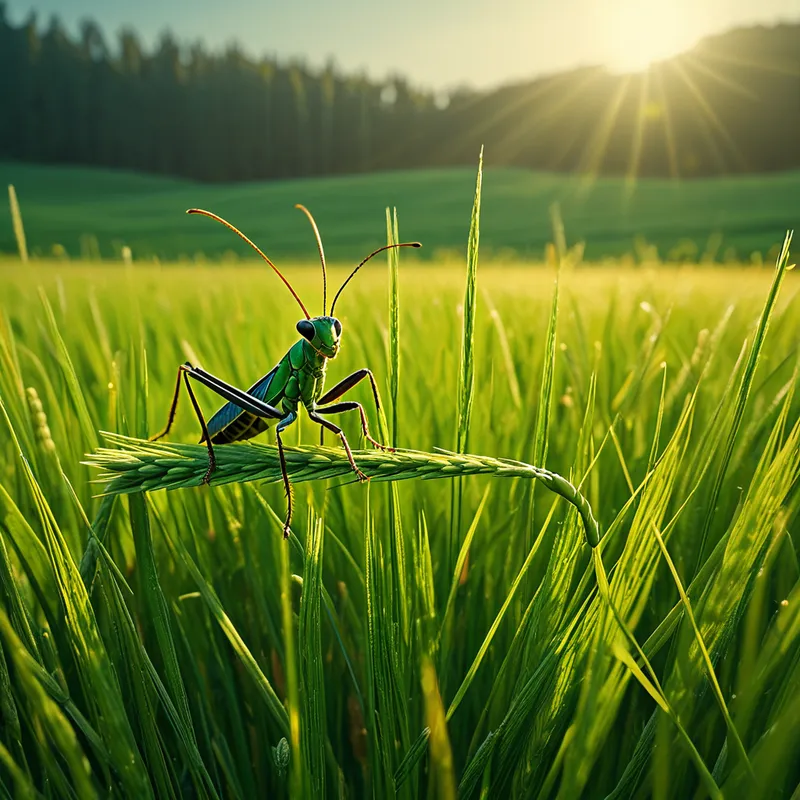
The other was the Grasshopper. He was a creature of the sun’s zenith. Perched upon a swaying stem, his body was a vessel for song. His legs were his bow, his wings his sounding board, and from him poured a ceaseless, jubilant music that rippled through the hot air. He danced on petals, drank dew, and saw the Ant’s endless march as a peculiar madness. “Sister Ant!” he would call, his voice a lyrical chirrup. “Why do you toil while the world offers a feast for the senses? Come, rest in the shade! Listen to the poetry of the breeze! The summer is eternal!”
The Ant would pause, a dark jewel in the green, but never for long. “I am preparing for winter,” she would say, her voice a dry whisper of practicality. “And you would be wise to do the same.” The Grasshopper would only laugh, a trill of pure, unburdened joy, and launch into another melody, believing the music itself was sustenance enough.
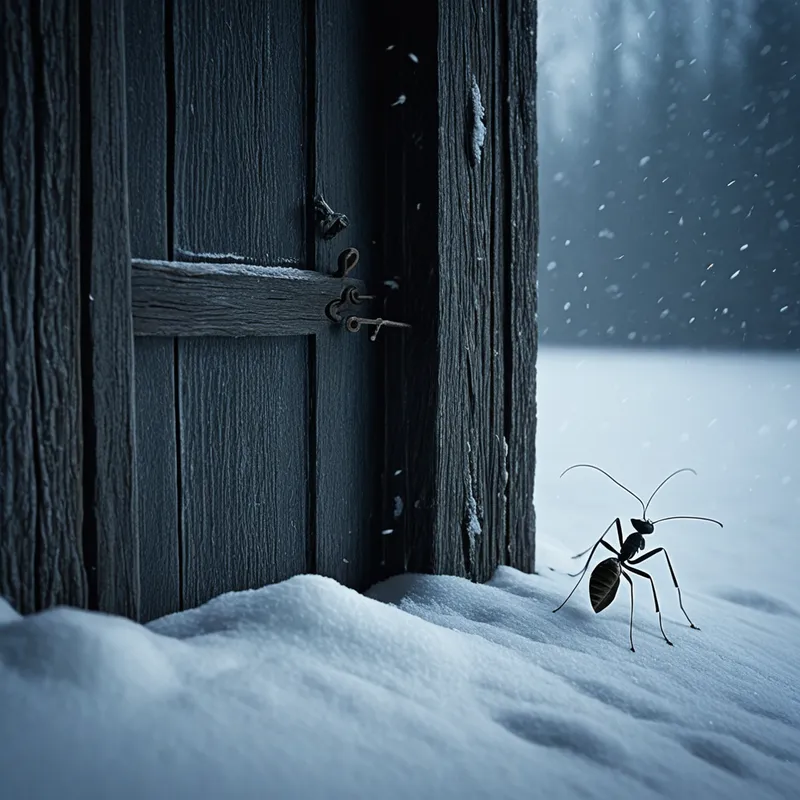
But the wheel of the year turns, indifferent to song. The tyrant sun weakened, its gold leaching into bronze, then copper. The conspirator wind grew cold and sharp. The great green symphony of the meadow faded to a brittle, brown silence. Then came the frost, painting the world in glass and bone, and after it, the snow—a soft, smothering shroud.
In his hollow stem, the Grasshopper’s music faltered, then died. His world, once vast and melodic, shrank to the desperate search for a single seed, a forgotten berry. The feast was over; the eternal summer, a lie told by his own heart. Hunger, a cold, gnawing stranger, took up residence in his belly. Shivering, his vibrant wings dulled, he remembered the citadel underground.
Through the bitter white, he stumbled to the familiar root by the oak. With the last of his strength, he scratched at the earthen door. It opened, and a wave of warmth and the rich, dusty scent of stored grain flowed out. There stood the Ant, in a chamber lined with plenty.
“Please,” chirped the Grasshopper, his voice a thin, broken thread. “I am cold and starving. Grant me a little of your food to see me through this deathly season.”
The Ant looked at him, her antennae still. The silence stretched, filled only by the howl of the wind outside her door. “You sang all summer,” she said, not with cruelty, but with the terrible, simple weight of truth. “Now, you may dance to the tune of winter.” And with that, she closed her door, leaving the Grasshopper to the mercy of the white world and the consequences of his endless, beautiful song.
Cultural Origins & Context
This stark parable originates from the vast, amorphous tradition attributed to Aesop, a figure who is himself a kind of myth—a possibly enslaved man of ancient Greece or Phrygia whose wisdom transcended his station. The fables were not sacred texts, but social tools, transmitted orally for centuries before being codified in collections. They were the property of the agora and the symposium, used by philosophers, politicians, and ordinary people to encapsulate complex ethical and practical truths in a memorable, accessible form.
The societal function of “The Ant and the Grasshopper” was fundamentally pedagogical and normative. In agrarian and early urban societies where survival was precarious and the seasonal cycle absolute, the fable was a cultural memetic device. It reinforced the virtues of prudence, diligence, and communal responsibility (as ant colonies exemplify). It was a warning against heedlessness and a stark lesson in natural consequences. The teller wasn’t just telling a story about insects; they were encoding a survival algorithm for the community: prepare, work together, respect time.
Symbolic Architecture
On the surface, the myth is a lesson in practicality. But its symbolic architecture reveals a profound psychic tension. The Ant and the Grasshopper are not merely two different creatures; they are two opposing, yet essential, principles of the human psyche.
The Ant embodies the Ego’s Reality Principle. She is consciousness oriented toward survival, structure, and the future. She represents discipline, labor, and the accumulation of resources—both material and psychological. Her world is linear, sequential, and built on cause and effect. She is the part of us that builds a career, saves money, and tends to our responsibilities.
The Ant does not hate the song; she fears the silence that follows it. Her labor is a hymn to time’s inevitable passage.
The Grasshopper embodies the Spirit of the Dionysian. He is the drive for immediate experience, beauty, art, and play. He represents spontaneity, creativity, and living fully in the present moment. His world is cyclical, aesthetic, and built on sensation and expression. He is the part of us that creates art, falls in love, and loses ourselves in wonder.
Their conflict is the eternal human struggle between duty and desire, between securing our existence and actually experiencing it. The myth’s traditional, harsh resolution suggests a cultural prioritization: survival of the community (the ant colony) must trump the indulgence of the individual (the solitary grasshopper). Psychologically, it depicts what happens when the Dionysian impulse completely overruns the ego’s capacity for stewardship.

The Dreamer’s Resonance
When this myth pattern arises in modern dreams, it rarely features literal insects. Instead, the dreamer may find themselves in a chaotic, beautiful party they must frantically clean, or desperately trying to store fleeting, melting jewels. They may be taking a vital exam for which they have not studied, while a hauntingly beautiful music distracts them.
These dreams signal a somatic and psychological process of integration alarm. The psyche is highlighting a critical imbalance. The “Grasshopper” aspect—the creative, impulsive, pleasure-seeking self—has been dominant at the expense of the “Ant” self—the organizing, providing, future-oriented self. The cold “winter” in the dream is the looming consequence: a deadline, a financial shortfall, a relationship neglect, or a profound sense of existential unpreparedness.
The somatic feeling is often one of anxious urgency, of time running out, coupled with a pang of regret for lost opportunities for preparation. The dream is not condemning joy, but sounding an alarm that the foundation is crumbling beneath the feast. It calls the dreamer to a moment of sober reckoning, to invoke the inner Ant to secure the territory so that the inner Grasshopper may one day sing again, safely.

Alchemical Translation
The individuation process, the alchemical work of becoming a whole Self, does not involve the victory of one archetype over the other, but their sacred marriage. The raw, base metal of our one-sidedness must be transmuted.
The initial state is separation: the Ant and Grasshopper live in different worlds, judging each other’s modes of being as folly. The first alchemical stage, nigredo (the blackening), is the harsh winter. It is the necessary suffering, the consequence that forces a crisis. The Grasshopper’s starvation and the Ant’s isolation behind her door represent the impoverishment of a psyche split against itself.
The winter is the crucible. It proves that song alone cannot sustain life, and that life without song is not worth sustaining.
The work of albedo (the whitening) is the recognition of mutual need. The Ant must ask: What is the point of all my stored grain if my world contains no music, no beauty, no spontaneous joy? My citadel becomes a tomb. The Grasshopper must learn: How can my song endure if I do not build a vessel, a body, a life strong enough to harbor it through life’s winters?
The culmination, rubedo (the reddening), is the integration. It is the conscious individual who works with the diligence of the Ant, building a resilient structure for their life, but who does so in order to create a space for the Grasshopper’s song. They schedule time for labor and time for play. They save money to buy a musical instrument. They build a career that allows for sabbaticals of pure creation. The stored grain becomes not a hoard, but the fuel for future festivals.
In this translation, the myth’s ending is not a final judgment, but a depiction of a failed integration. The alchemical challenge for the modern soul is to open the door. To let the shivering, creative spirit in, feed it with the fruits of discipline, and in return, allow its music to warm the sterile halls of pure practicality. To become, at last, the one who both builds the granary and composes the hymn for the harvest.
Associated Symbols
Explore related symbols from the CaleaDream lexicon: