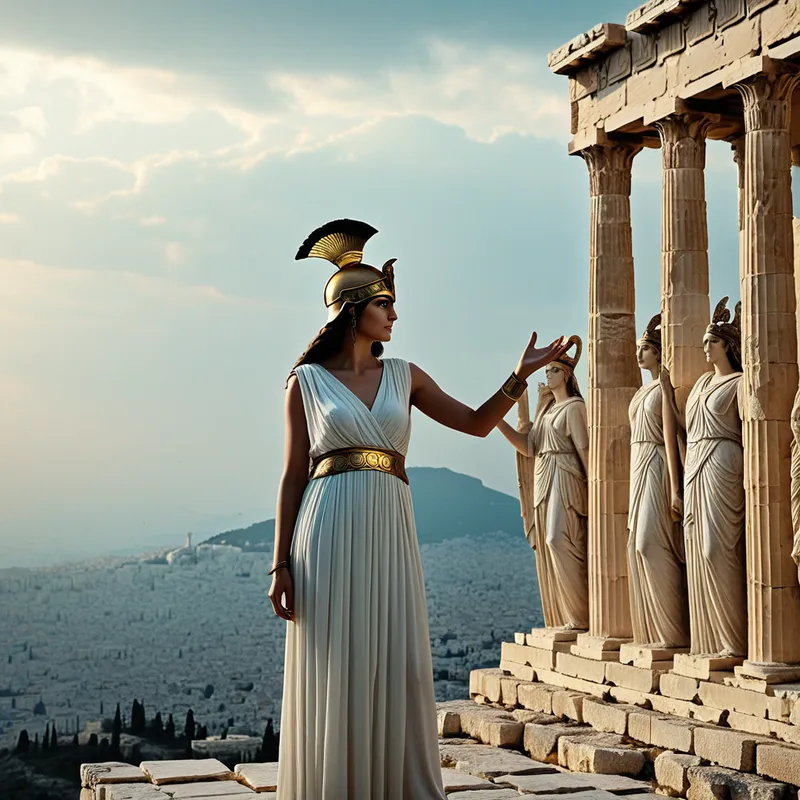
The Amnesty of Athena Myth Meaning & Symbolism
Athena persuades the vengeful Furies to accept a place of honor in Athens, transmuting blind rage into sacred, civilizing law.
The Tale of The Amnesty of Athena
Hear now a tale not of thunder, but of the quiet thunderclap of a mind made whole. It begins not on sun-drenched Olympus, but in the deep, dripping dark beneath the world, in a cave where the very stones weep with the memory of blood. Here dwell the Furies, born from the drops that fell when Uranus was wounded. They are the Hounds of Conscience, with eyes that see only the crime, with hearts that beat only for retribution. Their breath is the smell of rust, their song the wail of the unavenged dead.
Above, in the newborn city of Athens, a shadow hangs. Orestes, driven mad by their pursuit, clutches the navel-stone of the world at Delphi. He has shed a mother’s blood to avenge a father’s murder, and the ancient law of the Furies is absolute: kin-blood demands kin-blood. They circle him, their serpent locks hissing, their torches casting frantic shadows. He is guilt embodied, and they are guilt’s eternal consequence.
But a new sound cuts the fetid air. Not a scream, but the clear, resonant ring of bronze. Athena descends, her presence not a blaze but a clarifying dawn. She has come from afar, summoned by the cosmic dissonance. “Stay your hands,” her voice commands, not with force, but with the weight of a new possibility. “This endless cycle of blood for blood solves nothing. Let us have a trial. Let us have a judgment.”
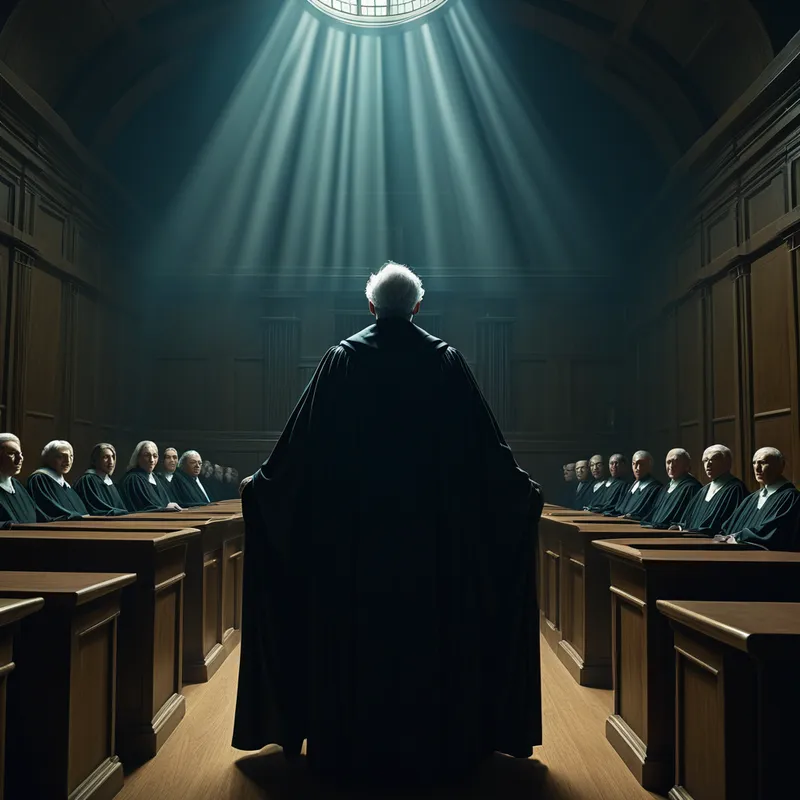
And so, on the holy hill of the Areopagus, the first court of justice is convened. The Furies shriek their case: the old, primal law, the bond of the womb, the sacred terror of matricide. Apollo speaks for Orestes, arguing the newer law of the father, of civic order. The air crackles with the tension between two worlds—the chthonic and the Olympian, the tribal and the civic, the raw cry of vengeance and the reasoned word of law.
Athena presides. She listens to the howl of the ancient ones and the logic of the shining god. When the votes of the mortal jurors are cast, they are equal. The tie falls to her. She lifts her hand, and in that gesture is the birth of something never before seen. “I cast my vote for Orestes,” she declares. “Not because the father’s claim is greater, but because I was born of no mother, from the brow of Zeus himself. I honor the male. Yet, I do not dishonor the female. The cycle must end here.”
The Furies erupt in a torrent of rage, threatening to blight the land, to poison the very soil of Athens with their curse. This is the pivotal moment. Athena does not raise her aegis to smite them. She does not banish them to Tartarus. Instead, she leans forward, her grey eyes holding their fiery gaze. She speaks not as a conqueror, but as a petitioner to revered elders. She offers them a home, not in the dark below, but in a sacred cave within the city’s heart. She offers them honor, worship, a new name: the Eumenides. She offers them a purpose—not as pursuers of blind rage, but as guardians of the just fear that upholds the law. She offers amnesty, and in doing so, she offers transformation.
The silence that follows is deeper than any noise. The serpentine locks grow still. The fiery torches dim to a gentle, hearth-like glow. The howls of the hounds soften into murmurs of acceptance. They take her hand. The poison of vengeance is alchemized into the bedrock of justice.

Cultural Origins & Context
This profound resolution forms the climax of Aeschylus’s Oresteia, a trilogy of plays first performed in Athens in 458 BCE. It is not a folk tale, but a sophisticated civic drama performed at the City Dionysia before the entire citizen body. The myth, as presented by Aeschylus, served a direct societal function: to provide a divine charter for the Areopagus council, Athens’ ancient and venerable court for trying homicide cases. It legitimized the city’s move from tribal blood-feud to a polis-based rule of law, framing this monumental cultural shift not as a human invention, but as a divine ordinance mediated by its patron goddess, Athena. The story was passed down through the powerful medium of public theater, where every citizen witnessed the terrifying Furies being persuaded to become the protectors of their very community.
Symbolic Architecture
The Amnesty is one of the most psychologically complete myths ever conceived. It maps the evolution of consciousness from a primitive, punitive super-ego to a mature, integrative psyche.
The Furies represent the raw, unconscious psychic material—the unprocessed trauma, the guilt that haunts us, the inner critic that knows only punishment. They are the autonomous complex of vengeance, the part of the psyche that demands an eye for an eye, trapping the soul in endless cycles of self-recrimination and projected blame.
The Furies are not monsters to be slain, but vital energies to be heard, honored, and redirected. They are the psyche’s immune system, gone rogue.
Athena represents the synthesizing power of conscious awareness—not cold intellect, but metis (cunning intelligence) married to sophrosyne (temperance). She is the ego’s capacity to hold tension, to listen to opposing inner voices, and to seek a third, transcendent way. Her amnesty is not forgiveness in the sentimental sense, but the act of granting a sacred space to that which we fear within ourselves. The trial itself symbolizes the internal process of bringing unconscious conflicts into the light of conscious examination.
The Dreamer’s Resonance
When this myth stirs in the modern dreamer, it often manifests as a profound confrontation with one’s own “Furies.” You may dream of being relentlessly pursued by shadowy figures for a past mistake, or of standing trial in a surreal courtroom where the prosecutors are your own feelings of shame or rage. The somatic experience can be one of constriction, panic, or a heavy, inescapable dread—the body feeling the hunt.
The turning point in the dream, mirroring the Amnesty, comes not with escape or victory, but with a moment of profound pause. The dream-Athena may appear as a calming presence, a sudden clear thought, a wise figure, or even the dreamer finding their own voice to speak to the pursuers. The resolution is the transformation of the pursuers into allies, or their integration into the architecture of the dreamscape—perhaps becoming guides or settling into a temple-like structure within the dream. This signals the psyche’s movement from being persecuted by a complex toward integrating its energy.
Alchemical Translation
The alchemical process modeled here is the rubedo, the reddening or final integration. It is the stage where the differentiated elements of the self are reunited into a new, conscious whole. The Amnesty is a master blueprint for individuation.
First, the nigredo: Orestes’ madness and the Furies’ pursuit—the descent into the blackness of guilt and fragmentation. Then, the albedo: Athena’s intervention and the trial—the raising of the conflict into the clear, white light of conscious scrutiny. Finally, the rubedo: the Amnesty itself. This is not a victory of light over dark, but the sacred marriage (hieros gamos) of the two.
True justice in the soul is not the execution of the shadow, but its naturalization as a citizen of the inner realm.
For the modern individual, this translates to the work of shadow integration. It is the practice of listening to our inner Furies—our rage, our shame, our deepest fears—not to obey them blindly or to annihilate them, but to offer them a seat at the council. We grant them amnesty by acknowledging their origin, honoring their protective intent (however distorted), and redirecting their fierce energy from self-torment into vigilant self-awareness. We transmute the curse of a relentless conscience into the blessing of a moral compass. In doing so, we build our own inner Areopagus, a psychic citadel where law replaces feud, and wisdom brokers peace between our warring parts.
Associated Symbols
Explore related symbols from the CaleaDream lexicon: