The Allegory of the Cave Myth Meaning & Symbolism
Prisoners chained in a cave mistake shadows for reality until one is freed, ascending to see the sun and returning with a transformative, unwelcome truth.
The Tale of The Allegory of the Cave
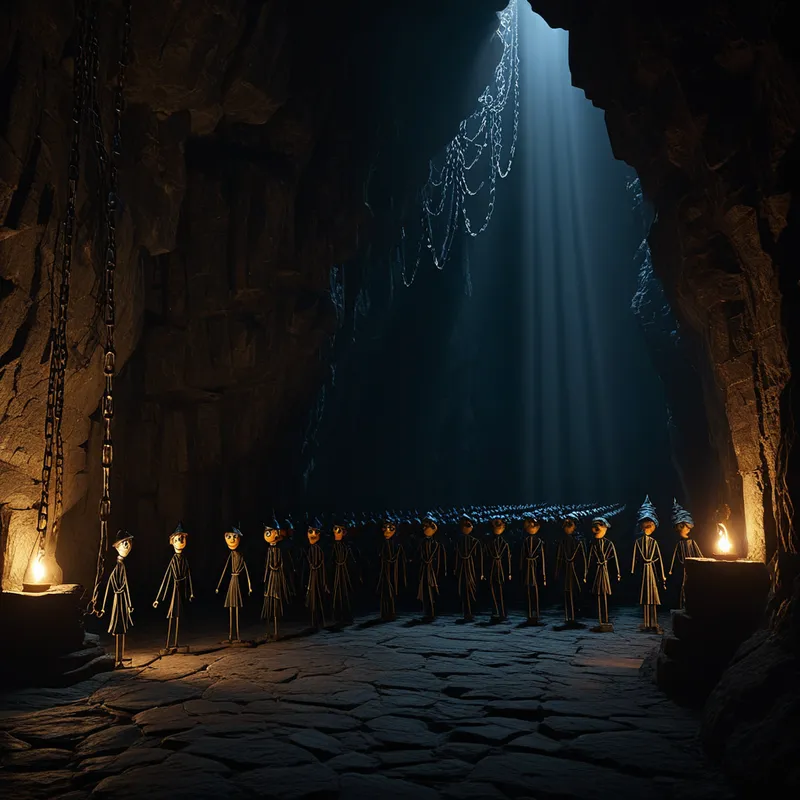
Imagine, if you will, a place beneath the earth. Not a tomb, but a dwelling. A cavernous chamber, so deep that the noise of the world above is but a forgotten rumor. Here, from their childhood, a company of people dwell, bound by chains. Not chains of malice, but of habit, fastened at the legs and necks so they cannot turn their heads. They face only forward, toward the blank, curving wall of the cave.
Behind them, higher up, a fire burns. And between this fire and the prisoners runs a low wall, like the screen at a puppet show. Along this wall, other people carry all manner of artifacts—statues of men and animals, vessels of wood and stone. The firelight casts the shadows of these objects onto the wall the prisoners stare at. The carriers speak, and their voices echo off the stone, seeming to come from the shadows themselves.
This is the only world the prisoners have ever known. The flickering play of silhouettes is their reality. They name the shadows as they pass: “a horse,” “a jug,” “a god.” They honor the quick and the graceful shadows, and scorn the slow and clumsy ones. The echoes are the voices of these shadow-beings. Their entire society, its honors and disputes, is built upon this phantom pantomime.
Now, picture one among them. The chains are loosened, or perhaps they break. He is compelled to stand, to turn his head, to walk toward the fire and the bustling path. The light of the flames assaults his eyes. The shapes that were once crisp shadows are now revealed as crude, painted puppets. He is confused. The pain in his eyes is sharp. The reality he knew is unmasked as a fabrication, and this new scene seems less real, more chaotic.
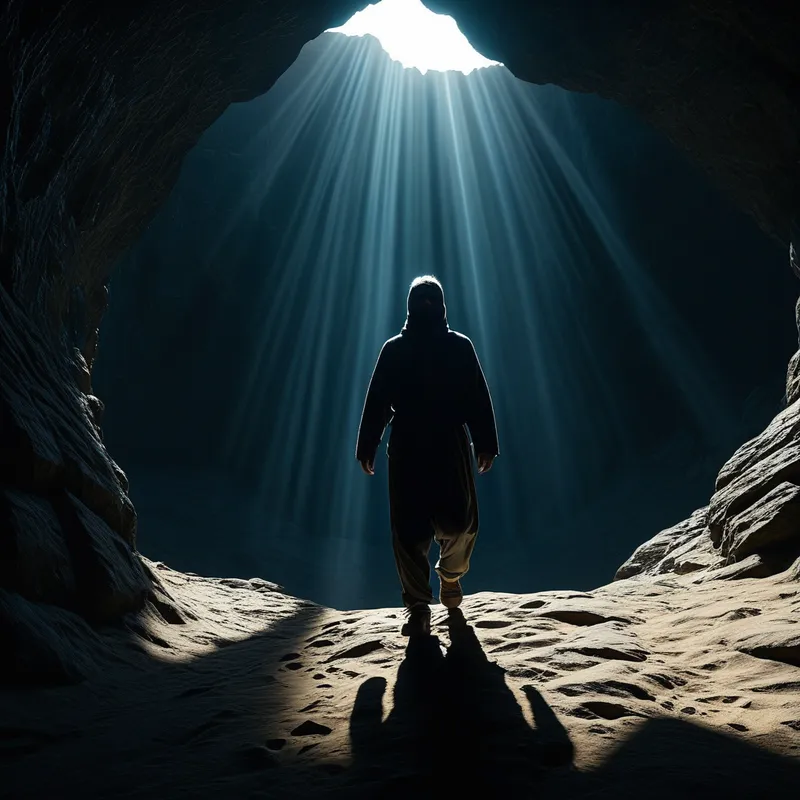
He is dragged further, up the rough and steep ascent, out of the cave mouth itself, into the world above. The light of the sun is an agony. He is blinded, overwhelmed. He can see nothing of the things that are now said to be true—the trees, the water, the animals, the stars. He would flee back to the cave and its comfortable shadows.
But slowly, his eyes adjust. First, he sees reflections in water. Then shadows of real things. Then, at last, he can behold the things themselves under the light of the moon and the stars. Finally, he turns his gaze to the sun itself, not in its reflection, but in its own place in the heavens. He understands it is the source of all—the seasons, the life, the very light that once made the cave’s pathetic shadows possible. Pity fills him for his former companions, who still debate the honors of shadows.
His journey is not complete. He must return. He descends back into the darkness, his eyes now unaccustomed to the gloom. He stumbles, a fool in the eyes of those who never left. He tries to tell them of the world above, of the sun, of true reality. They laugh at his ruined sight. They declare the ascent has harmed him, and that it is better not even to try. If they could lay hands on him, they would kill the one who seeks to free them.
Cultural Origins & Context
This is not a myth of gods and heroes, but a philosophical parable crafted by the Athenian thinker Plato, recounted by his teacher-figure Socrates in the dialogue The Republic (circa 375 BCE). It was an oral teaching within the Academy, a form of thought-experiment designed not for public festival but for private, rigorous dialectic. Its societal function was foundational: to illustrate the core Platonic doctrine of the Forms. It served as a radical critique of Athenian political life and popular opinion (doxa), arguing that what most people call reality is a pale imitation, and that true leadership belongs to those who have made the painful journey to enlightenment—the philosopher-kings. It is a myth of education (paideia) as a violent turning of the entire soul.
Symbolic Architecture
The Cave is the sensible world, the realm of unexamined opinion, cultural conditioning, and mediated experience. The prisoners are the unawakened psyche, identified entirely with the ego and its perceptions. The shadows are the illusions we take for truth—social narratives, sensory data, inherited beliefs.
The journey upward is the ascent of the soul into the intellectual world.
The fire is the imitative light, the sun of the cave—perhaps representing artificial culture, sophistry, or the limited light of the senses. The arduous ascent represents the painful discipline of philosophical and psychological inquiry. The sun is the Form of the Good, the ultimate reality, the Self, or the transcendent source of all being. The blinded eyes symbolize the shock of paradigm collapse, the death of the old self. The return to the cave is the philosopher’s—or the integrated individual’s—duty to engage with the world, despite the risk of ridicule or persecution. The final, tragic resistance of the prisoners illustrates the psyche’s fierce defense of its familiar prison, a profound statement about the terror of genuine freedom.

The Dreamer’s Resonance
When this myth stirs in modern dreams, it often manifests as a somatic experience of constraint and a dawning, unsettling awareness. You may dream of being in a familiar room that slowly reveals itself to be a set with false walls. You might be watching a compelling film, only to notice the edge of the screen, or to see a hand adjusting the projector. The somatic signature is often a stiffness in the neck—an inability to turn and see what is behind you.
Psychologically, this dream pattern signals a rupture in the persona. The ego’s agreed-upon reality is being challenged by material from the shadow or the prompting of the Self. The dreamer is in the process of disillusionment—a painful but necessary stripping away of a comfortable lie. It is the psyche’s own “turning of the soul,” initiating a process where one must choose between retreating to the familiar shadow-play or enduring the disorienting but liberating light of a deeper truth.

Alchemical Translation
The allegory is a perfect map of the alchemical nigredo and albedo, the process of individuation. The initial state is one of unconscious identification (prima materia). The breaking of chains is the call to adventure, often experienced as a crisis. The painful ascent is the nigredo—the confrontation with the shadow, the death of the old ego-identity, the “dark night of the soul.”
To see the sun is to achieve a conscious relationship with the Self, the inner sun around which the psyche orbits.
The vision of the sun is the albedo—illumination, the conscious connection to the guiding Self. But the work is not done. The citrinitas and rubedo occur in the return. The enlightened one must “descend with the treasure,” integrating this transcendent awareness back into the mundane world. This is the most difficult alchemy: to hold the vision of the sun while navigating the cave, to speak the language of light in a world of shadows, and to do so not with superiority, but with the compassion born of remembering one’s own chains. The myth thus models the complete arc of psychic transmutation—from captivity to liberation, and finally, to the responsibility of a hard-won wisdom.
Associated Symbols
Explore related symbols from the CaleaDream lexicon: