The Alchemist Myth Meaning & Symbolism
A solitary seeker journeys through fire and failure to transmute base matter into gold, discovering that the true treasure is the transformation of the self.
The Tale of The Alchemist
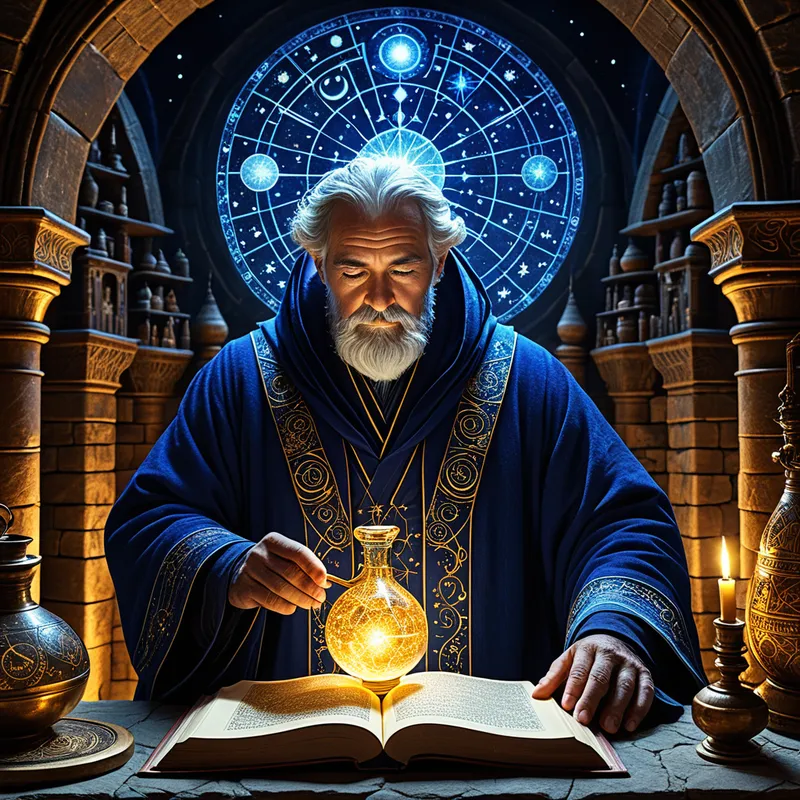
Listen. In the time before time was measured, when the world was a younger dream, there lived a seeker in a tower of silence. His name is lost, for names are for those who belong to the world below. We know him only as the Alchemist. His chamber was not of this earth; it was a cave hewn from ambition and a womb forged from fire. The air tasted of salt and sulfur, of longing and ash.
For years uncounted, his world was the dance of elements. He knew the sigh of quicksilver, the stubborn sleep of lead, the arrogant blaze of sulfur. He sought the Philosopher’s Stone, the sun condensed into matter, the key to turning the base into the sublime. His furnaces roared like caged dragons. His retorts wept glass tears. And always, failure. The lead remained lead, heavy with despair. The gold he sought was a mocking memory, a tale told by the embers.
One night, in the deepest hour, when even the stars seemed cold, a vision came. Not in flame, but in stillness. A voice that was not a voice spoke from the heart of his accumulated failure: “You seek to command the elements, but you have not let them command you. You look for the Stone in the crucible, but not in the crucible of your own soul.”
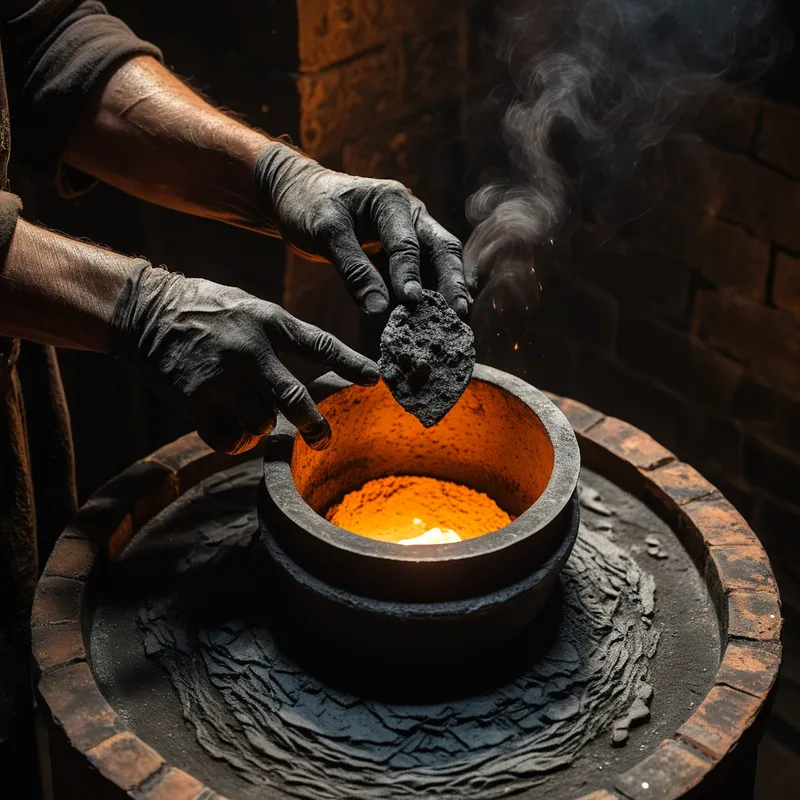
Stripped of all certainty, the Alchemist did a terrible thing. He took his most precious formula, the one that promised a shortcut to glory, and cast it into the fire. He shattered his favorite crystal vessel. He opened the tower window to the wind and the moon. He sat amidst the ruins of his art, empty-handed.
And in that emptiness, a new fire was kindled—not in the furnace, but in his chest. He began again, not to force, but to converse. He spoke to the lead of its density, its patience. He listened to the mercury’s flightiness. He understood the fire’s hunger. The work was no longer an operation, but a marriage.
Seasons turned. On a day indistinguishable from any other, he combined the prepared matters for the one-thousandth time. The fire burned not red, but with a strange, interior white light. The air hummed. In the vessel, a miracle of silence unfolded: the dull grey metal shimmered, wept a single tear of pure, solar gold, and then settled, transformed. Not just the metal. The very light in the room changed, becoming softer, older, full of a knowing peace. He held not just the Gold, but the understanding that the true Stone was the unbroken attention, the sacrificed pride, the self that had been burned and reborn in the process. The treasure was not the product, but the path.
Cultural Origins & Context
The figure of the Alchemist is a rare myth that belongs truly to Various culture. It has no single homeland, emerging simultaneously from the scriptoria of Hellenistic Egypt, the laboratories of medieval Islam, the ateliers of Renaissance Europe, and the philosophical traditions of China. It was not a folktale told to children, but an esoteric narrative passed down in coded texts, such as the Emerald Tablet, and through initiatory lineages.
Its tellers were the adepts themselves, writing under pseudonyms and veiling their operations in allegories of kings, queens, dragons, and lions. The myth’s societal function was dual. Exoterically, it chronicled the pursuit of material transmutation, driving early chemistry and proto-science. Esoterically, and more importantly, it provided a symbolic container for the most profound of human journeys: the transformation of the psyche from a state of unconscious, “base” suffering to one of integrated, “golden” enlightenment. It was a map for the few, written in the language of matter to describe the mysteries of spirit.
Symbolic Architecture
The myth’s power lies in its perfect symbolic correspondence between the outer laboratory and the inner world. The Alchemist is the ego, the conscious mind that initiates the quest for wholeness. The dark, isolated tower is the necessary retreat from collective norms, the opus solitudinis where one confronts the self without distraction.
The base metal—lead—is the heaviness of the unexamined life: our depressions, fixations, and shadow aspects. It is not to be discarded, but honored as the essential prima materia, the raw stuff of transformation.
The repeated failures represent the inevitable Nigredo, the dark night of the soul where all previous knowledge and identity crumble. The shattering of the old formula is the critical moment of surrender, where the ego’s willful striving (willfulness) is sacrificed. The subsequent “conversation” with the elements symbolizes the dialogue with the unconscious, personified as autonomous complexes and archetypal forces. The final transmutation is the Rubedo, or the birth of the Self, where the conscious and unconscious are married, producing a new, durable, and radiant psychic substance.
The Dreamer’s Resonance
When this myth stirs in the modern dreamer, it announces a profound phase of psychic transmutation. To dream of a laboratory, a furnace, or a solitary figure engaged in mysterious work is to sense the unconscious activating its own individuation process.
Somatically, this may manifest as a feeling of pressure, heat, or constriction in the chest—the “crucible” of the heart. Psychologically, it is the experience of being in the Nigredo: a depression that feels alchemical, not just clinical; a sense that one’s old identity is dissolving in a necessary, if terrifying, soup. Dreams of trying and failing to combine elements, or of precious substances turning to dust, mirror the Alchemist’s despair and point to an ego clinging to an outdated formula for life. The dream is the psyche’s way of insisting, “The method must change. You must be changed.”

Alchemical Translation
For the modern individual, the Alchemist’s journey models the non-linear, often painful, path of individuation. We all live with our “lead”—the inherited traumas, the unhealed wounds, the patterns of thought that weigh us down. The first step is to recognize this not as worthless slag, but as the essential starting material. Our conscious ambitions and life plans are the initial “formulas.”
The great crisis arrives when life itself, the ultimate alchemical fire, burns those formulas away. A loss, a failure, a betrayal—these are the fires of the furnace. The temptation is to rebuild the old ego-structure, to find a new, better formula.
The myth instructs us to do the opposite: to surrender. To sit in the ashes of the burnt-out identity. This is the Nigredo, the fertile void. From here, the work changes from “doing” to “listening.” We must “converse with our elements”—to engage with our emotions, our body’s wisdom, our dreams, and our shadows not as problems to fix, but as intelligent, autonomous aspects of the whole self seeking integration.
The Philosopher’s Stone that emerges is not a state of perfect, problem-free happiness. It is the lapis, the durable, centered awareness that can hold life’s contradictions without shattering. It is the “gold” of meaning, forged in the self’s own furnace. The final secret of the myth is that the treasure was never outside. The long, arduous work was the creation of the Stone. The transformed Alchemist, who has united the seeker and the sought, is the true Gold.
Associated Symbols
Explore related symbols from the CaleaDream lexicon: