The alchemical 'Coniunctio Opp Myth Meaning & Symbolism
The tale of the primordial sundering and the soul's sacred quest to reunite the divided king and queen, sun and moon, spirit and matter.
The Tale of The alchemical ‘Coniunctio Opp
Listen. In the beginning, before time was counted, there was One [Thing](/myths/thing “Myth from Norse culture.”/). A radiant, silent sphere containing all potential: light and dark, heat and cold, meaning and chaos, male and female. It was perfect, and therefore static. From the longing of eternity for experience, a great sigh echoed through [the void](/myths/the-void “Myth from Buddhist culture.”/). This sigh was the First Division.
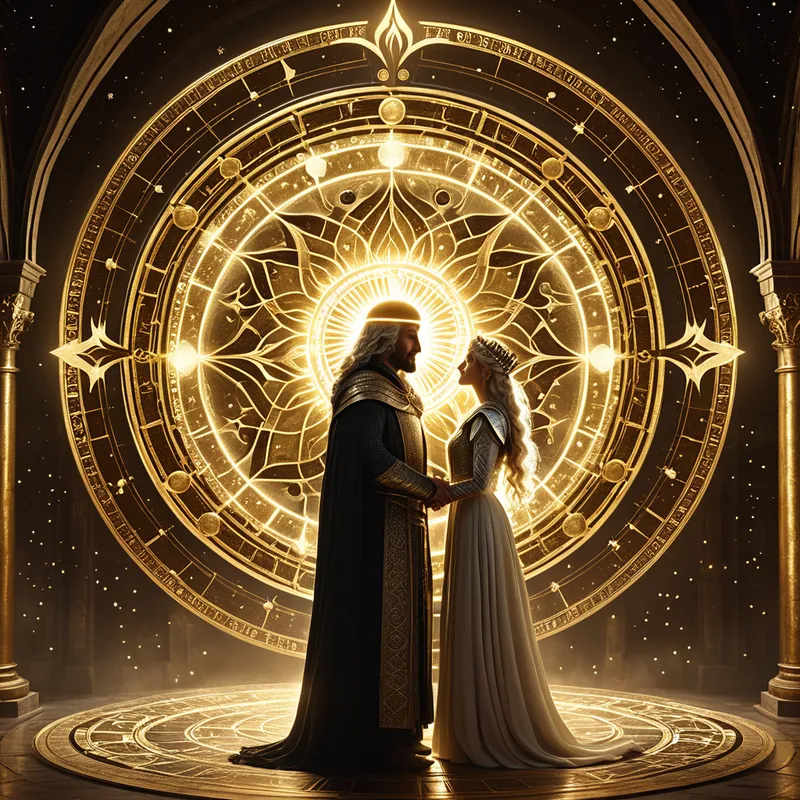
From the sphere emerged two sovereigns. From its bright summit descended the Rex, the Solar King. His body was forged of intent and will, his gaze the noonday sun that casts sharp, defining shadows. From the sphere’s deep, reflective base arose the Regina, the Lunar Queen. Her form was woven from substance and feeling, her presence the cool, tidal pull that shapes the unseen world. They beheld each other, and in that look was both profound recognition and terrifying alienation. They were halves of a forgotten whole.
Driven by the agony of their separation, each sovereign set out to conquer the other’s domain, believing wholeness lay in domination. The King, in his citadel of pure reason, sought to distill the Queen into a logical formula, to calcify her flowing silver into a fixed, golden law. The Queen, in her palace of shifting waters, sought to dissolve the King’s rigid forms, to drown his piercing light in the ocean of the unconscious. Their war was not of swords, but of essence. [The world](/myths/the-world “Myth from Tarot culture.”/) became a battlefield of extremes: dogmatic sun-scorched deserts opposed by chaotic, drowning floods.
Their conflict created the world of suffering, of paradox, of the unbearable tension between spirit and flesh, thought and emotion. They grew weak, their realms barren. The King became a brittle, lonely tyrant atop a crystal mountain. The Queen became a melancholic ghost drifting through a sea of mirrors. The original sphere seemed a cruel myth.
But deep within the rubble of their war, in the forgotten center where their energies had first clashed, a secret third thing was gestating. It was the [Mercurius](/myths/mercurius “Myth from Alchemical culture.”/), the paradoxical spirit, both mediator and trickster. It appeared not as a warrior, but as a guide, a vapor, a whispering wind. It spoke to the King of the beauty of dissolution, and to the Queen of the strength in structure. It did not preach peace, but hinted at a mystery more terrifying than war: [sacred marriage](/myths/sacred-marriage “Myth from Alchemy culture.”/).
Guided by this elusive spirit, exhausted by their lonely sovereignty, the sovereigns began a perilous descent into the tension, not away from it. The King allowed his golden armor to soften, to feel the cold kiss of doubt. The Queen allowed her silver tides to still, to hold the shape of a single, clear thought. They did not meet on his mountain or in her sea, but in the vas, the sealed vessel of the world itself—a hidden, circular chamber where all opposites are contained.
There, in the profound silence of the vas, the final act was not a battle, but a dissolution. As they embraced, their fixed forms began to melt. The King’s solar gold flowed like honey. The Queen’s lunar silver rose like fragrant smoke. Their essences commingled in a slow, cosmic dance, a hieros gamos. From this union, a new substance was born—neither gold nor silver, but a living, radiant white light that held both within it. The filius philosophorum was conceived in that light, a child of the whole world. The One Thing was remembered, not as a static sphere, but as a dynamic, breathing reality. The Coniunctio was complete.
Cultural Origins & Context
The myth of the Coniunctio Oppositorum is not the property of a single tribe or scripture, but a universal pattern emerging from humanity’s deepest observations of nature and the [psyche](/myths/psyche “Myth from Greek culture.”/). Its most systematic articulation is found in the symbolic texts of Western alchemy, spanning from Hellenistic Egypt through the Islamic [Golden Age](/myths/golden-age “Myth from Universal culture.”/) to the Renaissance laboratories of Europe. These adepts, often working in secrecy, used the language of chemistry—the marriage of [sulfur](/myths/sulfur “Myth from Alchemical culture.”/) and [mercury](/myths/mercury “Myth from Roman culture.”/), the solving and coagulating—to encode a profound psychological and cosmological drama.
The myth was passed down not by bards in halls, but by masters to apprentices, through cryptic manuscripts, emblematic illustrations like the [Rosarium Philosophorum](/myths/rosarium-philosophorum “Myth from Alchemical culture.”/), and oral tradition. Its societal function was dual. Exoterically, it promised the literal creation of [the Philosopher’s Stone](/myths/the-philosophers-stone “Myth from Alchemical culture.”/), a substance for transmuting base metals into gold and conferring immortality. Esoterically, and more importantly, it served as a map for individuation—the transmutation of the base, conflicted human soul into a unified, golden consciousness. It was a myth for initiates, providing a symbolic container for the terrifying yet necessary process of inner reconciliation.
Symbolic Architecture
At its core, the myth is a grand [metaphor](/symbols/metaphor “Symbol: A figure of speech where one thing represents another, often revealing hidden connections and deeper truths through symbolic comparison.”/) for the [structure](/symbols/structure “Symbol: Structure in dreams often symbolizes stability, organization, and the framework of one’s life, reflecting how one perceives their environment and personal life.”/) of [reality](/symbols/reality “Symbol: Reality signifies the state of existence and perception, often reflecting one’s understanding of truth and life experiences.”/) and [consciousness](/symbols/consciousness “Symbol: Consciousness represents the state of awareness and perception, encompassing thoughts, feelings, and experiences.”/), built on [the principle](/symbols/the-principle “Symbol: A fundamental truth, law, or doctrine that serves as a foundation for a system of belief, behavior, or reasoning, often representing moral or ethical standards.”/) that wholeness is achieved not through the victory of one [pole](/symbols/pole “Symbol: A pole in dreams often symbolizes stability, support, or a point of reference in life.”/) over its opposite, but through their sacred and paradoxical union.
The Rex and Regina represent the fundamental polarities of existence: conscious and unconscious, [logic](/symbols/logic “Symbol: The principle of reasoning and rational thought, often representing order, structure, and intellectual clarity in dreams.”/) and [intuition](/symbols/intuition “Symbol: The immediate, non-rational understanding of truth or insight, often described as a ‘gut feeling’ or inner knowing that bypasses conscious reasoning.”/), culture and [nature](/symbols/nature “Symbol: Nature symbolizes growth, connectivity, and the primal forces of existence.”/), yang and yin. Their initial war symbolizes the neurotic state of the divided psyche, where we [exile](/symbols/exile “Symbol: Forced separation from one’s homeland or community, representing loss of belonging, punishment, or profound isolation.”/) parts of ourselves we deem unacceptable, creating inner civil war and projecting conflict onto the world.
The true enemy is not the opposite, but the illusion that wholeness can exist without it.
The Mercurius is the crucial, often overlooked third. It symbolizes the transcendent function, the psychic agency that arises from holding the [tension](/symbols/tension “Symbol: A state of mental or emotional strain, often manifesting physically as tightness, pressure, or unease, signaling unresolved conflict or anticipation.”/) of opposites. It is the spark of [insight](/symbols/insight “Symbol: A sudden, deep understanding of a complex situation or truth, often arriving unexpectedly and illuminating hidden connections.”/), the sudden dream [image](/symbols/image “Symbol: An image represents perception, memories, and the visual narratives we create in our minds.”/), the intuitive leap that shows a way forward when logic and [emotion](/symbols/emotion “Symbol: Emotion symbolizes our inner feelings and responses to experiences, often guiding our actions and choices.”/) are deadlocked. The sealed vas represents the total commitment to the process—the therapeutic container, the meditative state, or the [crucible](/symbols/crucible “Symbol: A vessel for intense transformation through heat and pressure, symbolizing spiritual purification, testing, and alchemical change.”/) of a [life](/symbols/life “Symbol: The symbol of ‘Life’ represents a journey of growth, interconnectedness, and existential meaning, encompassing both the joys and challenges that define human experience.”/) [crisis](/symbols/crisis “Symbol: A crisis symbolizes turmoil, urgent challenges, and the need for immediate resolution or change.”/) where one cannot escape one’s own contradictions.
The Dreamer’s Resonance
When this myth stirs in the modern dreamer, it signals a profound somatic and psychological process of integration. One may dream of two figures—often a known man and woman, or abstract forces like fire and [water](/myths/water “Myth from Chinese culture.”/)—locked in conflict or dance. There may be dreams of chemical experiments, of two liquids merging, or of a child born from strange circumstances.
Somatically, this can feel like a deep, almost cellular restructuring—a tension between expansion and contraction, heat and coolness in the body. Psychologically, it is the experience of grappling with a major inner dichotomy: the responsible parent vs. the free spirit, the ambitious professional vs. the nurturing partner, fierce independence vs. deep longing for connection. The dream is not offering a simple solution, but presenting the image of the process itself. The anxiety or awe in the dream mirrors [the ego](/myths/the-ego “Myth from Jungian culture.”/)‘s terror and awe at relinquishing its polarized position to participate in a greater, unknown wholeness.

Alchemical Translation
For the modern individual, the myth models the non-linear, often painful, path of psychic transmutation. Our “base metal” is the leaden state of inner conflict and one-sidedness. The alchemical work begins with [nigredo](/myths/nigredo “Myth from Alchemical culture.”/), the recognition of our inner division—the depression or crisis that arises when the war between our inner King and Queen becomes unbearable.
The subsequent stages—albedo, citrinitas, and finally [rubedo](/myths/rubedo “Myth from Alchemical culture.”/)—mirror the slow, iterative process of therapy, creative work, or deep reflection. We consciously engage our opposite. The thinking type learns to value feeling. The introvert risks connection. The cynic allows for hope.
The Stone is not found; it is grown from the fertile compost of the surrendered self.
The triumphant Coniunctio is not a permanent state of blissful unity, but the achievement of a functional unity. It is the capacity to hold paradox without fracturing, to feel grief and joy simultaneously, to be strong in vulnerability. The filius philosophorum born from this is the nascent, more complete Self—a consciousness that can creatively engage the world from a place of inner coherence, having made peace with the eternal dance of opposites within. The myth endures because it is not a story about gods in a distant time, but a precise map of the soul’s journey home to its own mysterious, unified nature.
Associated Symbols
Explore related symbols from the CaleaDream lexicon: