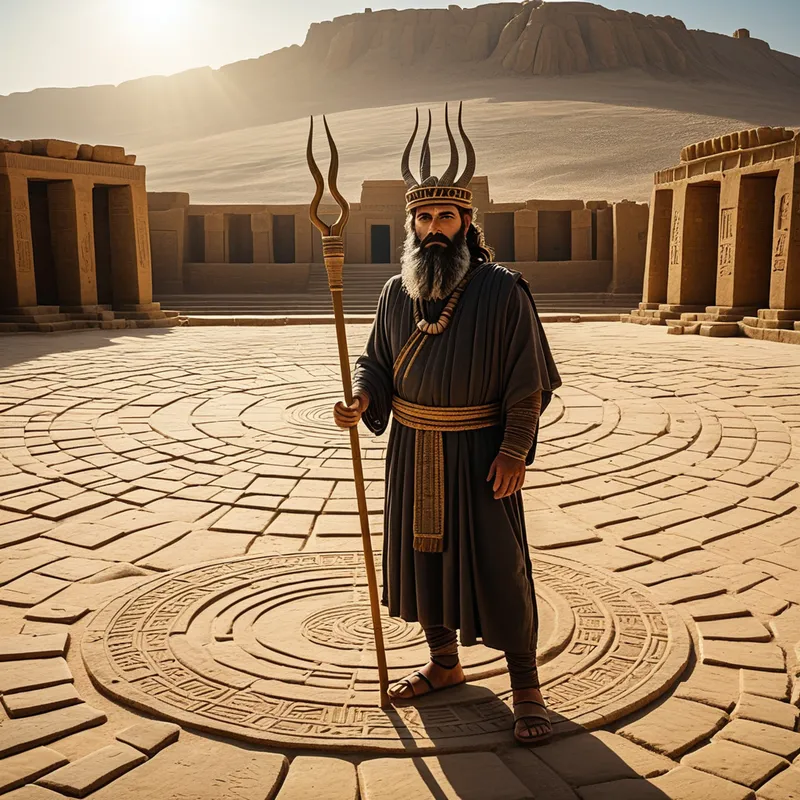
The Agora of Uruk Myth Meaning & Symbolism
A myth of the first marketplace, where divine law and human commerce meet, forging civilization's soul from clay and cosmic decree.
The Tale of The Agora of Uruk
Listen. Before the wheel turned, before the first king took his throne, there was a place of baked earth and blinding sun. It was not a city, not yet. It was a murmur in the dust, a gathering of shadows at the river’s bend. This is the tale of how that murmur became a voice, and that voice became law.
In the time when the gods walked the Edin, the people of Uruk were a scattered flock. They had barley and dates, clay and reed, but their hands were empty of a greater thing: measure. A man with a pot could not speak to a man with a sheep. Their exchanges were glances, guesses, fleeting agreements lost on the wind. The world was fluid, and in its fluidity, was strife.
The sun god Utu looked down from his chariot of fire. He saw not order, but chaos of potential. He saw not a people, but a thousand solitary sparks. In the hall of the gods, he spoke to his sister, Inanna, whose heart was the heart of the city. “Your children have breath,” Utu said, his voice the crackle of dry reeds, “but they have no tongue with which to bind their world. They have hands, but no scale for their deeds.”
Inanna, whose star is the morning and evening, knew the truth of it. She descended from her temple on the high place, her presence a scent of cedar and myrrh. She walked to the empty space between the well and the granary, a place trampled by many feet but claimed by none. There, she drove her scepter into the earth. “Here,” her voice echoed, not loud, but deep, settling into the very clay. “Here, the river of human want shall meet the mountain of divine order.”
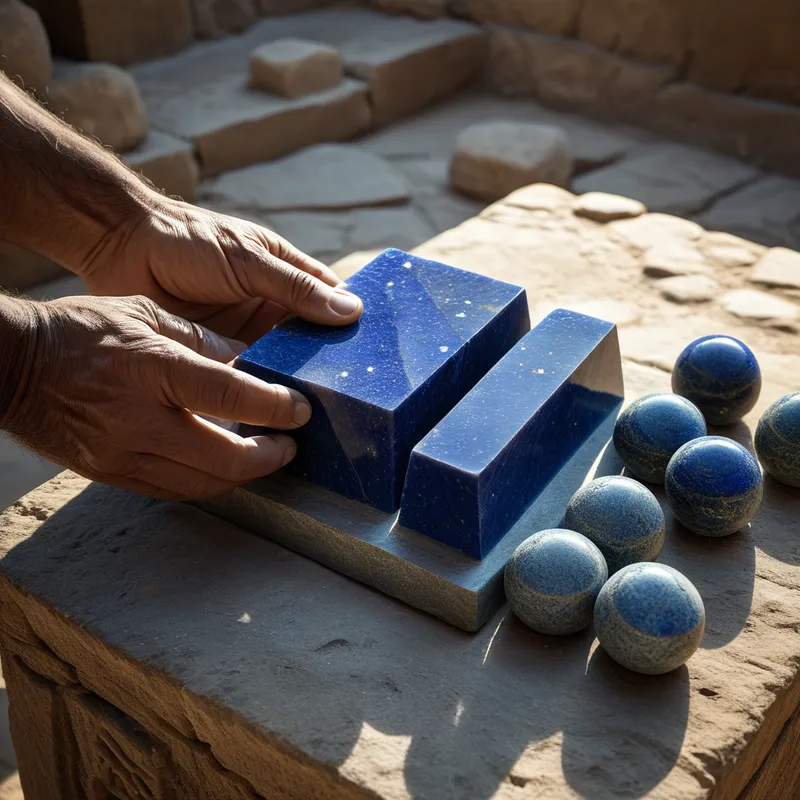
Then came Enki, the lord of the sweet waters and the deep Apsu. From his watery abode, he brought not a flood, but an idea. He knelt in the dust where Inanna had marked the spot. From his bag, he did not draw a weapon, but a coiled rope of star-measure and a rod of lapis lazuli, straight and true. With the rope, he measured the square: so many paces for the grain-sellers, so many for the metal-workers, so many for the judges to sit. With the rod, he drew a line in the earth, a furrow that drank the sunlight and held it as a boundary.
He spoke the first words of the Agora: “Let one thing be set against another, fairly, in the sight of Utu.” And as he spoke, the first weight was born—a stone smoothed by the river, knowing its own heft. The first measure was born—a clay vessel knowing its own capacity. The space was no longer empty. It was pregnant with potential exchange.
The people came, hesitant at first. A woman placed a woven basket on the line Enki had drawn. A man set a copper fish-hook beside it. They did not speak. They looked at the basket, at the hook, at the space between them. And in that space, a third thing appeared, invisible but solid as brick: value. A trade was struck. No fight ensued. The sun, Utu, bore witness.
Word spread like floodwaters in spring. The potter came with his wares, the shepherd with his wool, the scribe with his sharpened reed and tablet of damp clay. The Agora filled with the sounds of life: the haggling cries, the clink of weights, the scratch of stylus recording a promise. The dust, once stirred by random feet, now settled in patterns of purpose. The city of Uruk had found its beating heart, not in a king’s decree, but in a sacred, bustling emptiness where things—and by extension, people—could be equated, could be known.
Cultural Origins & Context
This foundational narrative is not a single epic poem like the Epic of Gilgamesh, but a mythic substrate woven into the very fabric of Mesopotamian urban consciousness. It emerges from the Sumerian world of the 3rd millennium BCE, a world inventing itself. The story of the Agora’s divine institution was likely passed down through temple liturgies and the oral traditions of merchant and scribal guilds.
Its societal function was profound: to sacralize commerce and law. In a culture where every aspect of life was imbued with divine presence, the marketplace could not be a profane space of mere greed. It had to be a mirror of cosmic order. By attributing its creation to Enki (god of wisdom and the underpinning order of things) and Inanna (the passionate force of civic life), the myth declared that economic exchange was not separate from the divine plan, but central to it. The Agora was where abstract divine justice (me) took tangible, daily form in balanced scales and fair contracts. It was the engine of civilization, and its rules were holy.
Symbolic Architecture
The Agora is far more than a marketplace. It is the archetypal Temenos—a sacred precinct where chaos is transformed into order. Its symbolic architecture is built from three divine gifts.
First, Inanna’s Scepter marks the center, the axis mundi of the civic world. It represents the eruption of collective need and the will to form community. It is the initial impulse that says, “We must come together.”
Second, Enki’s Rope and Rod are the instruments of differentiation and relation. The rope measures, creating bounded space from undifferentiated earth. The rod draws the line, establishing the principle of equivalence and boundary.
The first marketplace is not built of brick, but of the idea that one thing can stand for another. This is the birth of symbol itself.
Third, Utu’s Gaze is the transcendent witness. He is the unblinking sun of objective judgment, ensuring that the shadow of deception does not fall upon the transaction. His presence installs conscience into commerce.
Psychologically, the Agora represents the nascent ego-consciousness of a community—and by extension, of an individual. It is the internal space where we learn to “measure” our inner impulses, desires, and talents, to “exchange” primitive drives for socialized outcomes, and to do so under the gaze of an internalized moral principle (the Self).
The Dreamer’s Resonance
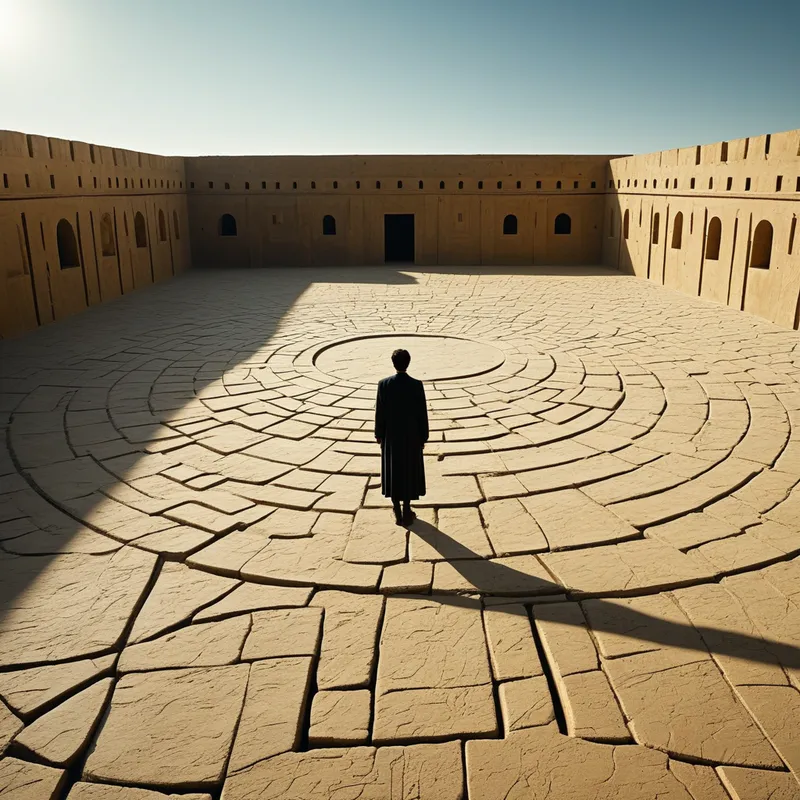
When this myth stirs in the modern unconscious, it often surfaces in dreams of profound negotiation and assessment. To dream of a vast, empty plaza you are compelled to fill speaks to a psyche preparing to “go public” with some part of itself—a talent, an idea, a need. The empty Agora is potential awaiting form.
Dreams of frantic, chaotic marketplaces where you cannot find a fair price or are cheated reflect a psychological state where your internal value system is in crisis. You feel your “inner measures”—your self-worth, your ethics—are being ignored or trampled.
Conversely, a dream of calmly and successfully trading an object in a sunlit, orderly square indicates a somatic and psychic process of integration. You are successfully “exchanging” an old part of your personality (the offered item) for something new and needed (the received item), guided by an emerging sense of inner law and fairness. The body may feel a sense of rightness, balance, and grounded relief.
Alchemical Translation
The individuation process modeled by the Agora myth is not the heroic conquest of a monster, but the civilizing, ordering, and making-conscious of our inner chaos. It is the opus of building a functioning psyche-economy.
The initial, undifferentiated state is the “scattered flock” of our complexes and instincts. The first alchemical step (Nigredo) is Inanna’s descent: acknowledging the chaotic, passionate need for internal order, which often feels like a crisis or a pressing lack.
The second step (Albedo) is Enki’s work: applying the cool, discerning waters of consciousness. This is the hard work of self-reflection—measuring our impulses with the rope of introspection, drawing clear boundaries (the rod) between what serves the whole self and what does not. We establish inner “laws”: healthy habits, ethical standards, personal values.
Individuation is the daily commerce of the soul, where we trade the raw ore of instinct for the minted coin of conscious action, always under the audit of the Self.
The final stage (Rubedo) is the thriving, sun-drenched Agora itself: a state where the psyche is a dynamic, orderly system. Energy (libido) flows freely but within channels. Different aspects of the self (the merchant, the scribe, the judge) interact productively. The transcendent principle (Utu/Self) is not a tyrannical ruler, but the implicit, illuminating standard that makes fair exchange possible. The individual becomes, like Uruk, a civilized entity—not by suppressing their nature, but by organizing it into a sacred, living marketplace of the soul.
Associated Symbols
Explore related symbols from the CaleaDream lexicon: