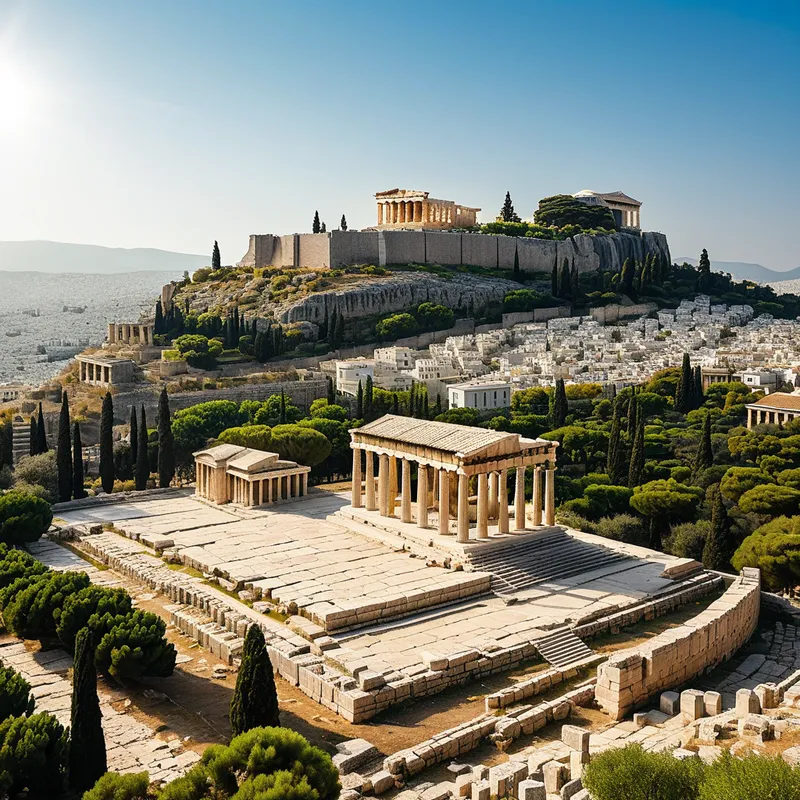
The Agora of ancient Athens (m Myth Meaning & Symbolism
The Agora was the beating heart of Athens, a sacred marketplace where philosophy, politics, and commerce converged to forge the soul of a civilization.
The Tale of The Agora of ancient Athens (m
Hear now, not of a single hero, but of a space that became a hero in its own right. It did not rise from the sea foam like Aphrodite, nor was it forged in the divine smithy of Hephaestus. It was born from the collective breath of a people, carved from the very limestone soul of Attica.
In the beginning, it was merely a clearing—a widening in the dusty path below the high, fortified rock. But the people of Athens, those restless children of Athena, felt a stirring. They needed more than a crossroads; they needed a crucible. So, they laid the first stones not for a temple to a god, but for a temple to the human spirit in congress. They called it the Agora: the Gathering Place.
Come, walk its sacred ground at dawn. Smell the air—a potent blend of baking bread from the magerios, the sharp tang of olive oil, the dry scent of papyrus scrolls, and the underlying, eternal smell of sun-warmed stone. Hear the cacophony that is the music of civilization: the clink of bronze obols changing hands at a merchant’s table; the rhythmic scrape of a sculptor’s chisel; the heated, laughing debate of young men under the deep shade of the Stoa; the clear, ringing voice of a herald reading the laws of the city from a stone stele.
Here, the conflict was not monster against man, but idea against idea. In one corner, a farmer from the hills, calloused hands gripping a pottery shard, inscribing the name of a man he believed a threat to the city—his vote an act of power he held nowhere else in the world. In another, a philosopher, cloak worn thin, traps a well-dressed general in a logical net, proving that courage without self-knowledge is mere recklessness. The rising action is the daily, glorious tumult of ten thousand interactions, a democracy not of quiet ballots but of shouted opinions, of public persuasion, of risk and reputation.
The resolution is never final, for the Agora is a story without end. It resolves each day at sunset, when the shadows of the Hephaisteion grow long and the crowds disperse. The resolution is the city itself, still standing, its decisions made, its goods exchanged, its truths—for a moment—agreed upon. It is the fragile, magnificent order conjured from chaos, again and again, by the simple, audacious act of coming together to speak, to trade, to choose.
Cultural Origins & Context
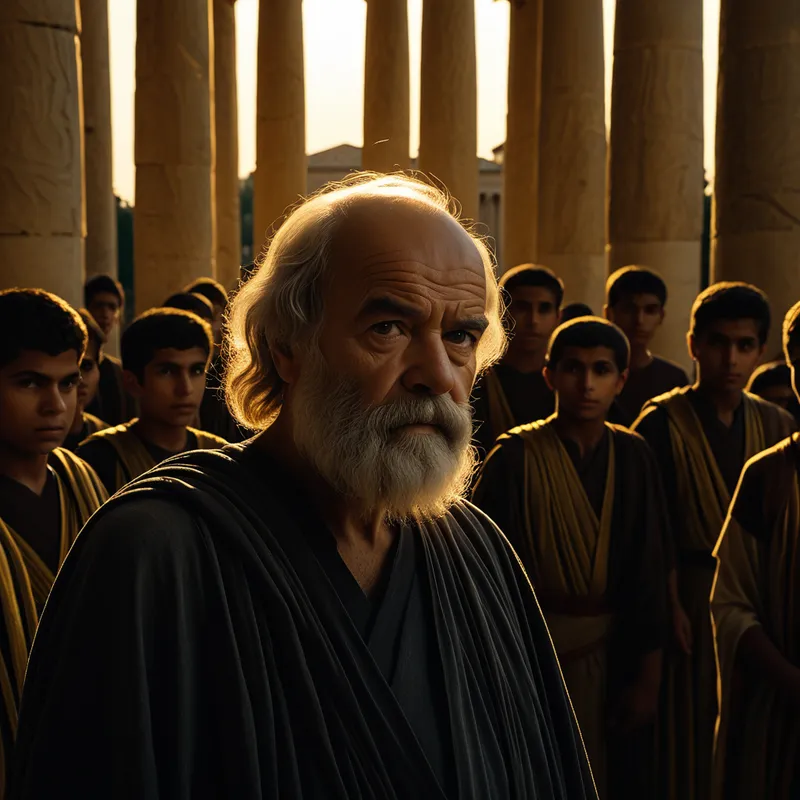
The Agora was not a myth preserved in epic verse, but a living, breathing reality central to the Athenian experiment in the 5th and 4th centuries BCE. Its story was passed down not by bards, but by historians like Herodotus and Thucydides, and immortalized in the philosophical dialogues of Plato and Xenophon. Its function was societal oxygen. It was the administrative, commercial, political, social, and intellectual heart of the city. Here, the Council of 500 met, courts were held, athletes trained, and religious processions began. It was the stage upon which the drama of Athenian democracy—with all its brilliance, pettiness, and peril—was performed daily. To be an Athenian citizen was to be a participant in the Agora; to be excluded from it was a form of social death.
Symbolic Architecture
Psychologically, the Agora represents the ego’s necessary forum—the structured, sunlit space where the disparate elements of the psyche are brought to be named, negotiated, and integrated.
The Agora is the psyche’s marketplace, where raw instinct (commerce) must learn the language of value, where shadowy opinion (politics) is forced into the light of public discourse, and where inner truth (philosophy) is honed against the whetstone of contradiction.
The Stoa symbolizes the sheltered mind, the place of reflection under the roof of culture and reason. The merchant’s table represents the instinctual, transactional layer of the psyche—our basic needs and desires. The herald’s stele is the voice of the internalized law, the super-ego or moral compass. The scattered ostraka (pottery shards used for voting) symbolize the individual’s potent, sometimes destructive, power of choice and rejection. The Agora, in its totality, is the archetype of enantiodromia in action—the chaotic multiplicity of human life finding a temporary, dynamic order through agreed-upon rules and open dialogue.
The Dreamer’s Resonance
To dream of an Agora is to dream of a critical phase of internal assembly. A bustling, vibrant Agora in a dream suggests the dreamer is in a process of actively sorting, debating, and integrating various aspects of their life, relationships, or professional pursuits. There is a healthy, if noisy, internal dialogue.
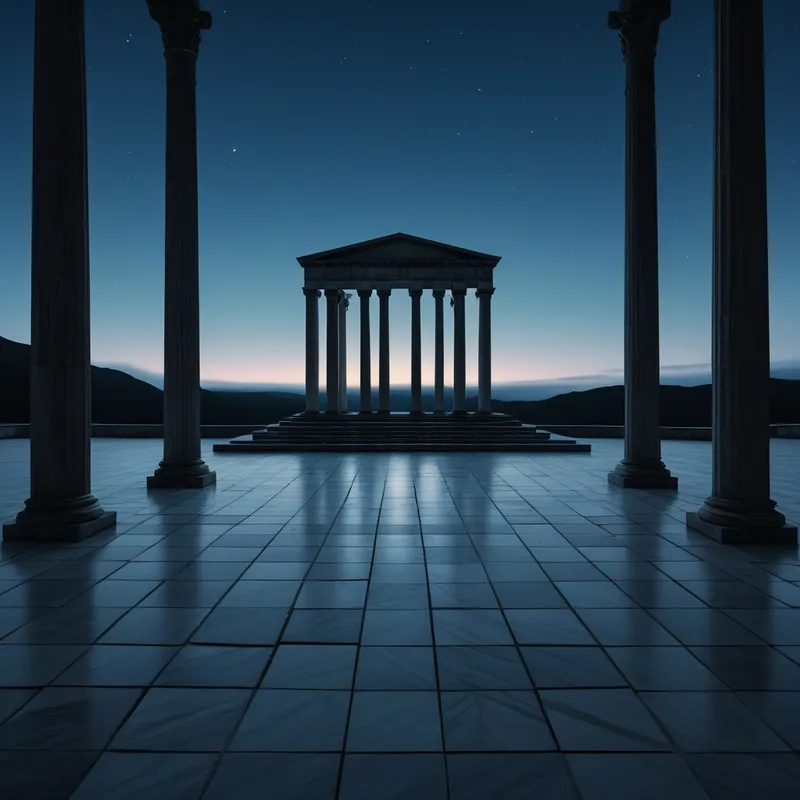
A ruined, empty, or silent Agora is a profound signal. It speaks of a paralyzed inner dialogue, a collapse of the psychic structure where decisions are made and values are exchanged. The dreamer may feel incapable of making a choice, articulating a need, or reconciling conflicting inner voices. The somatic feeling is often one of being lost in a vast, empty space within oneself, where echoes of unmade decisions bounce off crumbling columns. Conversely, dreaming of being barred from the Agora reflects a deep sense of disenfranchisement from one’s own life, a feeling of having no voice or agency in one’s own psyche.
Alchemical Translation
The alchemical process mirrored in the Agora is not the nigredo of despair, but the subsequent albedo and citrinitas—the ordering and integration of the dissolved elements. The raw material (prima materia) is the chaotic swarm of our instincts, opinions, biases, and talents.
Individuation requires building an inner Agora—a conscious, respectful space where the inner merchant, the inner politician, the inner philosopher, and the inner fool are all given a place to speak and are held accountable to the common good of the Self.
First, one must gather these fragments (the act of going to the marketplace). Then, one must allow them to debate (the conflict of the Stoa), letting logic challenge emotion, and let caution question ambition. Next, one must transact—make conscious choices, “buying” and “selling” commitments, investing time and energy wisely (the commerce). Finally, one must decide and legislate—establish inner laws based on these negotiations (the voting, the herald’s decree). The triumph is not the annihilation of one inner voice by another, but the establishment of a resilient, adaptable polis of the Self. The modern individual’s struggle is to architect this inner civic space amidst the noise of the world, to become both citizen and architect of their own soul’s democracy, where dialogue precedes dominion, and the shared space of the Self is held sacred.
Associated Symbols
Explore related symbols from the CaleaDream lexicon: