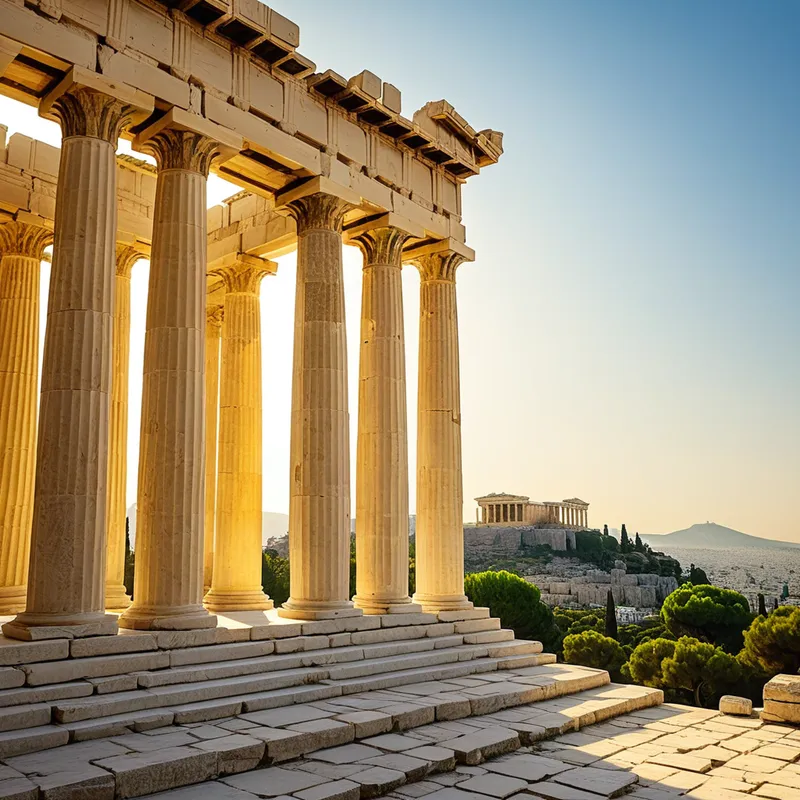
The Agora of ancient Athens Myth Meaning & Symbolism
The mythic heart of Athens, where divine order and human discourse collided to birth the polis, the self, and the sacred space of becoming.
The Tale of The Agora of ancient Athens
Before the stones were laid, there was only the wild hill and the chattering plain below the high rock. It was a place of dust and thyme, of goat paths and the whisper of dry leaves—a place belonging to no one and to the earth itself. Then came the shaping will. It did not arrive with a thunderclap, but with a measured step.
First came Athena, her gaze as grey and clear as a winter sky. Where she stood, the chaotic earth yearned for pattern. With a thought, she drew a line in the dust—straight, true, aiming for the heart of the sun’s path. This line was Logos: reason, proportion, the principle that separates the meaningful from the void. From this line grew the idea of the boundary, the sacred limit, the temenos.
But a space defined is a space empty. Into this nascent order flowed the multitude. Not an army, but a cacophony of voices—the farmer with soil under his nails arguing boundary with the potter, the ship-owner from Piraeus smelling of salt and tar debating duty with the landowner, the widow pleading for justice, the poet reciting verses that made the heart ache. This was the realm of Hermes, the quick-tongued, the connector, the one who dwells in the in-between. He did not bring structure, but motion; not law, but the negotiation of law. His gift was the word exchanged, the deal struck, the rumor born, the message delivered. He filled Athena’s geometric silence with the vibrant, messy music of human discourse.
The Agora was born in the tension between these two divine currents. It was not a temple of pure silence, nor a market of pure noise. It was the crucible where they met. You could feel it underfoot. The paving stones, worn smooth by countless sandals, were laid with Athena’s precision, yet their surface was polished by Hermes’ restless traffic. In the Bouleuterion, men sought Athena’s clarity to draft laws. Outside its doors, in the colonnades of the Stoa Poikile, they invoked Hermes’ fluidity to debate, dissect, and often dismantle those very laws.
The conflict was the process. The rising action was the daily tide of humanity—the scent of baking bread from the agoranomoi’s stalls mixing with the ink-and-papyrus smell from the scroll sellers, the drone of a sophist’s lecture competing with the clatter of dice from a gaming table. The resolution was never final. It was the fragile, miraculous moment when from the clash of a hundred private interests, a public good—a decision, a verdict, a shared understanding—would momentarily coalesce, like a perfect bubble forming on turbulent water, before popping to let the process begin anew. The Agora did not offer answers. It was the living question, etched in stone and alive in air: How shall we live together?
Cultural Origins & Context
The myth of the Agora is not preserved in a single epic poem but is written into the very bones of Western political and psychological imagination. Its storytellers were not bards in royal halls, but the citizens of Athens themselves, from the 6th to the 4th centuries BCE. They performed the myth daily by their participation. The historical Agora was the physical and civic heart of the polis, but its function elevated it to a cosmological principle.
It was passed down through the lived experience of democracy—direct, contentious, and profoundly public. Philosophers like Plato (who distrusted its fickleness) and Aristotle (who analyzed its mechanics) were its analysts. Playwrights like Sophocles and Aristophanes staged its tensions between individual and community. Its societal function was nothing less than the enactment of citizenship. To step into the Agora was to step out of the private realm of the household (oikos) and into the light of the public sphere, to become a visible part of the body politic. It was the engine of eleutheria (freedom) and the school of arete (excellence), demanding that individuals translate their private concerns into public speech.
Symbolic Architecture
Psychologically, the Agora represents the constructed center of the conscious self. It is the ego’s forum, the psychic space where inner contents are brought to be examined, debated, and integrated.
The Agora is not the Self, but the conscious clearing where the Self becomes legible. It is where chaos takes the form of an argument, and order learns the language of persuasion.
Athena symbolizes the differentiating principle of consciousness—the function that draws boundaries, establishes categories, and insists on clarity and truth. She is the inner architect, the voice that says, “This, not that.” Hermes symbolizes the connective, communicative principle—the psychic energy that moves between complexes, carries messages from the unconscious to consciousness, and thrives on ambiguity, exchange, and transformation. He is the inner diplomat, the trickster who ensures no law becomes too rigid.
The Agora’s architecture is thus a map of the psyche. The defined boundary (the temenos) is the skin of the ego, the necessary separation that allows for identity. The open space within is the field of awareness. The various buildings—the law court, the temple, the market—represent different psychic functions: judgment, reverence, the exchange of value (libido). The myth teaches that a healthy psyche is not a monolithic kingdom ruled by a single despotic ego, but a vibrant, contentious, self-governing polis.
The Dreamer’s Resonance
To dream of an Agora is to dream of a critical phase of internal negotiation and integration. The somatic feeling is often one of being in a crowded, significant, but slightly overwhelming open space. You may be searching for someone, trying to speak and losing your voice, or witnessing a pivotal debate.
If the dream Agora is in ruins, it suggests a collapse of inner dialogue. The ego’s forum has been abandoned; conscious values are fragmented, and the psyche is ruled by private, unexamined complexes (a reversion to the oikos). If it is vibrant but chaotic to the point of panic, it indicates an overload—too many Hermetic messages flooding the Athenian structure, a crisis of too much input and too little discernment. Dreaming of speaking eloquently in the Agora marks a moment of powerful self-articulation, where a previously unconscious content successfully presents itself to the conscious mind and is heard.
Alchemical Translation
The alchemical process modeled by the Agora is the coniunctio oppositorum—the sacred marriage—of the differentiating and the connecting principles. Individuation is not the victory of Athena over Hermes, or of order over chaos. It is the creation of a sustainable, dynamic space where their eternal dialogue can occur.
The goal is not to silence the debate, but to become the Agora itself—the vessel capable of holding the tension.
The modern individual’s “agora-work” involves first establishing the temenos: creating the disciplined, mindful space of self-reflection (therapy, journaling, meditation). This is the Athena-work of building a reliable ego-structure. Then comes the Hermes-work: admitting the multitude—allowing the voices of the shadow, the anima/animus, the inner child, and the complexes to enter that space, not as rulers, but as citizens with the right to speak.
The conflict and resolution are continuous. A rigid, over-Athenian personality must learn Hermes’ fluidity and empathy. A chaotic, over-Hermetic personality must learn Athena’s focus and integrity. The triumph is the moment of synthesis: when a deep, intuitive insight (Hermetic message) is given clear, actionable form (Athenian structure), or when a stubborn, rational position (Athenian law) is softened and humanized by compassion (Hermetic persuasion). In this ongoing alchemy, the individual does not find a static self, but becomes the living process of democracy—the polis of the soul, perpetually voting, debating, and forging its identity in the sacred marketplace of being.
Associated Symbols
Explore related symbols from the CaleaDream lexicon: