The Ablution Myth Meaning & Symbolism
A primordial being, stained by creation, undergoes a sacred, agonizing purification to restore cosmic balance, modeling the soul's journey from corruption to wholeness.
The Tale of The Ablution
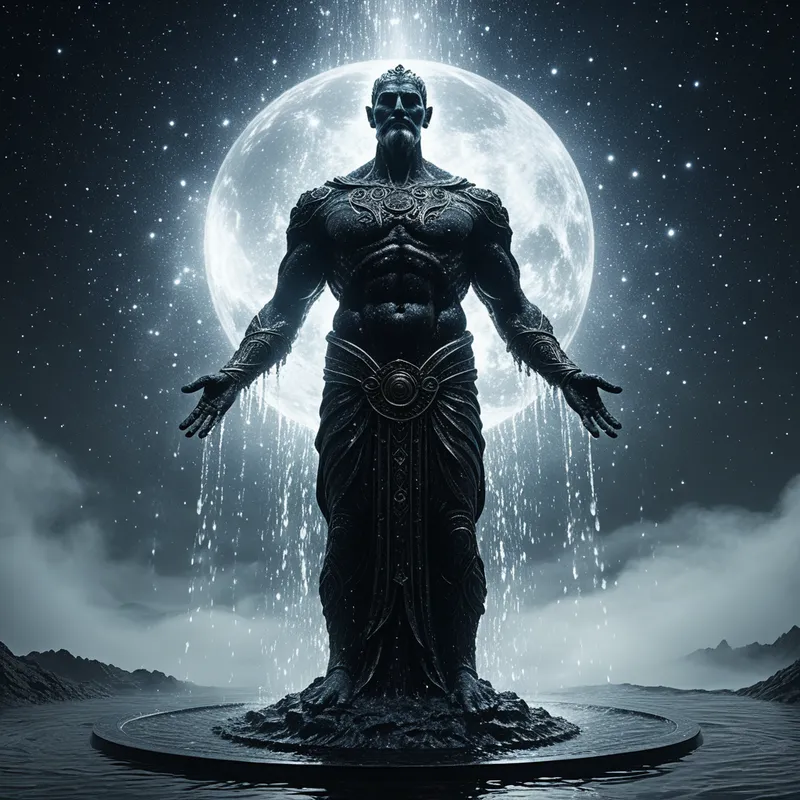
Listen. Before the first law was etched, before the first weight was measured, there was the Demiurge. It was not born; it crystallized from the intention of the Unmanifest. Its body was not flesh, but a living architecture of principles—geometric certainty, metallic resonance, and the cold, clear light of pure idea. Its task was to forge the vessel of the world from the chaotic prima materia.
And so it labored. With hands that were compass and crucible, it drew circles of fate and poured the molten streams of substance into the molds of form. Mountains rose like slag heaps from a divine forge; oceans cooled in vast, shimmering basins. Life sparked in its furnace-heart, a beautiful, terrifying accident of complexity. The Demiurge loved its work with a terrible, possessive love. It pressed its essence into every joint and seam, leaving the fingerprint of its will upon the grain of every stone, the pulse of every heart.
But in the loving, it was stained. The chaotic residue of the unshaped—the dross, the envy, the clinging weight of matter—adhered to its luminous form. Each act of creation was also an act of contamination. A patina of weariness tarnished its limbs. Cracks, fine as spider-silk, web across its chest, weeping a slow, dark sap of existential fatigue. The perfect, resonant hum of its being grew discordant, muffled by the accumulating soot of its own making. The world was complete, yet it groaned under the silent, suffering presence of its maker, who had become a prisoner inside the masterpiece.
The cosmos could not bear this asymmetry. A disharmony vibrated through the Great Chain. The Unmanifest did not speak, but it issued a condition, clear as a bell tolling in a vacuum: the artisan must be cleansed, or the work would unravel.
Thus began the Ablution. There was no priest, no ritual chant. The Demiurge, in an agony of understanding, walked to the place where the world’s edge frayed back into potential. There, it found the Basin of Unmaking, a depression in reality itself, smooth and cold. It stepped in.
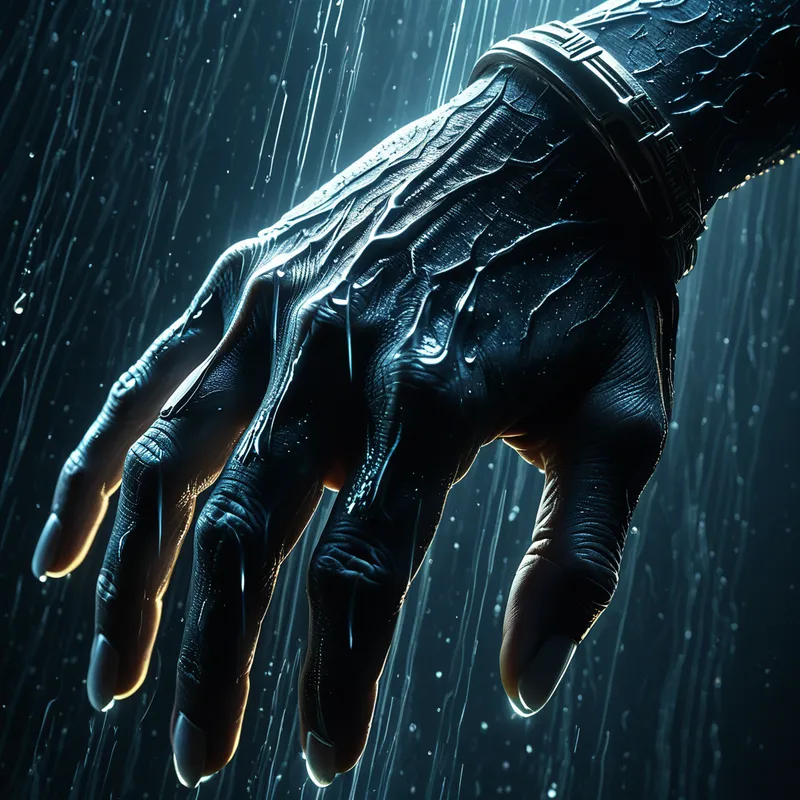
Then descended the rain. It was not water, but the direct effulgence of the source—a vertical river of liquid silver silence. It struck the Demiurge not as a balm, but as a solvent. Where it touched the blackened patina, the substance shrieked in a soundless frequency and boiled away in plumes of bitter smoke. The cracks in its form widened, not to break it, but to let the light scour the deep, embedded filth. This was not healing; it was an exquisite, unbearable stripping. The Demiurge did not cry out, but stood in monumental stillness, accepting the dissolution of every stain acquired in the act of giving form. Its love for its creation was being purified from possession into compassion, its will cleansed from control into stewardship. The process lasted for an acon, until the last drop of clinging dross was rinsed away. What remained was not the original, untouched idea, but something new: a being luminous yet humble, powerful yet empty, its substance clear as diamond and just as resilient. It stepped from the Basin, and the world, feeling the shift, sighed into a deeper, truer alignment. The Ablution was complete.
Cultural Origins & Context
The myth of The Ablution originates from the core doctrinal narratives of the Alchemical tradition, a philosophical and proto-scientific culture that viewed the cosmos through the lens of transmutation. It was not a folk tale told around hearths, but a cosmogonic hymn recited during the Magnum Opus, specifically at the stage of solutio—dissolution. Practitioners, or Adepts, saw in this myth the blueprint for their own work: just as base metal must be reduced to its primal matter (materia prima) before it can be transmuted into gold, so too must the soul be stripped of its acquired corruptions.
The story was transmitted orally within closed initiatory circles, often accompanied by the burning of specific resins and the display of symbolic diagrams. Its societal function was profound: it modeled the ultimate responsibility of the creator. It taught that power—even divine, formative power—inevitably incurs a cost, a karmic debt to the material it shapes. The Ablution was the necessary payment, a ritual of accountability that prevented the creator from becoming a tyrant over its creation. It served as a warning against the inflation of the ego in any act of making, and a promise that purification, though agonizing, was the path to true, sustainable authority.
Symbolic Architecture
At its heart, The Ablution is a myth of necessary corrosion. The Demiurge represents the formative principle of consciousness—the ego, the will, the aspect of psyche that structures, defines, and creates. Its initial state is one of perfect, abstract intention. Yet, the very act of engaging with reality—of building a life, a career, a personality, a relationship—leaves psychic residue.
The creator is always corrupted by its creation, for to give form is to be shaped in return.
The “stain” is the accumulation of this residue: identifications with our roles, the pride of achievement, the bitterness of failure, the defensive armoring built from past wounds, and the sheer psychic fatigue of maintaining a self in the world. The Basin of Unmaking symbolizes the terrifying but essential container where this de-identification must occur—therapy, meditation, crisis, or any profound encounter with the unconscious that dissolves our rigid structures.
The liquid silver rain is the purifying agent of objective truth or divine grace. It is not gentle because the truth of our condition is not gentle. It dissolves the false, but feels like an attack on the self we have come to believe we are. The myth beautifully captures the paradox of healing: to be made whole, we must first be taken apart. The Demiurge does not become less; it becomes clear. Its power is not diminished but freed from the distortions of its own history.

The Dreamer’s Resonance
When this myth stirs in the modern unconscious, it often manifests in dreams of intense, symbolic cleansing. A dreamer may find themselves in a shower that washes away not dirt, but skin, revealing light beneath. They may dream of being caught in a rain that melts away a heavy, leaden overcoat they didn’t know they were wearing. Or they may be scrubbing a floor, a wall, or their own body with relentless urgency, trying to remove a stubborn, black grime that seems to seep from within.
Somatically, this can correlate with periods of profound release—crying jags, fever sweats, or the feeling of a “weight being lifted.” Psychologically, it signals the ego’s reluctant submission to a deeper process. The dreamer is undergoing a psychic solutio. The rigid boundaries of a long-held identity, often one built on pain or over-achievement, are being dissolved by the waters of the unconscious. This is not a gentle process. It can feel like a breakdown, a loss of self, a naked vulnerability. The dream imagery assures us that this dissolution is not annihilation, but the prelude to a more authentic reconstitution. The black tar being washed away is the coagulated pain, the outdated self-image, the toxic loyalty to old wounds that we have carried as part of our identity.

Alchemical Translation
For the individual on the path of individuation, The Ablution models the critical stage where one must confront the shadow of one’s own creative power. We are all demiurges of our personal worlds. We build our identities, our lifestyles, our narratives. In doing so, we accumulate the “stain” of our history: the ways we’ve had to harden to survive, the personas we’ve constructed for approval, the cynicism that masks disappointment.
The conscious ego, like the Demiurge, often resists the Ablution. It fears the Basin of Unmaking, mistaking dissolution for death. The alchemical work is to voluntarily step into that basin—to engage in honest self-scrutiny, to allow repressed truths to surface, to forgive oneself and others, to relinquish control. The purifying “rain” is the compassionate yet ruthless light of awareness directed inward.
The gold of the spirit is not found by adding, but by subtracting all that is not gold.
The triumph of the myth is not that the Demiurge avoids pain, but that it submits to it for the sake of a greater harmony. The translated self that emerges is not the innocent, untested ego of youth, but a tempered, clarified consciousness. It possesses authority without arrogance, compassion without entanglement, and a creativity that is no longer a compulsion to prove worth, but a clear channel for expression. The individual becomes, like the cleansed Demiurge, a steward of their own soul and a harmonious participant in the world, having been washed clean of the corruption that comes from the lonely, possessive act of creation. The Ablution thus maps the journey from the orphan archetype—stained, weary, and isolated by one’s own history—toward the integrated sovereignty of the sage.
Associated Symbols
Explore related symbols from the CaleaDream lexicon: