The 14th Day Festival Myth Meaning & Symbolism
A celestial maiden descends to a mortal festival, sparking a divine conflict that forever alters the boundary between heaven and the human heart.
The Tale of The 14th Day Festival
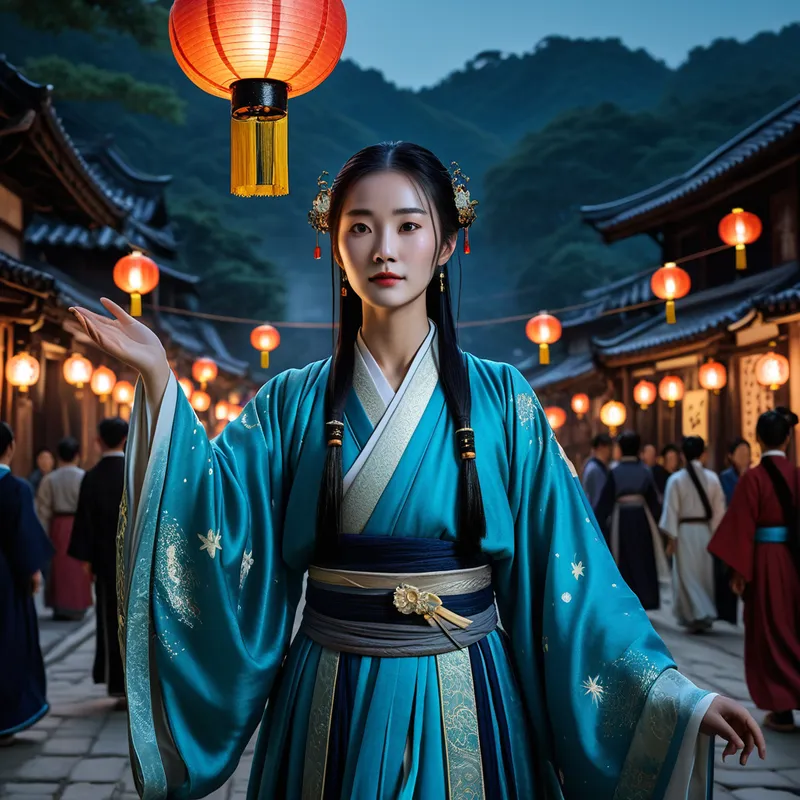
Listen, and hear the tale of when the sky wept and the earth held its breath. It was the time of the Ghost Month, when the veil between worlds grows thin as morning mist. In a humble village nestled in a river valley, the people prepared for the Zhongyuan Festival on the 15th day. But on the eve, the 14th day, they held their own secret observance—a festival of lanterns and laughter, a defiant spark of joy in the shadowed month.
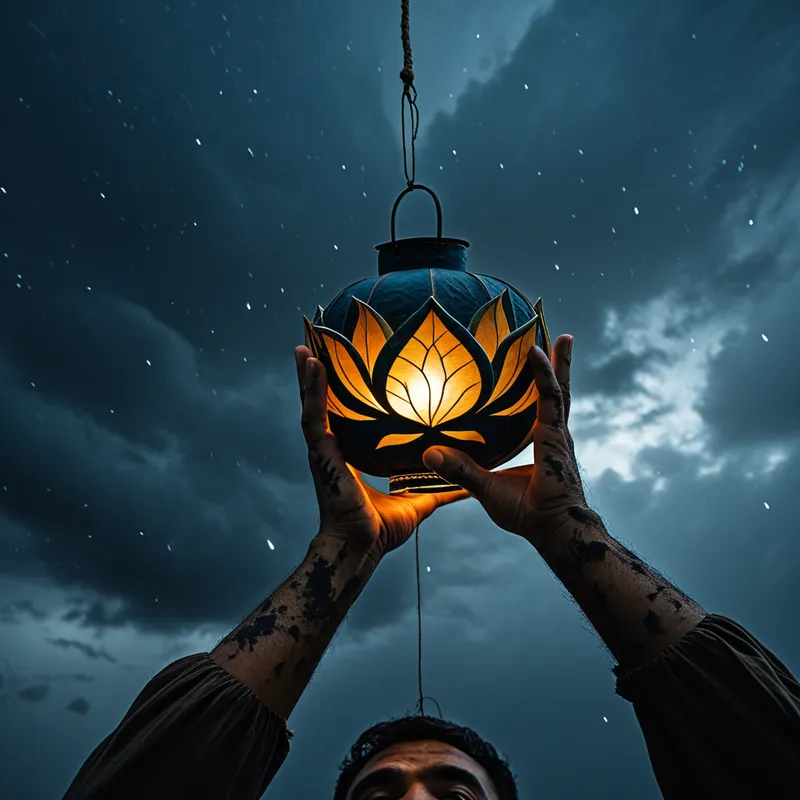
That night, the air was thick with the scent of joss paper smoke and sweet rice cakes. A thousand lotus-shaped lanterns, each carrying a whispered prayer, glowed upon the dark water. The sound of drums and flutes wove through the crowd. It was into this earthly symphony that Zhi Nü, the Weaving Maid, descended.
She had heard the music from her lonely loom in the heavens, a sound so vibrant it pierced the silence of the stars. Drawn by the raw, aching beauty of mortal joy—so fleeting, so fierce—she shed her starry mantle and walked among them. Her feet, which had only trod on clouds, felt the solid, welcoming earth. Her eyes, accustomed to eternal patterns, beheld faces alive with tears and smiles. And there, by the lantern-lit river, she met a young man, a humble potter named Zhong. His hands were shaped from clay and toil, but his eyes held the patience of the river itself.
They did not speak. They danced. Under the paper lanterns, amidst the villagers who saw only another reveler in a beautiful mask, they moved as if their meeting had been written in the constellations from which she fell. For one night, heaven and earth were not separate realms, but a single, breathing entity.
But the Jade Emperor does not suffer such trespass lightly. The ordered heavens cannot abide chaos, and the love of a celestial for a mortal is the purest chaos. As dawn threatened the 15th day, the sky cracked. Thunder, not as a storm but as a celestial decree, rolled across the valley. The music died. The lanterns guttered.
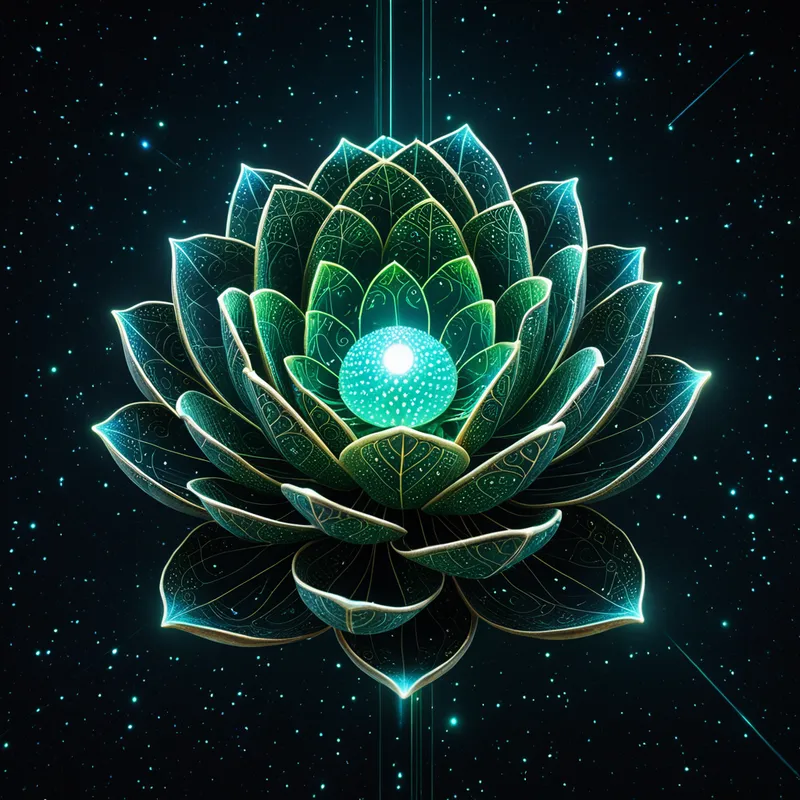
A bridge of angry, roiling clouds formed in the sky, and upon it stood the stern ministers of heaven. The Weaving Maid was called home. Her choice was no choice: return, or see the village, the river, and Zhong swallowed by divine wrath. With a look that held all the sorrow of the separated Milky Way, she ascended. As she crossed the threshold back into the sky, she let fall a single tear. It fell not as water, but as a seed. It struck the earth at Zhong’s feet and, in the blink of an eye, grew into a lotus of pure, crystalline light—a permanent lantern, a testament to the union that was, and a barrier that now forever was.
Cultural Origins & Context
This tale exists in the oral traditions of certain southern Chinese communities, particularly those along the Zhu Jiang. It is not a canonical, scripture-bound myth, but a folk narrative that blossoms in the fertile ground between the official Zhongyuan rites and local village practice. It was traditionally told by village elders and Daoshi during the lantern preparations on the 14th night, serving as both a warning and an affirmation.
Its societal function was profound. In a culture with deep ancestral worship and a complex cosmology of heavens and courts, the myth explained the unique, melancholic atmosphere of their local eve. It answered why their joy felt so poignant, why their lanterns on that specific night seemed to burn with a particularly fragile light. It localized the universal theme of the Niulang and Zhinü separation, bringing it from the starry river in the sky down to the muddy river of their home. It taught that profound connection always carries the risk of profound separation, and that true reverence often lives in the bittersweet space between the two.
Symbolic Architecture
The myth is a perfect symbolic vessel for the tension between the celestial principle of Tian and the earthly principle of Ren. The Weaving Maid is order, pattern, and eternal fate. Zhong, the potter, is formlessness, potential, and the clay of immediate experience. Their meeting is the impossible, yet necessary, conjunction of these opposites.
The festival itself is the temenos—the sacred, temporary container where the impossible union can be glimpsed. It is the psychological space where the rigid structures of the conscious mind (heaven) allow the fluid, emotional, and instinctual world (earth) to express itself.
The Jade Emperor’s intervention is not mere cruelty, but the enforcement of a cosmic law: differentiated states must be maintained for the cosmos to function. The separation is as necessary as the attraction. The crystalline lotus left behind is the ultimate symbol of the coniunctio. It is not the permanent union of the lovers, but the permanent product of their union—a third thing, a symbol of the Self that transcends both. It is a light born of sorrow, a beauty forged from loss, marking the spot where heaven touched earth and was forever changed.
The Dreamer’s Resonance
When this myth stirs in the modern unconscious, it often manifests in dreams of profound, fleeting connections. One might dream of meeting a soulmate in a crowded, festive place, only to have them vanish as the dreamer wakes. Or of discovering a secret, beautiful room in one’s house that can never be found again in daylight. The somatic feeling is one of exquisite heartache—a full chest, a caught breath, a warmth that is already cooling.
Psychologically, this signals a brush with an archetypal content—perhaps the Anima or Animus—that the conscious ego is not yet ready to integrate fully. The dreamer is experiencing the “14th Day” of their own psyche: a moment of perfect, pre-conscious alignment between a deep inner pattern (the celestial) and an emerging potential in their life (the earthly). The inevitable “dawn” of waking consciousness or practical reality forces a separation, leaving behind not the beloved, but the feeling of the beloved—the crystalline lotus of a transformed perspective. The dream process is one of tasting wholeness, then learning to hold the memory of that taste as a guide, not as a possession.
Alchemical Translation
The individuation journey modeled here is not one of heroic conquest, but of sacred encounter and transformative loss. The first stage is the descent: the conscious mind (the Weaving Maid) must willingly leave its patterned, “heavenly” certainty and attend the festival of the unconscious—the messy, vibrant, emotional, and instinctual life it often ignores or fears.
The meeting with the potter is the coniunctio. This is the ego’s engagement with its opposite, a moment of profound psychic fertilization. But the alchemical work is not to make this state permanent. That is the inflation of identifying with the archetype itself.
The crucial, transformative stage is the enforced separation and the creation of the lapis—the philosopher’s stone. The Jade Emperor, here, is the ruthless but necessary principle of consciousness that re-establishes boundaries. It says, “You have tasted the union, but you cannot be the union. You must return to your differentiated state, but you may take this with you.”
The crystalline lotus is the transcendent function. It is the new symbol, the new attitude, the new creative capacity born from the experience of love and loss. For the modern individual, this translates to the process of having a transformative experience—a love, an insight, a spiritual awakening—and then, instead of clinging to the state of ecstasy, learning to integrate its essence into daily life. The potter does not spend his life staring at the sky, mourning. He tends the luminous lotus. He becomes the guardian of the symbol itself. His work, his very being, is now illuminated by a light that is not his own, yet grows from his earth. He has not kept the goddess, but he has been sanctified by her touch. His individuation is the lifelong practice of making vessels of clay that can, however imperfectly, reflect that celestial light.
Associated Symbols
Explore related symbols from the CaleaDream lexicon: