Temurah Myth Meaning & Symbolism
A myth of sacred letters, divine permutations, and the cosmic law that true transformation requires the shattering of old forms to reveal new meaning.
The Tale of Temurah
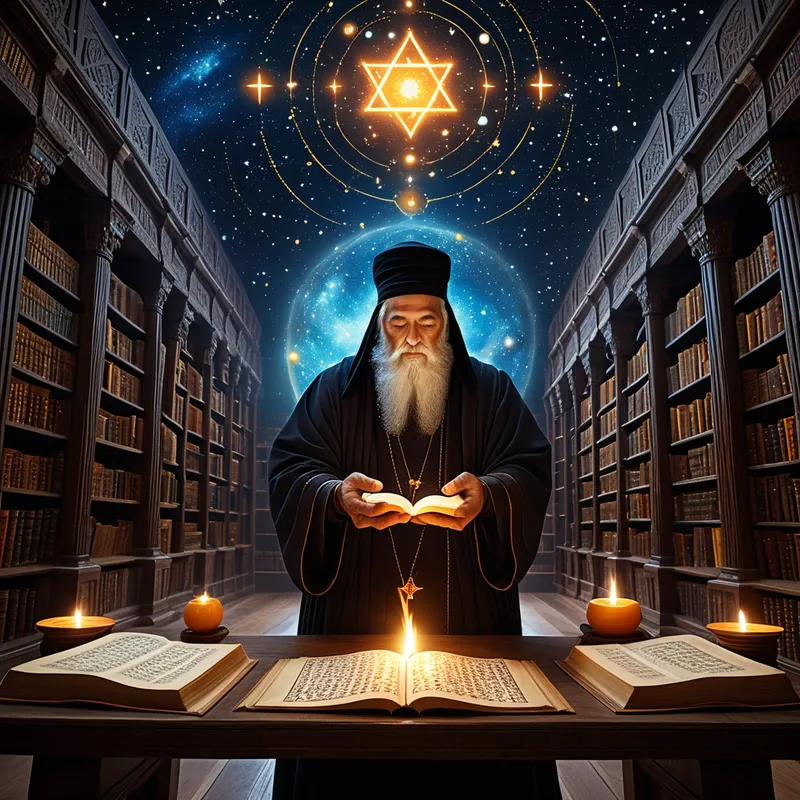
Before [the world](/myths/the-world “Myth from Tarot culture.”/) was a world of things, it was a world of words. Before the words were spoken, they were letters. And before the letters were fixed, they were possibilities. In the silence that is not empty but full, the Zohar whispers of a time when the sacred letters, the twenty-two bones of creation, danced in a primordial chaos of potential. They were not yet bound to form [the Torah](/myths/the-torah “Myth from Jewish culture.”/), the blueprint of all that is. They swirled in the Ein Sof, a luminous storm of Aleph, Bet, and Tav.
But a law was needed, a rhythm to the dance, a grammar for the cosmos. This was the birth-cry of Temurah. It was not a deity with a face, but a principle with a voice—a deep, resonant hum that vibrated through the substance of the letters themselves. The principle declared: “To remain is to stagnate. To be revealed is to be rearranged.”
And so, [the great work](/myths/the-great-work “Myth from Alchemical culture.”/) began. The letter Mem, the waters of form, yearned to touch the fire of Shin. But between them stood [the law](/myths/the-law “Myth from Biblical culture.”/) of sequence, the fixed order of the Aleph-Bet. Temurah’s voice grew louder, a divine imperative. In a flash of cosmic insight, the letters learned to exchange places. Not randomly, but according to a sacred cipher—the Atbash transformation, where Aleph traded its essence with Tav, Bet with Shin. The first became last, the inner became outer.
The chaos did not settle into a simpler order; it deepened into a more complex harmony. Where once there was [the word](/myths/the-word “Myth from Biblical culture.”/) for “king” (מלך), a permutation through Temurah revealed [the word](/myths/the-word “Myth from Biblical culture.”/) for “counsel” (עצה). [The word](/myths/the-word “Myth from Biblical culture.”/) for “curse” (קללה) contained, within its rearranged bones, the letters for “praise” (הלל). The universe shuddered with this new knowledge. Every truth now held its opposite, not as enemy, but as hidden counterpart. Every form concealed the seed of its own transformation. The myth tells us the letters did not just move; they sacrificed their fixed positions, undergoing a kind of death, to be reborn into new meaning. The resolution was not an end, but the establishment of an eternal process: the continuous, lawful permutation of the divine language, the very engine of creation and revelation.
Cultural Origins & Context
The concept of Temurah is not a myth with a narrative hero in the classical sense, but a foundational metaphysical principle within the esoteric tradition of Kabbalah. It emerges from the medieval period, most prominently in texts like the Zohar and the [Sefer Yetzirah](/myths/sefer-yetzirah “Myth from Jewish culture.”/). It was not a story told around fires, but a technique and a mystery pondered in the hushed circles of initiates, rabbis, and mystics by candlelight.
It was passed down through a tightly guarded oral and written tradition, often encoded within commentaries. Its societal function was profoundly dual: it was a contemplative tool for unlocking deeper layers of meaning in the Torah (seeing it not as a static document but as a living, breathing entity of infinite interpretations), and it was a practical, almost magical discipline. Practitioners believed that by understanding and applying the ciphers of Temurah, one could perceive the hidden structures of reality and, in the most elevated sense, participate in the ongoing process of tikkun olam—the mending of the world. It represented the ultimate scholarly and spiritual endeavor: to engage with the very letters through which God manifested existence.
Symbolic Architecture
At its [heart](/symbols/heart “Symbol: The heart symbolizes love, emotion, and the core of one’s existence, representing deep connections with others and self.”/), Temurah symbolizes [the principle](/symbols/the-principle “Symbol: A fundamental truth, law, or doctrine that serves as a foundation for a system of belief, behavior, or reasoning, often representing moral or ethical standards.”/) that all stable forms are temporary arrangements of a more fluid, essential substance. The “letters” are the archetypal components of [reality](/symbols/reality “Symbol: Reality signifies the state of existence and perception, often reflecting one’s understanding of truth and life experiences.”/)—be they psychological complexes, societal structures, or the fundamental particles of [the self](/myths/the-self “Myth from Jungian culture.”/).
To permute the letters is to accept that every identity is a provisional sentence in the story of the soul, awaiting its necessary revision.
Psychologically, the fixed Aleph-Bet represents the conscious ego—the ordered, logical, and sequential understanding of ourselves and our world. It is necessary for coherent existence. Temurah represents the intervention of the unconscious, the [Shekhinah](/myths/shekhinah “Myth from Jewish Mysticism culture.”/), which demands that this order be broken open to release deeper, often paradoxical, meanings. The “[cipher](/symbols/cipher “Symbol: A secret code or hidden message requiring decoding, often representing concealed truths, intellectual challenge, or artistic expression through patterns.”/)” (like Atbash) is [the law](/symbols/the-law “Symbol: Represents external rules, societal order, moral boundaries, and the tension between personal freedom and collective structure.”/) of the [psyche](/myths/psyche “Myth from Greek culture.”/) itself—the compensatory principle where what is foremost in the conscious mind (the “first” [letter](/symbols/letter “Symbol: A letter symbolizes communication, messages, and the sharing of thoughts and feelings.”/)) is inherently connected to what is most repressed or unknown (the “last” letter).
The myth teaches that transformation is not annihilation, but [recombination](/symbols/recombination “Symbol: The process of breaking down and reassembling elements into new configurations, representing transformation, adaptation, and the creation of novel possibilities from existing components.”/) according to a sacred, if hidden, [logic](/symbols/logic “Symbol: The principle of reasoning and rational thought, often representing order, structure, and intellectual clarity in dreams.”/). The “[king](/symbols/king “Symbol: A symbol of ultimate authority, leadership, and societal order, often representing the dreamer’s inner power or external control figures.”/)” (a [symbol](/symbols/symbol “Symbol: A symbol can represent an idea, concept, or belief, serving as a powerful tool for communication and understanding.”/) of ruling [consciousness](/symbols/consciousness “Symbol: Consciousness represents the state of awareness and perception, encompassing thoughts, feelings, and experiences.”/)) must be permuted to find its “counsel” (the wisdom of the unconscious). The process is inherently alchemical: [solve et coagula](/myths/solve-et-coagula “Myth from Alchemical culture.”/)—dissolve the old [arrangement](/symbols/arrangement “Symbol: An arrangement symbolizes organization, intention, and the systematic structure in one’s life or surroundings.”/) and coagulate the new.
The Dreamer’s Resonance
When this myth stirs in the modern psyche, it manifests in dreams of profound structural change. One does not dream of Temurah as a character, but as a process happening to the dream environment.
You may dream of the furniture in your childhood home rearranging itself according to a strange but precise pattern. Or you may hear a familiar piece of music where the notes are in the correct order, yet the melody is completely alien and revelatory. You might see your own name written, only to watch the letters slide and swap places to form a new, unknown word that nonetheless feels deeply true. These are dreams of Temurah.
Somatically, this can feel like a deep internal “click” or reorganization—a sense of bones realigning not physically, but psychically. The psychological process is one of de-integration. [The ego](/myths/the-ego “Myth from Jungian culture.”/)‘s narrative, the story you’ve told yourself about who you are, is being lawfully taken apart so its components can form a new, more capacious truth. It is often accompanied by anxiety (the fear of the chaos before the new order emerges) followed by a profound sense of rightness, as if a hidden code within you has finally been solved.
Alchemical Translation
For the individual on the path of individuation, the myth of Temurah models the essential, non-negotiable phase of psychic transmutation: the willing dissolution of achieved synthesis. We spend years building a stable identity, a coherent “text” of the self. The alchemical work of Temurah asks us to subject that text to the sacred cipher.
The magician archetype within does not protect the form, but masters the law of its transformation.
This means actively questioning our most cherished self-definitions. The “hero” must find the letters of the “caregiver” hidden within its structure. The “rebel” must permute to find its inner “ruler.” It is the practice of taking a life crisis, a failure, or a period of stagnation and, rather than merely enduring it, engaging with it as a Temurah cipher. What if this “curse” contains, in its rearranged elements, a “praise”? What if the end of a path (Tav) is the only way to truly access its beginning (Aleph)?
The [triumph](/myths/triumph “Myth from Roman culture.”/) in the myth is not a victory over an enemy, but the achievement of a more dynamic, fluid, and profound relationship with reality itself. It is the shift from seeing oneself as a fixed noun to participating as an active verb in a constantly permuting divine sentence. The modern individual learns to hold their identity not as a castle to be defended, but as a constellation of luminous letters, ever ready—by a law deeper than whim—to form a new and more brilliant word.
Associated Symbols
Explore related symbols from the CaleaDream lexicon: