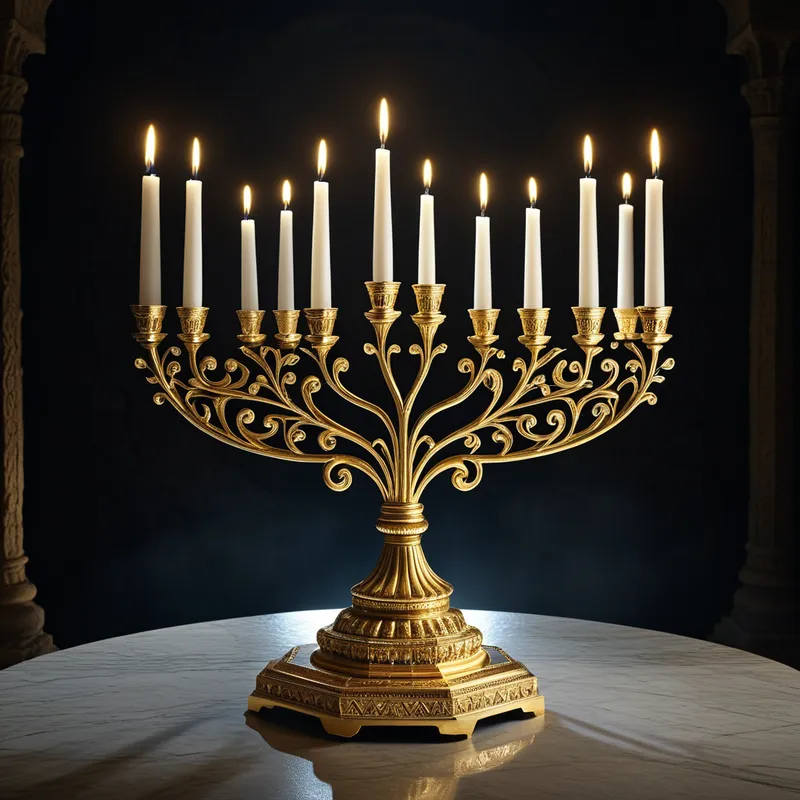
Temple Menorah Myth Meaning & Symbolism
The seven-branched golden lampstand, divinely designed and humanly wrought, that held the eternal flame in the heart of the ancient Temple.
The Tale of the Temple Menorah
In the beginning, there was a blueprint written in fire. It was not a blueprint for a fortress or a throne, but for a vessel of light. In the vast, whispering silence of [the desert](/myths/the-desert “Myth from Biblical culture.”/), atop a mountain shrouded in cloud and thunder, the pattern was given. It was shown to a man whose face shone with a terrifying proximity to the source of all things.
The command was precise, a geometry of the sacred. “You shall make a lampstand of pure gold. Its base, its stem, its cups, its calyxes, and its flowers shall be of one piece with it.” And it was to have six branches coming out of its sides, three on the left and three on the right, each adorned with three cups shaped like almond blossoms, with a calyx and a flower. And on the central stem, four such cups. From this beaten gold, from this single, hammered unity, would spring forth seven lamps. And the light would be directed forward, to illuminate the space before it.
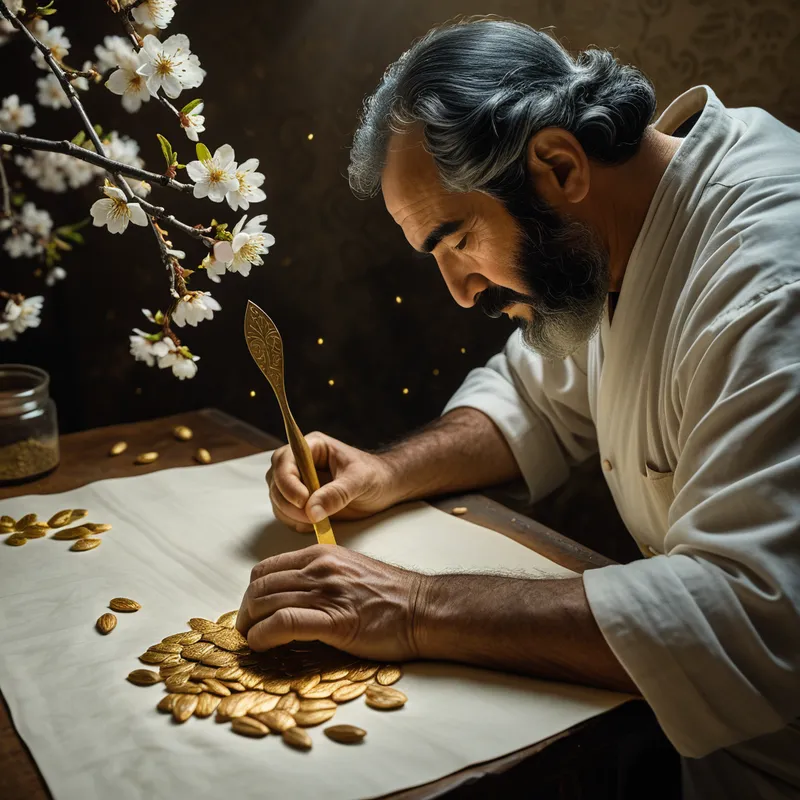
The task fell to Bezalel, son of Uri, in whose heart the spirit of wisdom, understanding, and knowledge dwelled. He took the heavy, ingot-like talent of pure gold. He did not cast it in a mold. Instead, with a holy patience, he began to beat it. The hammer fell, not in violence, but in a rhythmic, deliberate act of coaxing form from potential. Under his hands, the inert metal began to remember. It remembered the curve of the almond branch in early spring, the promise of the blossom before the fruit. It remembered the symmetry of life, the branching of rivers and veins. From one mass, the base grew solid, the central pillar rose, and from its sides, the six branches unfolded like a living tree of fire.
When it was done, it stood not as a mere object, but as a captured prayer in gold. It was placed in the [Tabernacle](/myths/tabernacle “Myth from Biblical culture.”/), in the outer chamber called the Holy Place, to the south, opposite the table of [showbread](/myths/showbread “Myth from Biblical culture.”/). And the priests, the sons of Aaron, were charged with a perpetual duty: to tend its flames. With the finest clear olive oil, beaten, not pressed, they would fill the seven lamps. Each evening, as [the world](/myths/the-world “Myth from Tarot culture.”/) outside grew dark, they would ascend the lamps, causing them to give light all through the night until morning. It was the ner tamid, the eternal light. A small, defiant sun held in a tent of curtains and hides, a promise that even in [the wilderness](/myths/the-wilderness “Myth from Biblical culture.”/) of wandering or the silence of the inner chamber, the light was never, ever to go out.
Cultural Origins & Context
The mythos of the [Menorah](/myths/menorah “Myth from Judeo-Christian culture.”/) is inextricably woven into the foundational texts of the Torah, specifically in the book of Exodus. Its origin is presented not as a human invention, but as a divine revelation given to [Moses](/myths/moses “Myth from Biblical culture.”/) during the 40 days on Sinai. This places it at the very heart of the covenant relationship, a central artifact of the portable Tabernacle that housed the divine presence.
Its primary societal function was liturgical and symbolic, serving as a core ritual object in the priestly service. The meticulous instructions for its construction, fuel, and maintenance are part of the Priestly Code, transmitted and preserved by the priestly caste. Later, with the construction of the First and Second Temples in [Jerusalem](/myths/jerusalem “Myth from Biblical culture.”/), [the Menorah](/myths/the-menorah “Myth from Biblical culture.”/) (or multiple Menorot) became a permanent fixture of [the Temple](/myths/the-temple “Myth from Jewish culture.”/) service, its daily lighting a key ritual witnessed by the community. Its image was seared into the national consciousness, becoming a primary symbol of the Temple itself, of divine wisdom, and of the Jewish people. After the Temple’s destruction, the Menorah transformed from a ritual object into a potent symbol of memory, hope, and spiritual continuity, its form forbidden to be replicated exactly but endlessly reinterpreted in art, coinage, and literature.
Symbolic Architecture
The [Menorah](/symbols/menorah “Symbol: A seven-branched candelabrum central to Judaism, symbolizing divine light, wisdom, and the enduring covenant between God and the Jewish people.”/) is a masterpiece of symbolic [architecture](/symbols/architecture “Symbol: Architecture in dreams often signifies structure, stability, and the framing of personal identity or life’s journey.”/), a map of cosmic and psychic order. Its primary [material](/symbols/material “Symbol: Material signifies the tangible aspects of life, often representing physical resources, desires, and the physical world’s influence on our existence.”/), pure gold, represents the highest value, incorruptibility, and divine [radiance](/symbols/radiance “Symbol: A powerful symbol of illumination, divine presence, and inner awakening, often representing clarity, truth, and spiritual energy.”/). That it is beaten from a single talent is paramount; it speaks of an underlying unity from which all diversity emerges. The many branches are not attached; they are of the whole. This is a profound [statement](/symbols/statement “Symbol: A statement in a dream can symbolize the need to express one’s thoughts or beliefs, reflecting a desire for honesty or clarity.”/) on the [nature](/symbols/nature “Symbol: Nature symbolizes growth, connectivity, and the primal forces of existence.”/) of creation and the [soul](/symbols/soul “Symbol: The soul represents the essence of a person, encompassing their spirit, identity, and connection to the universe.”/): multiplicity arising from, and never separate from, a singular [source](/symbols/source “Symbol: The origin point of something, often representing beginnings, nourishment, or the fundamental cause behind phenomena.”/).
The [number](/symbols/number “Symbol: Numbers in dreams often symbolize meaning, balance, and the quest for understanding in the dreamer’s life, reflecting their mental state or concerns.”/) seven is the number of divine completion—the days of creation, [the celestial spheres](/myths/the-celestial-spheres “Myth from Medieval Christian culture.”/). The six branches plus the central stem symbolize the natural world (six directions: north, south, east, west, up, down) oriented around and illuminated by a central, transcendent principle. The almond [blossom](/symbols/blossom “Symbol: A symbol of new beginnings, growth, and the unfolding of potential, often marking a transition or the start of a journey.”/) [motif](/symbols/motif “Symbol: A recurring thematic element, pattern, or design in artistic or musical works, representing underlying ideas or emotional currents.”/) is not mere decoration. The [almond tree](/symbols/almond-tree “Symbol: The almond tree symbolizes resilience and the duality of creation and destruction, often associated with the nurturing aspects of nature.”/) is the “watcher” in the Levant, blooming suddenly and early. It symbolizes divine vigilance, swift fulfillment of promise, and the beautiful, fragile, yet recurring miracle of [life](/symbols/life “Symbol: The symbol of ‘Life’ represents a journey of growth, interconnectedness, and existential meaning, encompassing both the joys and challenges that define human experience.”/).
The Menorah does not create light; it receives, holds, and directs it. It is the humanly crafted vessel for a divine flame, modeling the sacred partnership between heavenly blueprint and earthly craftsmanship.
Psychologically, it represents the structured, cultivated [consciousness](/symbols/consciousness “Symbol: Consciousness represents the state of awareness and perception, encompassing thoughts, feelings, and experiences.”/). The central stem is the [axis](/symbols/axis “Symbol: A central line or principle around which things revolve, representing stability, orientation, and the fundamental structure of reality or consciousness.”/) of [the Self](/myths/the-self “Myth from Jungian culture.”/), [the ego](/myths/the-ego “Myth from Jungian culture.”/) aligned with a deeper [purpose](/symbols/purpose “Symbol: Purpose signifies direction, meaning, and intention in life, often reflecting personal ambitions and core values.”/). The six branches are the differentiated functions of the [psyche](/myths/psyche “Myth from Greek culture.”/)—thought, feeling, [sensation](/symbols/sensation “Symbol: Sensation in dreams often represents the emotional and physical feelings experienced in waking life, highlighting one’s intuition or awareness.”/), [intuition](/symbols/intuition “Symbol: The immediate, non-rational understanding of truth or insight, often described as a ‘gut feeling’ or inner knowing that bypasses conscious reasoning.”/), and more—all nourished by the same source and all oriented to shed light on the “[space](/symbols/space “Symbol: Dreaming of ‘Space’ often symbolizes the vastness of potential, personal freedom, or feelings of isolation and exploration in one’s life.”/) before it,” the [path](/symbols/path “Symbol: The ‘path’ symbolizes a journey, choices, and the direction one’s life is taking, often representing individual growth and exploration.”/) of life. The command for the light to face forward is a command for consciousness to be applied, to illuminate one’s actions and [journey](/symbols/journey “Symbol: A journey in dreams typically signifies adventure, growth, or a significant life transition.”/).
The Dreamer’s Resonance
When the Menorah appears in a modern dream, it rarely comes as a simple religious icon. It arrives as an archetypal structure of light emerging from [the personal unconscious](/myths/the-personal-unconscious “Myth from Jungian Psychology culture.”/). To dream of kindling the Menorah often coincides with a phase of seeking inner order, of attempting to align disparate parts of one’s life (the branches) around a central, guiding principle or vocation (the central stem). There is a somatic sense of ritual, of careful, deliberate action meant to sustain illumination.
Dreaming of a broken or darkened Menorah speaks to a crisis of meaning or a fragmentation of the psyche. The dreamer may feel their [inner light](/myths/inner-light “Myth from Buddhist culture.”/) is inaccessible, their life’s structure compromised, or their connection to a sense of sacred order severed. The gold may be tarnished, or the branches may be bent. This is [the shadow](/myths/the-shadow “Myth from Jungian culture.”/) side of the symbol: the fear that [the vessel](/myths/the-vessel “Myth from Alchemical culture.”/) cannot hold the light, or that the fuel of inspiration has run dry.
Conversely, to dream of fashioning or repairing a Menorah signals a profound work of psychic integration. The dream-ego takes on the role of Bezalel, engaging in the slow, patient work of hammering the raw material of experience (the talent of gold) into a coherent, beautiful, and functional form. This is active individuation in its most concrete symbolic form.
Alchemical Translation
The myth of the Menorah is a precise alchemical manual for the transmutation of the soul. The [prima materia](/myths/prima-materia “Myth from Alchemical culture.”/), the base substance, is the undifferentiated, “talent-weight” of the individual’s potential—a heavy, valuable, but shapeless mass. The divine blueprint is the call from the Self, the archetypal image of wholeness that feels like a command from a higher order.
The alchemical fire is the disciplined, repeated hammering—the trials, reflections, and conscious efforts of a life examined. This is not random suffering, but the deliberate opus of shaping. The goal is not to create something new from separate parts, but to reveal the form already latent within the whole. The six branches are not welded on; they are discovered, unfolded. This is the process of differentiating one’s talents and faculties without losing the sense of core integrity.
The ultimate alchemical product is not the gold itself, but the hollow space of the cup that can receive the oil, and the open wick that can sustain the flame. The work is to become a vessel for a light that is not one’s own.
Finally, the operation requires the oil—the pure, beaten oil of experience refined into wisdom, not the crude, pressed oil of reactive emotion. This is the fuel for the ner tamid, the eternal inner light that must be tended daily. The ritual is the maintenance of consciousness itself. The [triumph](/myths/triumph “Myth from Roman culture.”/) is not a single heroic act, but the quiet, perpetual victory of keeping a small, steady flame burning in the inner sanctuary, through all the nights of the soul, illuminating the path toward morning. It is the individuated Self, not as a blazing sun, but as a faithful lamp, holding its place in the divine order, casting its light forward.
Associated Symbols
Explore related symbols from the CaleaDream lexicon: