Tawhirimatea Myth Meaning & Symbolism
The story of the storm god who refused the primal separation of his parents, unleashing his grief as the world's first winds and tempests.
The Tale of Tawhirimatea
In the time before time, when the world was a tight, suffocating embrace, there was only Ranginui and Papatūānuku. They clung together in a darkness so complete it was a kind of light, their children born into the cramped, warm space between them. These children were not like us; they were the primal forces of the world, dreaming in the dark.
But one son, Tāne Mahuta, grew restless. He yearned for space, for light, for a world to shape. He pressed his strong back against his father, the sky, and his feet against his mother, the earth, and with a groan that shook the very fabric of being, he pushed. The sound was the first sound—the cracking of a cosmic egg. Light, raw and blinding, flooded the space between. Ranginui was wrenched upwards, weeping great dews of sorrow. Papatūānuku lay below, her body now the land, shuddering with the agony of separation. The world was born in this terrible, beautiful rent.
All the other children scrambled to this new world, to claim their domains in the light. All but one.
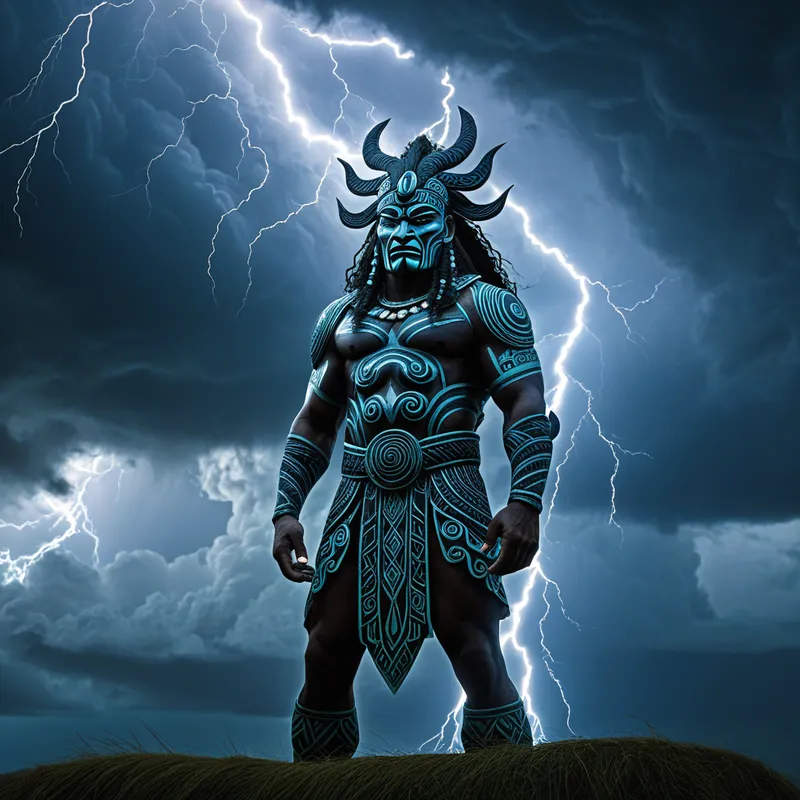
Tawhirimatea did not move. He had loved the dark. He had loved the closeness, the unbroken hum of his parents’ union. The violent light was a desecration; the separation, a crime. While his brothers set about adorning the earth and sea, Tawhirimatea remained in the space between, his heart a gathering storm. He looked up at his father, now a distant, weeping blue, and down at his mother, a scarred and grieving green. A fury, cold and pure, began to coil within him.
This was not a rage of pettiness, but of profound, cosmic grief. His family was shattered. So, he went to his father. He gathered the sighs and sobs of Ranginui, the moans of the winds that now wandered lost between heaven and earth. He breathed them in, and they became his strength. Then, he turned his face to the new world below.
He unleashed his breath. It was not a wind, but the Wind—a screaming, tearing gale that ripped at the forests Tāne Mahuta had raised. He summoned the fierce squalls and the twisting hurricanes. He became the thunder, rolling his anguish across the sky; he became the lightning, slashing the heavens with his pain. He attacked his brothers with the very elements of their broken home: he lashed the seas of Tangaroa, he scorched the canoes of Rongo, he pursued Haumia-tiketike and Tūmatauenga with relentless fury.
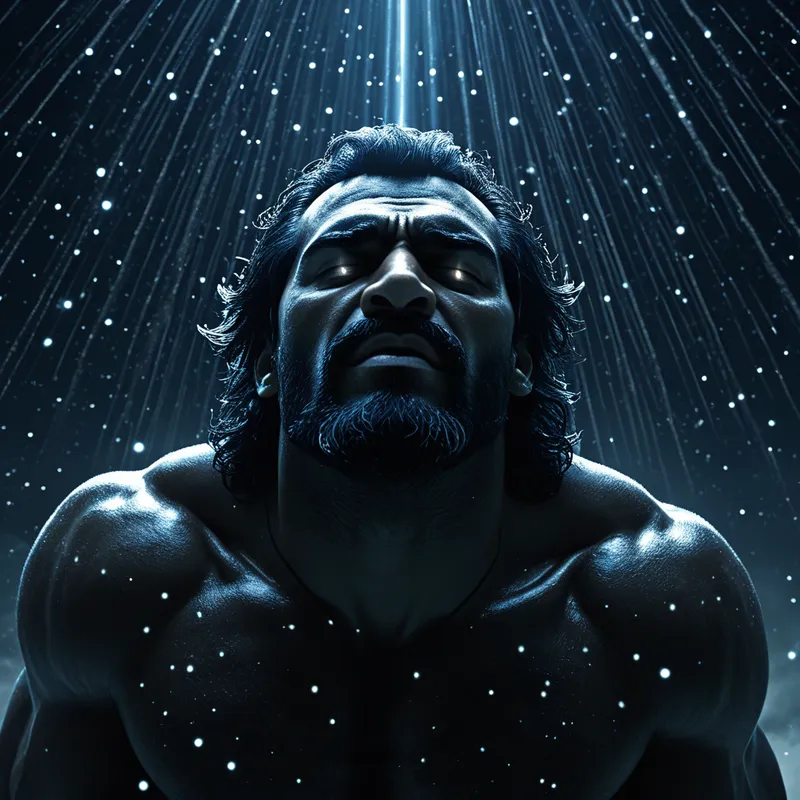
But one brother stood firm: Rūaumoko, still cradled in his mother’s bosom. Against the deep, grinding resistance of the earth itself, even Tawhirimatea’s fury could not prevail. Exhausted, but unyielding, he made his final, terrible choice. He would not join the world born of separation. In a act of ultimate defiance and transformation, he tore out his own eyes. He cast them upwards, into the vast vault of his father’s body. There, they lodged and began to glow—not with sight, but with a distant, cold watchfulness. They became the stars, Ngā Mata o Tawhirimatea. He retreated to the highest realms, becoming the eternal, brooding power of the storm, forever howling his lament between his separated parents, the first and most passionate mourner of a broken unity.
Cultural Origins & Context
This myth is part of the Kōrero Tuku Iho, the sacred stories passed down through generations. It was not mere entertainment but whakapapa—cosmology, history, and law woven into one. Recited by tohunga during rituals and taught within the whānau and hapū, it explained the origin of the natural world and humanity’s place within it.
The story of Tawhirimatea served a crucial societal function. It personified the awesome, destructive power of New Zealand’s weather, making it comprehensible and placing it within a familial drama. More deeply, it modeled complex emotional truths. It acknowledged that creation is often traumatic, that progress can feel like betrayal, and that some grief is so vast it becomes a permanent, powerful force in the world. It gave a language for the righteous anger that can arise from loss and the dignity in refusing to simply "move on."
Symbolic Architecture
Tawhirimatea is the archetype of the Shadow that refuses integration on others' terms. He represents the part of the psyche that clings to the primal, undifferentiated state—the comfort of the womb, the unconscious unity before the ego’s birth (Te Wehenga). His brothers symbolize the necessary, forward-driving forces of consciousness: structure, cultivation, exploration. Tawhirimatea is the necessary counter-force: the emotional truth that creation hurts.
The storm is not chaos, but the voice of a sacred protest. It is the psyche's refusal to let a foundational trauma pass in silence.
His rage is not nihilistic destruction; it is the energetic manifestation of profound, unattended grief. The winds are his cries, the thunder his arguments. His final act—tearing out his eyes to create the stars—is a supreme alchemical image. It is the transmutation of personal, sensory suffering (sight) into an impersonal, guiding, and eternal symbol (light). He sacrifices his immediate, personal perspective to become a universal, distant witness.
The Dreamer's Resonance
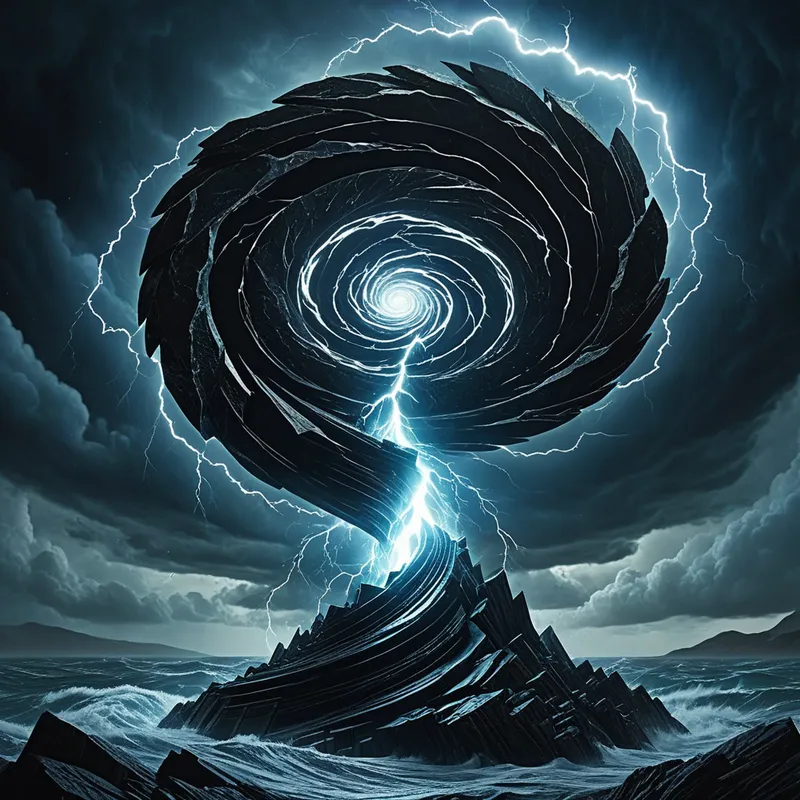
When this myth stirs in modern dreams, it often manifests not as a literal storm god, but as a somatic and emotional climate. The dreamer may experience dreams of being in a house where the walls are buckling from an immense, silent pressure outside. They may dream of a family gathering where a terrible, unspoken grief causes the air to thicken and objects to vibrate.
Psychologically, this signals a process where a long-suppressed emotional truth—often related to a foundational family separation, betrayal, or loss—is demanding recognition. The "storm" is the psyche’s attempt to equalize the pressure. The dreamer is Tawhirimatea, holding the grief that others in their system (their inner "brothers") have ignored or built over. The process is one of legitimizing a righteous, perhaps lonely, fury that is not about destruction, but about the integrity of feeling. It is the somatic recognition that some wounds are cosmological, and their healing requires not quiet acceptance, but a full-throated acknowledgment of their scale.
Alchemical Translation
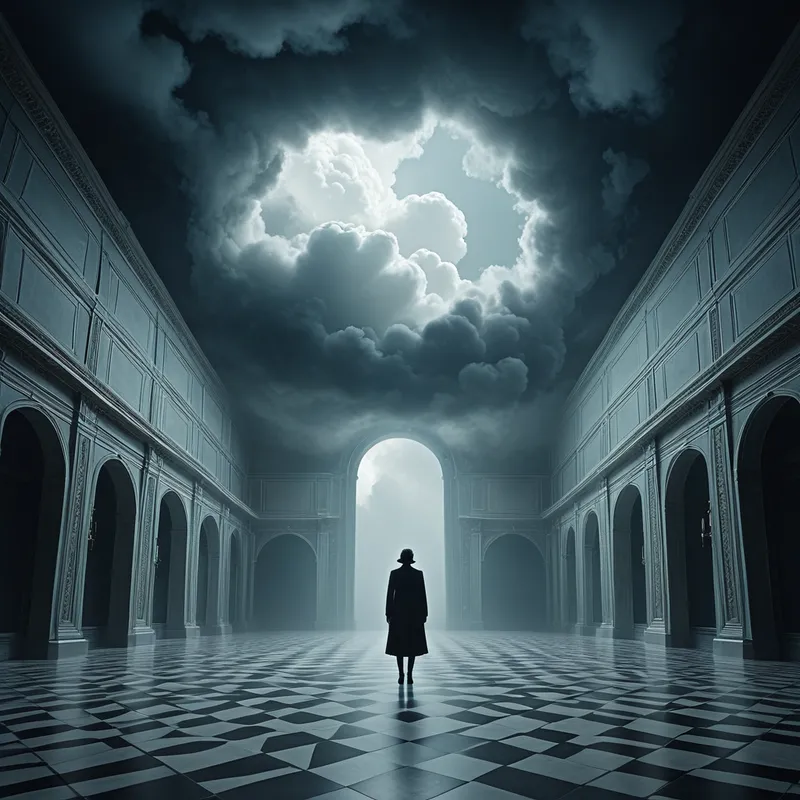
The individuation journey modeled by Tawhirimatea is not one of reconciliation with the source of pain, but of sacred separation and sovereign expression. His path is for the part of the soul that cannot and will not "forgive and forget" a primal rupture. His alchemy is one of distillation.
First, he fully embodies his truth. He does not mute his grief-rage; he gathers it, gives it voice as wind and thunder. This is the critical stage of owning one's shadow emotion, not as a flaw, but as a potent energy.
The power lies not in calming the storm, but in learning to speak its language and direct its breath.
Second, he chooses his realm. He does not descend to the conquered earth of his brothers. He claims the liminal, dynamic space between—between past and future, grief and action, attachment and release. This is the psychological act of carving out an authentic identity that honors one's pain without being consumed by it.
Finally, he transmutes his wound into a witness. The tearing out of the eyes is the ultimate act of psychic alchemy. It represents the move from being a victim of what one has seen ("my family was broken") to creating a new perspective from the very substance of the pain. The stars are cold, distant, but they guide. They are light born of darkness, order born of rage. For the modern individual, this translates to transforming a personal history of trauma or betrayal into a guiding philosophy, a creative outlet, or a deep empathy that can light the way for others. One ceases to be the child screaming in the broken home and becomes the poet who names the constellations of loss, giving form and meaning to the dark.
Associated Symbols
Explore related symbols from the CaleaDream lexicon:
- Sky — The domain of Ranginui and later Tawhirimatea, representing the father principle, distance, and the realm of emotion and spirit.
- Earth — The body of Papatūānuku, representing the mother principle, the grounded world, and the foundation from which life—and trauma—springs.
- Thunder — The voice of Tawhirimatea's protest, symbolizing the shocking, unavoidable announcement of deep psychic pain and righteous anger.
- Wind — The breath and agency of Tawhirimatea, representing the powerful, invisible force of emotion that can both cleanse and destroy.
- Light — The traumatic yet creative force introduced by the separation, which Tawhirimatea ultimately transmutes his pain into, becoming the stars.
- Separation — The core trauma of the myth, the primal act (Te Wehenga) that births the conscious world but also inaugurates eternal grief and conflict.
- Rage — The sacred, transformative energy of Tawhirimatea, representing a psyche's refusal to accept a foundational injustice without expression.
- Grief — The deep, abiding sorrow that fuels the storm, the emotional truth that precedes and gives meaning to the rage.
- Star — The alchemical product of Tawhirimatea's sacrifice, a wound transformed into a guiding, eternal witness in the darkness.
- Chaos — The apparent state brought by the storm, which is actually a higher-order response to a primal disorder (the forced separation).
- Rebirth — The entire cosmos is reborn through the separation, and Tawhirimatea himself is reborn as an elemental, eternal force.
- Shadow — Tawhirimatea embodies the psychological Shadow, the rejected, emotional truth that must be acknowledged for wholeness.