Taranaki and Pihanga Myth Meaning & Symbolism
A myth of volcanic mountains as ancestors, where love, rivalry, and exile carve the sacred geography of Aotearoa into the soul's terrain.
The Tale of Taranaki and Pihanga
Listen. In the time before time, when the world was young and the bones of the earth still glowed with inner fire, the great mountains of the central North Island were not stone and soil, but living ancestors—atua of immense power and passion. They walked, they spoke, they loved.
In the heart of this land, surrounded by his kin—Tongariro, the fierce and noble chief; Ngauruhoe, his fiery son; and Ruapehu, the ancient and enduring—stood the beautiful Pihanga. Cloaked in the deep green of primeval forest, she was the heart of the land, radiant and life-giving. All who beheld her were captivated.
Among them was Taranaki, a mountain of proud stature and handsome form. His love for Pihanga was a deep, slow-burning fire. But his love was not alone. Tongariro, the paramount chief, also desired Pihanga as his own. A terrible tension settled over the land, a heat that made the very air tremble.
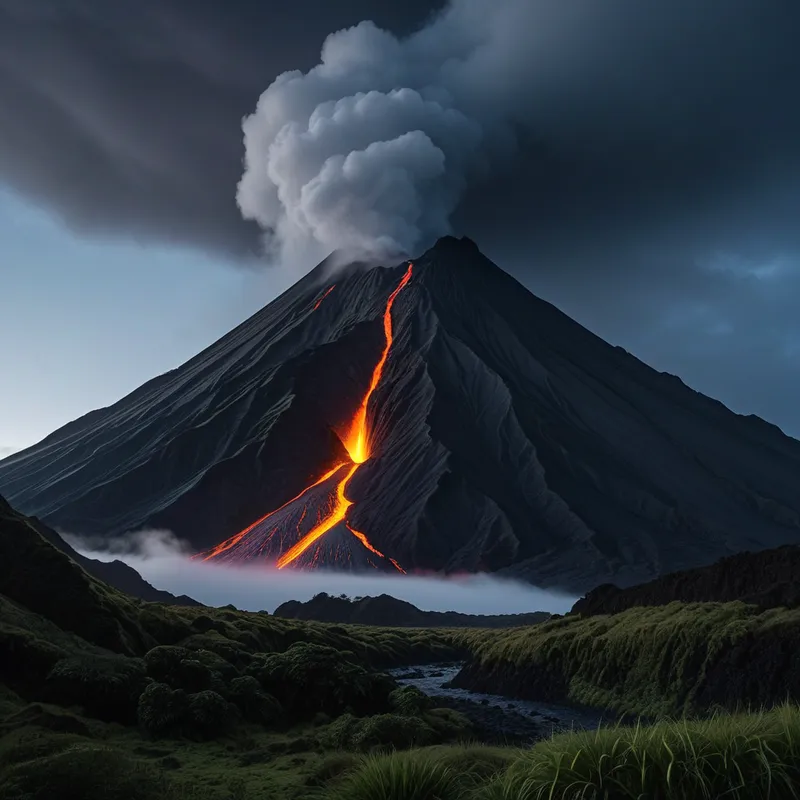
The conflict could not be contained. It erupted in a cataclysm of elemental fury. The mountains battled—not with weapons of wood and stone, but with the very forces of creation. Tongariro summoned searing lava and choking ash. The earth shook with his rage. Taranaki fought with all his might, his slopes streaming with torrents of water and mud, but against the combined might of the central mountains, he was overmatched.
Defeated, heartbroken, Taranaki knew he could no longer stay. In the deep, dark silence before dawn, he made his choice. With a sound that split the world—a groan of immeasurable grief and rending stone—he tore his roots from the beloved earth. Weeping tears of steaming rock, he began his long, lonely journey to the west. He gouged a deep, weeping wound through the land as he went, the Whanganui River flowing into the scar of his passage.
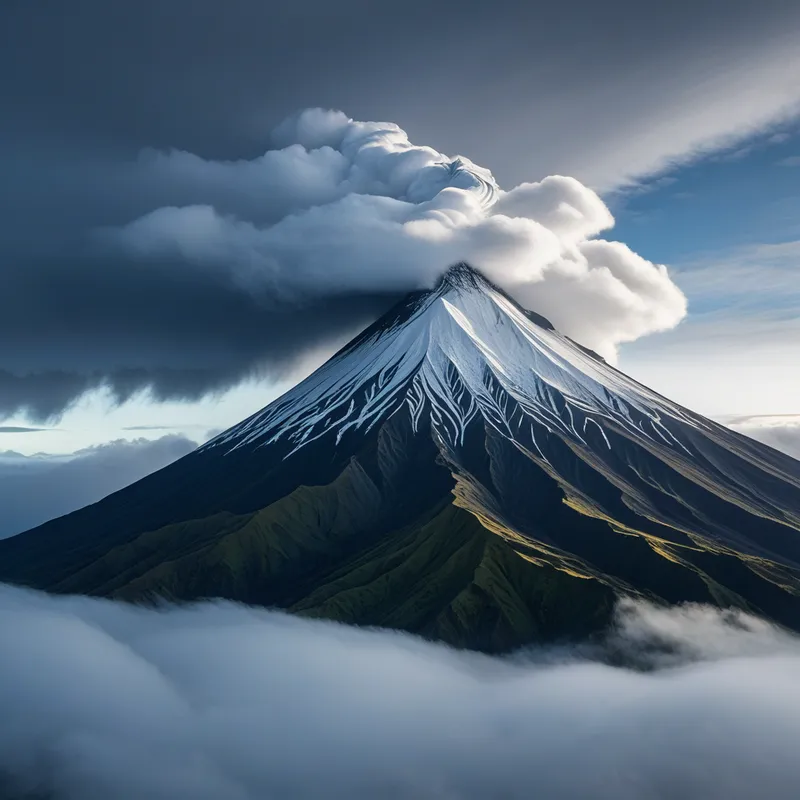
He travelled until he reached the wild western coast. There, exhausted and sorrowful, he turned his back on his former home and settled, facing the endless Tasman Sea. Some say the cloud that forever clings to his peak, the korowai of mist, is his enduring grief. And on clear days, from his lonely summit, they say he can still gaze eastward, catching a glimpse of Pihanga’s distant, verdant form—a love forever remembered, forever lost.
Cultural Origins & Context
This pūrākau belongs to the Māori tribes of the central North Island, particularly Ngāti Tūwharetoa, who hold Tongariro and his kin as sacred ancestors. It is a pepeha, a foundational narrative that literally maps identity onto the landscape. The story was not merely told; it was recited as an act of mana and connection, explaining the visible, physical world—why Taranaki stands alone, why the Whanganui River winds so deeply, why the volcanic plateau is shaped as it is.
Passed down through generations by tohunga and storytellers, its function was multifaceted. It encoded environmental knowledge, explained geological phenomena, and established tribal boundaries and relationships. Most profoundly, it reinforced the Māori worldview of whakapapa—the genealogical connection that links people, mountains, rivers, and forests as one family. The land is not a resource; it is an ancestor, with all an ancestor’s passions, conflicts, and enduring presence.
Symbolic Architecture
At its core, this myth is a profound [allegory](/symbols/allegory “Symbol: A narrative device where characters, events, or settings represent abstract ideas or moral qualities, conveying deeper meanings through symbolic storytelling.”/) of the [heart](/symbols/heart “Symbol: The heart symbolizes love, emotion, and the core of one’s existence, representing deep connections with others and self.”/)’s [exile](/symbols/exile “Symbol: Forced separation from one’s homeland or community, representing loss of belonging, punishment, or profound isolation.”/). Taranaki represents the part of the self that loves deeply but outside the sanctioned order. His love is authentic, yet it challenges the established [hierarchy](/symbols/hierarchy “Symbol: A structured system of ranking or authority, often representing social order, power dynamics, and one’s position within groups or institutions.”/) embodied by Tongariro.
The most sacred landscapes are often carved by the most profound heartbreaks. The geography of the soul is shaped not by stillness, but by necessary, tectonic movement.
The conflict is not between good and evil, but between two powerful, legitimate forces: [the law](/symbols/the-law “Symbol: Represents external rules, societal order, moral boundaries, and the tension between personal freedom and collective structure.”/) of the tribe (Tongariro) and the call of the individual heart (Taranaki). The [resolution](/symbols/resolution “Symbol: In arts and music, resolution refers to the movement from dissonance to consonance, creating a sense of completion, release, or finality in a composition.”/) is not victory, but a transformative, painful [departure](/symbols/departure “Symbol: A transition from one state to another, often representing change, growth, or leaving behind the familiar.”/) that creates new, sacred [space](/symbols/space “Symbol: Dreaming of ‘Space’ often symbolizes the vastness of potential, personal freedom, or feelings of isolation and exploration in one’s life.”/). Taranaki’s [journey](/symbols/journey “Symbol: A journey in dreams typically signifies adventure, growth, or a significant life transition.”/) westward is an archetypal [movement](/symbols/movement “Symbol: Movement symbolizes change, progress, and the dynamics of personal growth, reflecting an individual’s desire or need to transform their circumstances.”/) into the unknown, into the [realm](/symbols/realm “Symbol: The symbol of ‘Realm’ often signifies the boundaries of one’s consciousness, experiences, or emotional states, suggesting aspects of reality that are either explored or ignored.”/) of the solitary. The [river](/symbols/river “Symbol: A river often symbolizes the flow of emotions, the passage of time, and life’s journey, reflecting transitions and movement in one’s life.”/) of tears he creates becomes a [life](/symbols/life “Symbol: The symbol of ‘Life’ represents a journey of growth, interconnectedness, and existential meaning, encompassing both the joys and challenges that define human experience.”/)-giving [pathway](/symbols/pathway “Symbol: A symbol of life’s journey, direction, and personal progress, representing choices, transitions, and the unfolding of one’s destiny.”/) for others (the Whanganui), showing how personal [grief](/symbols/grief “Symbol: A profound emotional response to loss, often manifesting as deep sorrow, yearning, and a sense of emptiness.”/), when fully lived, can become a [source](/symbols/source “Symbol: The origin point of something, often representing beginnings, nourishment, or the fundamental cause behind phenomena.”/) of nourishment for an entire ecosystem of the [soul](/symbols/soul “Symbol: The soul represents the essence of a person, encompassing their spirit, identity, and connection to the universe.”/).
The Dreamer’s Resonance
When this myth stirs in the modern dreamer, it signals a profound somatic and psychological process of dislocation for the sake of integrity. To dream of being a lone mountain, or of making a grievous, self-inflicted wound to escape a conflict, speaks to a soul at a crossroads.
The somatic experience may be one of deep, aching loneliness in the chest, a feeling of being “uprooted” or fundamentally out of place. Psychologically, the dreamer is likely facing a situation where their deepest affection or creative impulse is in irreconcilable conflict with their “tribal” identity—their family system, professional role, or internalized expectations. The dream does not promise a happy reunion, but it validates the necessity of the exile. It confirms that to remain would mean a slow death of the spirit, a suffocation under the ash of compromise. The dream is the inner Taranaki beginning his westward journey, tearing himself away from a familiar but ultimately untenable homeland.

Alchemical Translation
The alchemical process modeled here is one of separatio followed by coagulatio—a necessary, violent separation leading to a new, solidified form. The psychic transmutation is from a state of enmeshment within a collective dynamic (the central mountains) to a state of sovereign, if sorrowful, individuality.
Individuation often requires a volcanic eruption—a tearing away from the familiar psychic landscape to claim one’s own ground, however lonely.
The first stage is the eruption of conscious conflict—the feeling that one cannot stay. The second is the agonizing via negativa, the journey of exile, where one carries the wound (the river valley) as evidence of the cost. The final stage is not a cure for the loneliness, but a transformation of it into a defining feature. Taranaki does not cease to be a mountain; he becomes the mountain of the west. His grief becomes his weather, his defining mist. For the modern individual, this translates to the difficult process of leaving a job, a relationship, or a belief system that cannot contain one’s true nature. The triumph is not in forgetting the lost love (Pihanga), but in integrating the memory of it into a new, self-authored identity. One becomes whole not by returning, but by fully inhabiting the new territory the exile has claimed.
Associated Symbols
Explore related symbols from the CaleaDream lexicon:
- Mountain — The enduring, sovereign self. Taranaki’s journey is the process of becoming a distinct, unmovable entity, even in isolation.
- Journey — The necessary, painful passage from the known to the unknown, which in itself becomes a sacred and defining act of creation.
- Wound — The deep, generative scar left by departure. It is not merely damage, but the source of a new life-flow, like the river from Taranaki’s grief.
- Love — The primal, attractive force that motivates both connection and catastrophic conflict, ultimately reshaping the world.
- Exile — The state of being cast out or choosing to leave, which becomes the crucible for forging an independent identity.
- River — The flowing, life-sustaining manifestation of deep emotion and grief, carving its path through the landscape of the psyche.
- Heart — The central organ of feeling and courage, which can be broken yet remains the fiery core of one’s being, as molten as the earth’s mantle.
- Earth — The foundational reality, the body, and the familial connection from which one must sometimes tear away to become oneself.
- Grief — The heavy, mist-cloaking emotion that is not a sign of failure, but the authentic weather of a transformed life.
- Shadow — The rejected, exiled part of the self or the community that must travel to the west to find its own form and power.
- Sacrifice — The giving up of a cherished place and connection, not for a greater good, but for the integrity of one’s own soul.
- Destiny — The unique, solitary path one is forced to walk after a fundamental conflict, which defines one’s ultimate form and purpose.