Tara Myth Meaning & Symbolism
The myth of Tara, the sacred hill of Irish kings, is a story of sovereignty, sacrifice, and the eternal marriage between ruler and land.
The Tale of Tara
Listen, and let the mists of memory part. This is not a story of a single hero, but of a place that is a person, a throne that is a heart. It is the tale of Tara.
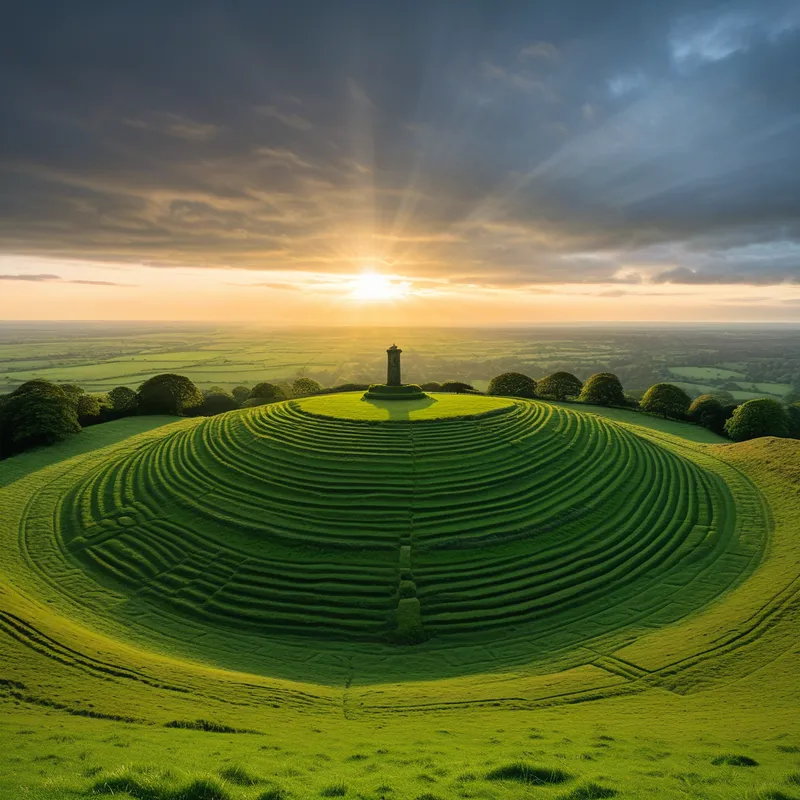
In the green embrace of Ériu, there rises a hill, gentle in slope but infinite in presence. It is not the highest, but it is the navel of the world. Here, the sky leans close to whisper to the land. And the land is not silent earth; she is a goddess. She is the Flaitheas, the spirit of sovereignty, and she sleeps within the hill, dreaming of a worthy king.
The air on Tara is thick with the breath of ancestors. The ghosts of ancient feasts linger in the Forrad, and the stars map themselves onto the patterns of ditches and mounds. At its center lies the Lia Fáil, a grey, unassuming pillar. It is the still point, the testing stone.
Now comes a man who would be Ard Rí. He has won battles, gathered allies, and his name is on the lips of the poets. But none of that matters here. On the day of the Feis Temro, he ascends the hill alone, stripped of his armor, clad only in a plain tunic. The druids chant, their voices a low hum that vibrates in the bone. The assembled tribes are a sea of silent faces below.
He approaches the Stone. This is the moment. Not of crowning, but of recognition. He places his bare foot upon the cold granite of the Lia Fáil. A hush swallows the world. The hill holds its breath. The goddess beneath the soil opens one eye.
If he is true—if his spirit is aligned not with personal glory, but with the deep, nourishing justice of the land—then the stone cries out. A roar splits the silence, a sound that is neither rock nor beast, but the voice of the land itself accepting its mate. The cry echoes to the four corners of Ireland, proclaiming the sacred marriage. The king is not crowned by men, but wedded to the goddess. He drinks the ale of sovereignty from a sacred cup, and in that draught, he ceases to be merely a man. He becomes the embodiment of the tribe’s contract with the world: to protect, to provide, to mediate between the people and the powers of sky and soil.
But if his heart harbors corruption, if his desire is for power alone, the stone remains dumb. The silence is more terrible than any shout. The mist will creep in, the goddess will turn her face away, and the man will descend the hill, not as a king, but as a ghost, his destiny unmade. The hill endures, waiting, always waiting, for the one whose sovereignty is a form of love.
Cultural Origins & Context
The mythic complex of Tara is not a single narrative but a tapestry of place-lore, dynastic propaganda, and sacred geography woven over millennia. Its origins lie in the pre-Celtic Neolithic, with the mound already a site of profound importance, later adopted and mythologized by the incoming Gaelic culture. It functioned as the ultimate ideological anchor of early Irish society.
This was not a “myth” told around a fire in the way of a hero’s saga. It was a lived, performed reality. The story was the ritual itself—the inauguration of the High King. It was transmitted through the elite custodians of memory: the filid and the druids. Their poetry and ceremonial prescriptions were the myth in action. The societal function was paramount: it sacralized political power, binding it inextricably to cosmic order and communal well-being. A king’s legitimacy flowed from this numinous contract with the Flaitheas, not merely from military force. This provided a check on tyranny—a king who failed in his duties of justice and fertility was, by mythic definition, no true king at all, and his reign would falter.
Symbolic Architecture
At its core, the myth of Tara is an archetypal drama of right relationship. The hill is the axis mundi, the point where heaven, earth, and the otherworld intersect. The king aspirant represents the conscious ego, seeking order and authority. The goddess of the land represents the vast, unconscious psyche—the anima mundi or world soul—and specifically the instinctual, fecund, and often terrifying feminine principle that must be integrated, not conquered.
The true king does not rule the land; the land rules through him. Sovereignty is not possession, but a state of resonant alignment.
The Lia Fáil is the ultimate symbol of this test. It is the touchstone of authenticity. Its “cry” is the symbolic moment of recognition when the personal will surrenders to, and becomes a vessel for, a transpersonal purpose. The sacred marriage is the hieros gamos, the alchemical conjunction of opposites: masculine and feminine, conscious and unconscious, culture and nature. This union promises prosperity and peace—the famed “king’s truth” (fír flathemon) that makes the land fruitful and the seasons regular.
The Dreamer’s Resonance
When this mythic pattern stirs in the modern unconscious, it rarely appears as a literal hill or stone. Instead, one may dream of standing before a daunting interview panel that is also a council of ancient trees. Or of being offered a promotion—symbolized by a key or a crown—that feels simultaneously glorious and like a heavy, constricting weight. The somatic sensation is often one of profound testing: a tightening in the chest, a dryness in the throat as one prepares to “speak one’s truth” before an invisible authority.
This is the psyche’s initiation into a new level of personal responsibility and authenticity. The “sovereignty goddess” in the dream may manifest as a formidable mentor, an alluring yet intimidating potential partner, or even as the dreamer’s own body, sick or radiant, demanding proper care and respect. The conflict is between the desire for external validation (the crown offered by the “tribe”) and the internal requirement for integrity (the silent judgment of the “stone”). To fail the test in the dream is not a catastrophe, but a crucial signal that the ego is not yet aligned with the deeper Self; the current ambition is out of sync with the soul’s true jurisdiction.
Alchemical Translation
The alchemical journey modeled by Tara is the opus of individuation, where the lead of the petty ego is transmuted into the gold of the Self, the inner sovereign. The initial stage is the nigredo: the aspirant’s lonely ascent, stripped of worldly status, facing the unknown. This is the dark night of the soul, the confrontation with the shadow.
The moment at the Lia Fáil is the albedo, the whitening. It is the crucial, reflective moment of self-judgment and clarity. Is the motivation pure? Is the intended “rule” of one’s life—over one’s career, relationships, creative output—in service to the Self, or to the persona?
The cry of the stone is the sound of the psyche recognizing its own rightful ruler. It is the moment the complex dissolves into consciousness.
The sacred marriage is the rubedo, the reddening, the coniunctio. This is the integration achieved. The conscious mind (the king) and the unconscious (the land) are wedded. The individual no longer acts from a place of isolated willpower, but from a connected, instinctual knowing. Their “rule” becomes an authentic expression of their deepest nature, which naturally brings “fruitfulness”—creativity, meaningful relationships, and a sense of purpose that nourishes both the individual and their world. The hill of Tara, therefore, is not just a historical site, but an eternal psychic blueprint. It maps the journey from seeking power over one’s life to embodying authority from within it, in right relationship with the vast, dreaming land of the soul.
Associated Symbols
Explore related symbols from the CaleaDream lexicon: