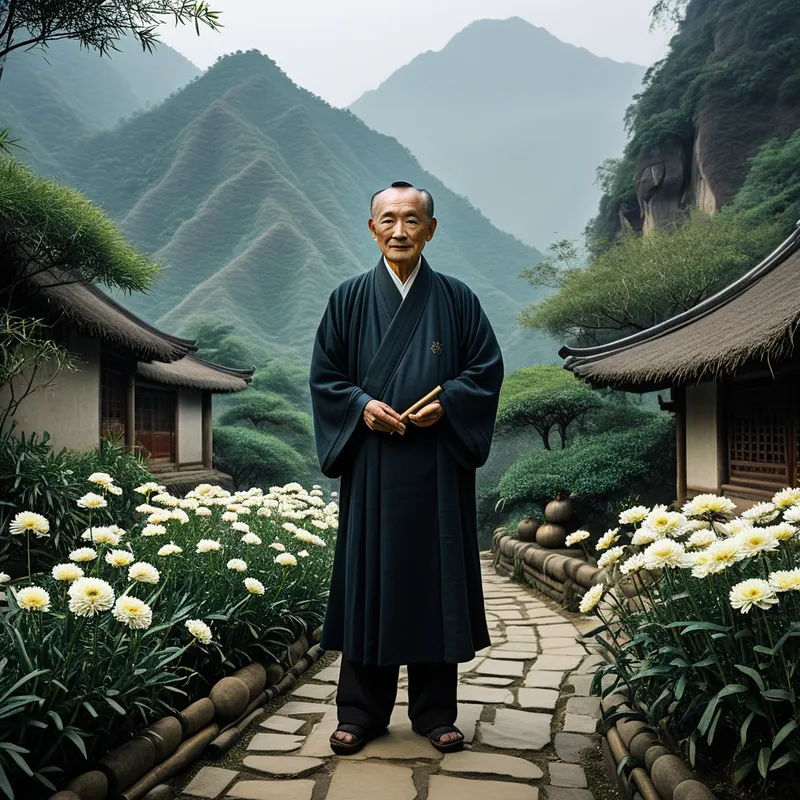
Tao Yuanming Myth Meaning & Symbolism
The story of a scholar who rejects the artifice of court life to find his true self in the simplicity of nature, wine, and poetry.
The Tale of Tao Yuanming
Listen, and hear a tale not of gods on high, but of a man who walked [the earth](/myths/the-earth “Myth from Hindu culture.”/) and found heaven in the dirt of his own garden. It begins not with a birth, but with a leaving.
In the time of the Jin Dynasty, [the world](/myths/the-world “Myth from Tarot culture.”/) was a tapestry of ambition and silk. The corridors of power in Jiankang hummed with the whispers of clerks and the rustle of official decrees. Among them was Tao Yuanming. For years, he played his part. He wore the stiff robes, bowed at the proper angles, and penned documents that smelled of ink and obligation. But with each passing season, the robe grew heavier, the bow more strained, the ink more like ash on his tongue.
One afternoon, as the autumn sun slanted low, a superior official arrived for an inspection—a man whose very presence was a performance of pomp. Protocol demanded Tao gird himself, straighten his cap, and greet this personage with elaborate, subservient ceremony. The command hung in the air. Tao stood in his office, the smell of bureaucracy thick around him. He looked at his official seal, a cold piece of bronze that bound him to this pantomime. He looked out the door, where a stray chrysanthemum grew wild by the step.
“I cannot bend my spine for five bushels of rice,” he said, to the silent walls. The words were quiet but final, like a stone dropped into a deep well.
He removed his official hat and silk belt. He placed his seal of office carefully upon the desk. Then, he walked out. He did not look back at the towering gates of the yamen. He walked until the cobblestones gave way to dirt paths, until the scent of dust and ripe persimmons replaced the odor of sealed scrolls. He returned to his village, to a patch of land south of the mountain.
There, he built a humble cottage. His neighbors were farmers; his music, the sigh of the pines. He planted chrysanthemums by his eastern fence and took joy in plucking them, his gaze often resting on the southern mountains. He tilled the soil, his hands growing calloused, his back aching with a truth that no courtly bow could ever impart. At dusk, he would sit with a jar of home-brewed wine, watching the clouds gather and disperse over the peaks. He wrote poems not for advancement, but for the sheer necessity of it—verses that spoke of returning birds, of finding contentment in poverty, of the profound peace that comes when the soul is no longer at war with its own nature.
His life became his masterpiece. He did not flee to the mountains as a hermit seeking immortality; he returned to the earth as a man seeking himself. The conflict was not resolved with a battle, but dissolved in a long, slow exhalation. The resolution was the sunrise over his own field, the taste of his own wine, and the unshakable knowledge that he was, at last, home.

Cultural Origins & Context
Tao Yuanming (c. 365–427 CE) is a unique figure in world mythology: a historical person whose life was so authentically lived that it transcended biography and entered the realm of archetype. His story is not a folktale passed down by anonymous bards, but a literary and cultural artifact preserved through his own poetry and a biography in the Book of Jin. He lived during a period of political fragmentation and moral uncertainty, where the Confucian ideal of loyal service was often at odds with the Daoist yearning for natural spontaneity and the growing Buddhist influence emphasizing detachment from worldly dust.
His myth was carried not by oral storytellers, but by scholars, poets, and painters across centuries. For the educated elite of imperial China, perpetually caught in the tension between public service (shi) and private cultivation (yin), Tao’s life became the ultimate [reference](/myths/reference “Myth from Global/Universal culture.”/) point. He modeled a third way: not failed ambition or escapist fantasy, but a conscious, dignified choice for authenticity. His societal function was that of a cultural mirror and a pressure valve. He embodied the soul’s rebellion against the machinery of the social [persona](/myths/persona “Myth from Greek culture.”/), offering a sanctioned, even revered, path for integrating the rejected parts of [the self](/myths/the-self “Myth from Jungian culture.”/)—the farmer, the drinker, the solitary dreamer—into a cohesive whole.
Symbolic Architecture
The myth of Tao Yuanming is a profound map of an [inward](/symbols/inward “Symbol: A journey toward self-awareness, introspection, and the exploration of one’s inner world, thoughts, and unconscious mind.”/) [journey](/symbols/journey “Symbol: A journey in dreams typically signifies adventure, growth, or a significant life transition.”/). Its symbols are not fantastical beasts, but everyday objects charged with immense psychological meaning.
- The Discarded Seal & [Robes](/symbols/robes “Symbol: Robes symbolize social roles, authority, and spiritual or professional identity, often representing the persona one presents to the world.”/): These represent the [Persona](/symbols/persona “Symbol: The social mask or outward identity one presents to the world, often concealing the true self.”/), the [costume](/symbols/costume “Symbol: A costume symbolizes the roles we play in life and the masks we wear, often reflecting personal desires or societal expectations.”/) of social [obligation](/symbols/obligation “Symbol: A perceived duty or responsibility imposed by social norms, relationships, or internalized expectations, often involving a sense of being bound to act.”/). Casting them off is the ultimate act of de-identification. It is not the destruction of the [persona](/symbols/persona “Symbol: The social mask or outward identity one presents to the world, often concealing the true self.”/) (which remains a necessary tool), but the conscious dis-ownership of its tyranny.
- The Thatched Cottage and Garden: This is the [Temenos](/myths/temenos “Myth from Greek culture.”/), the sacred [enclosure](/symbols/enclosure “Symbol: A bounded space representing psychological containment, social boundaries, or existential limitations. It can symbolize both safety and restriction.”/) of the [soul](/symbols/soul “Symbol: The soul represents the essence of a person, encompassing their spirit, identity, and connection to the universe.”/). It is a bounded [space](/symbols/space “Symbol: Dreaming of ‘Space’ often symbolizes the vastness of potential, personal freedom, or feelings of isolation and exploration in one’s life.”/) where the individual can exist according to their own inner law. It is humble, vulnerable to the elements, yet utterly one’s own.
- The [Chrysanthemum](/symbols/chrysanthemum “Symbol: A flower symbolizing longevity, rejuvenation, and the cycle of life and death in spiritual traditions.”/): More than a flower, it is a [symbol](/symbols/symbol “Symbol: A symbol can represent an idea, concept, or belief, serving as a powerful tool for communication and understanding.”/) of [autumn](/symbols/autumn “Symbol: A season symbolizing transition, harvest, and decay, representing life’s cycles between abundance and decline.”/), of flourishing in the time of decay, of noble integrity that withstands the frost. Psychologically, it represents the [beauty](/symbols/beauty “Symbol: This symbol embodies aesthetics, harmony, and the appreciation of life’s finer qualities.”/) and [resilience](/symbols/resilience “Symbol: The capacity to recover quickly from difficulties, adapt to change, and maintain strength through adversity.”/) of the authentic self that can only [bloom](/symbols/bloom “Symbol: Represents growth, vitality, and the flourishing of potential, often tied to emotional awakening or physical health.”/) after the superficial blooms of ambition have fallen away.
- The Southern Mountains: They are the eternal, unchanging [background](/symbols/background “Symbol: The background in a dream can reflect context, environment, and underlying influences in the dreamer’s life.”/), the symbol of the Self in Jungian terms. Tao “takes pleasure” in them; they are always there, a constant reminder of a [reality](/symbols/reality “Symbol: Reality signifies the state of existence and perception, often reflecting one’s understanding of truth and life experiences.”/) larger and more enduring than the petty dramas of the [human](/symbols/human “Symbol: The symbol of a human represents individuality, complexity of emotions, and social relationships.”/) world.
- The [Wine](/symbols/wine “Symbol: Wine often symbolizes celebration, indulgence, and the deepening of personal connections, but it can also represent excess and escape.”/): This is the agent of [dissolution](/symbols/dissolution “Symbol: The process of breaking down, dispersing, or losing form, often representing transformation, release, or the end of a state of being.”/) and [connection](/symbols/connection “Symbol: Connection symbolizes relationships, communication, and bonds among individuals.”/). It dissolves the rigid boundaries of [the ego](/myths/the-ego “Myth from Jungian culture.”/), allowing for a fluid, poetic state of [consciousness](/symbols/consciousness “Symbol: Consciousness represents the state of awareness and perception, encompassing thoughts, feelings, and experiences.”/) where the [separation](/symbols/separation “Symbol: A spiritual or mythic division between realms, states of being, or consciousness, often marking a transition or loss of connection.”/) between self and [nature](/symbols/nature “Symbol: Nature symbolizes growth, connectivity, and the primal forces of existence.”/), self and solitude, softens. It is the sacrament of his personal religion of authenticity.
The true journey is not measured in li traveled, but in layers of pretense shed. The destination is not a place on a map, but a state of being where one’s inner nature and outer life are in harmony.
The Dreamer’s Resonance
When the archetype of Tao Yuanming stirs in the modern unconscious, it rarely appears as a historical figure. Instead, it manifests as a profound somatic and psychological process of withdrawal and reclamation.
You may dream of quitting a job in a dramatic, silent gesture, walking away from a glass tower into a sun-drenched field. You may dream of a neglected, overgrown garden behind your modern house, a space you suddenly feel compelled to tend. You may dream of being asked to perform a meaningless, humiliating ritual for authority and feeling a surge of liberating refusal. These dreams signal a [psyche](/myths/psyche “Myth from Greek culture.”/) at a breaking point with inauthenticity. The somatic feeling is often a deep, visceral clenching in the gut or chest—the “bent spine”—followed by an expansive, airy release upon the act of refusal or departure.
The process is one of the ego’s rebellion against a life lived for external validation. It is the soul’s insistence that the cost of “five bushels of rice”—security, status, approval—has become too high, paid in the currency of one’s own essence. The dream is an invitation to identify what “seal and robes” you are wearing that no longer fit, and what “cottage” of the self you have left untended.

Alchemical Translation
The alchemical process modeled by Tao Yuanming is not the [Magnum Opus](/myths/magnum-opus “Myth from Alchemical culture.”/) of conquering dragons, but the Opus Minor of consistent, humble return. It is the alchemy of individuation through simplification.
- [Nigredo](/myths/nigredo “Myth from Alchemical culture.”/) (Blackening): The initial stage is the recognition of the contaminatio—the poisoning of the spirit by a life out of alignment. This is the depression, the sense of ashes in the mouth, the heavy robe in the Jin office. It is a necessary despair that destroys the illusion that the current path is sustainable.
- Albedo (Whitening): The act of leaving is the albedo. It is the separation, the washing clean. Discarding the seal is the [separatio](/myths/separatio “Myth from Alchemical culture.”/) of the true self from the false social identity. The journey home is the ablutio—the purification through the elemental act of walking the dirt road.
- Citrinitas (Yellowing): This is the stage of cultivation in the cottage. It is the slow, patient work of tending the inner garden—the chrysanthemums of integrity, the vines of poetic feeling, the crops of simple, nourishing truth. The “yellowing” is the dawning light of self-sufficiency and inner authority.
- [Rubedo](/myths/rubedo “Myth from Alchemical culture.”/) (Reddening): The final stage is not a fiery [triumph](/myths/triumph “Myth from Roman culture.”/), but the warm, enduring glow of integration. It is embodied in the evening wine. Here, the opposites are united: solitude and connection, poverty and richness, effort and ease. The man who left the world is now fully in it, but on his own terms. His life itself becomes the philosopher’s stone—the ordinary transformed into the extraordinary through the power of authentic being.
The ultimate transmutation is not of lead into gold, but of obligation into choice, of performance into presence, and of a life scripted by others into a poem written by one’s own hand.
For the modern individual, the myth does not command us to quit our jobs and buy a farm. It instructs us to identify the internal “official” we are serving without question, and to find, however we can, our “eastern fence” to tend. It is the call to perform, daily, the small, authentic act—the honest word, the neglected creative impulse, the moment of true rest—that cumulatively builds the cottage of the soul. In a world demanding constant optimization and engagement, Tao’s legacy is the radical, transformative power of conscious, graceful withdrawal into the sovereignty of one’s own nature.
Associated Symbols
Explore related symbols from the CaleaDream lexicon: