Tanngrisnir and Tanngnjóstr Myth Meaning & Symbolism
The myth of Thor's goats, who are slain and resurrected, embodying the sacred cycle of sacrifice, sustenance, and miraculous renewal.
The Tale of Tanngrisnir and Tanngnjóstr
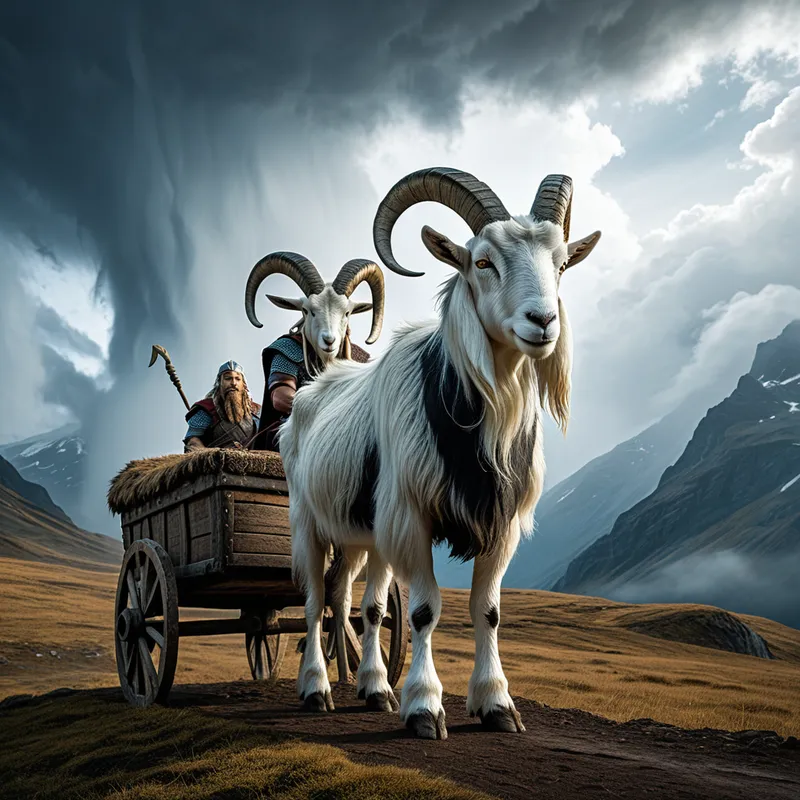
Hear now the tale of the Thunderer’s steeds, a story not of gleaming chariots but of a humble cart, and of companions who were both sustenance and salvation. In the days when Asgard’s walls stood tall and the roots of Yggdrasil drank from deep wells, the god Thor would often fare forth. Not always to battle giants, but to traverse the wild, humming Midgard, to feel the soil of the earth beneath his feet and the wind from the mountains on his face.
His chariot was not drawn by horses, but by two goats of unmatched might and spirit: Tanngrisnir and Tanngnjóstr. Their coats were the grey of gathering storms, their eyes held the sharp light of lightning before the crack of thunder, and their hooves struck sparks from the stone. They pulled his wooden cart across fjord and forest, their breath steaming in the cold air, a rumble in their throats a constant echo of their master’s domain.
On one such journey, as dusk painted the sky in bruised purples, Thor and his companion Loki found themselves far from hall or hearth. The land was barren, and their bellies growled with a hunger no godly stature could silence. Thor halted the cart in the lee of a great rock. He looked upon his goats, not with malice, but with the grim necessity of the wild.
“We must eat,” he said, his voice the low roll of distant thunder. He laid his great hands upon the heads of Tanngrisnir and Tanngnjóstr. He spoke words of thanks, of promise. Then, with the heavy finality of a falling tree, he slew them.
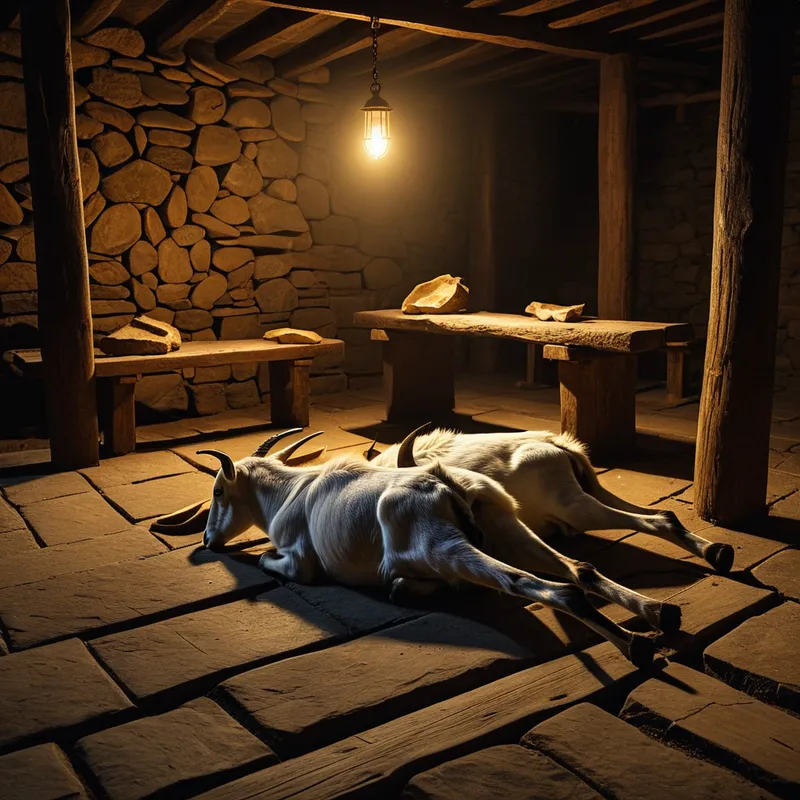
That night, in the flickering light of a meager fire, the air was rich with the scent of roasting meat. Thor and Loki feasted, consuming every morsel of the noble beasts. When the meal was done, nothing remained but clean-picked bones and the two empty hides, laid out with care upon the stony ground. Thor, his hunger sated, gathered the bones. With the reverence of a ritual, he placed every splinter and rib upon the goatskins. Then he raised his mighty hammer, Mjölnir, and held it aloft.
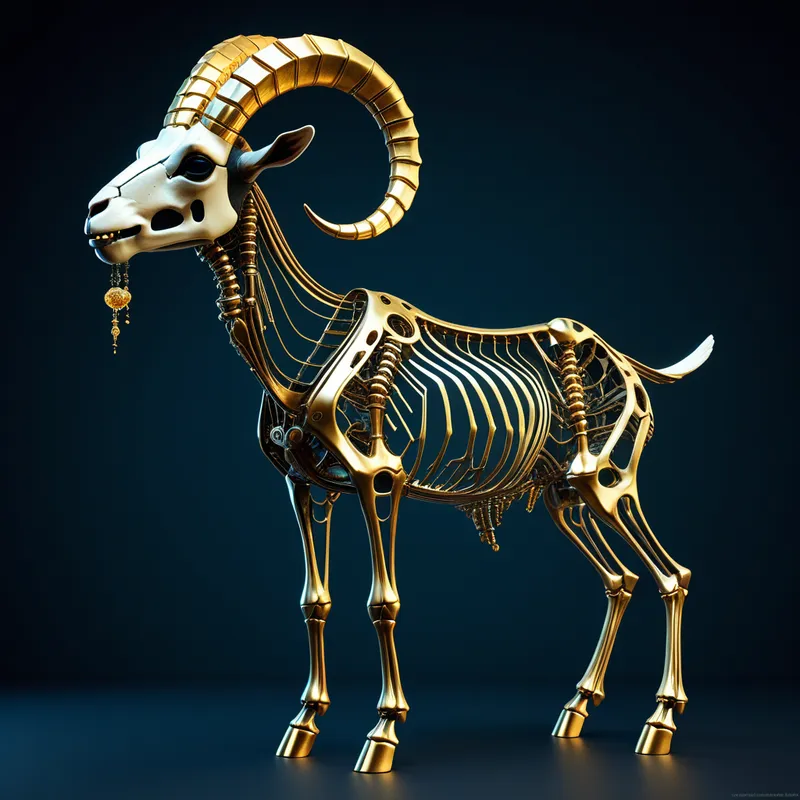
He spoke a blessing, a command woven with the primal force of creation itself. The power of the hammer, which could shatter mountains, now hummed with a different potency—the force that quickens seed in soil and pulse in vein. A light, golden and warm as a hidden sun, enveloped the bones. They trembled, clicked, and knit together. Sinew and muscle wove from nothingness, grey fur sprouted like frost on stone. And with a shuddering breath and a shake of their formidable heads, Tanngrisnir and Tanngnjóstr stood once more, whole and hale, bleating softly into the cold night. But as they stirred, Thor’s keen eye noticed a flaw. One of the goats limped, ever so slightly. A thigh bone, belonging to the quick-witted Loki, had been cracked for its marrow.
The god’s brow darkened like a tempest sky. The covenant had been broken. The magic of total renewal required total fidelity. The lesson was etched in the goat’s slight limp—a permanent mark of the transgression, a reminder that even divine cycles demand perfect respect. Yet, the miracle held. The goats lived. The journey could continue.
Cultural Origins & Context
This myth comes to us from the Poetic Edda and is recounted in detail in the Prose Edda by Snorri Sturluson. It was not a tale of grand cosmology like the forging of the world, but a traveling story, a þáttr (short narrative) told in longhouses during the dark months. Its function was multifaceted. On a literal level, it explained the awe-inspiring resource of Thor—a god who carried his own sustenance, who could never be stranded. It reinforced values of hospitality and the sacred responsibility of a guest, as the myth was often tied to stories of Thor arriving at a farmstead and providing his goats for a feast.
More deeply, it was a story of reassurance in a harsh world. For a people dependent on livestock, where the slaughter of an animal in winter was both necessary and perilous, the tale presented a divine model of the ideal cycle: use everything, waste nothing, and trust in the possibility of regeneration. It placed the act of eating within a sacred framework of death and rebirth, mediated by the holy instrument of Mjölnir. The story taught that destruction is not an end, but a phase in a greater, sustaining round—if the rules of the ritual are honored.
Symbolic Architecture
At its core, the myth of Tanngrisnir and Tanngnjóstr is a masterful symbol of the self-renewing system, the engine of life that consumes itself to fuel itself. The goats are not mere animals; they are the embodied dynamism of Thor’s power—his strength, his mobility, his vitality. To consume them is to consume one’s own resources, one’s own energy, to spend the very capital of the soul.
The most profound sustenance comes from the willing sacrifice of a part of the self. The feast is always, first, an act of self-devouring.
Psychologically, Tanngrisnir (“Snarler”) and Tanngnjóstr (“Teeth-grinder”) represent the instinctual, driving forces of the psyche—our raw vitality, our hunger, our grinding will to persist. They are the animal power that pulls the chariot of consciousness across the landscapes of our lives. The act of slaughtering them is the necessary descent, the moment of exhaustion, burnout, or conscious choice to dismantle our own driving energies. We must, at times, “kill” our own momentum to feed the needs of the present moment.
The resurrection by Mjölnir is the crucial symbol. The hammer represents the focused, transformative application of will and spiritual law. It is not passive hope that restores, but an active, disciplined blessing. The miracle is conditional: all the bones must be preserved intact. This is the law of wholeness. Every part of the experience, every “bone” of the sacrificed energy, must be honored and included for full restoration. Loki’s act of breaking the bone is the shadow—the carelessness, the greed, the failure to respect the totality of the process. The resulting limp is the psychic scar, the enduring lesson that incomplete participation in our own cycles of breakdown and renewal leaves us wounded, albeit still functional.
The Dreamer’s Resonance
When this myth stirs in the modern unconscious, it often manifests in dreams of consumption and regeneration. One might dream of eating a beloved animal or pet, followed by feelings of profound guilt and then wonder as the animal reappears, whole. Others dream of their car—a modern “goat” that provides mobility and power—breaking down completely, only to reassemble itself. Somatic sensations accompanying such dreams can include a deep, gnawing hunger in the gut, or a strange, buzzing vibration in the hands and arms, mirroring the resonant power of Mjölnir.
To dream this pattern is to be in the midst of a profound somatic and psychological process of depletion and potential rebirth. The dreamer is at the point where their accustomed energies, their “goats,” are spent. The psyche is initiating a necessary sacrifice. The anxiety in the dream is the fear that this death is permanent—that the resources will not return. The dream’s resolution (or lack thereof) shows the dreamer’s relationship to their own inner “hammer”—their faith in their capacity for self-renewal and their adherence to the inner law that demands they honor every part of their experience. A limp in the resurrected creature points to a current or past act of self-betrayal, a cutting of corners in one’s own healing process.
Alchemical Translation
In the alchemical journey of individuation, the myth maps the stage of solve et coagula—dissolve and coagulate. The individual must first dissolve the current form of their vital energy (the slaughter and consumption of the goats). This is an act of courageous self-impoverishment, willingly entering a state of need to force a transformation.
The alchemical vessel is the self. The fire is necessity. The prima materia is one’s own exhausted strength. The gold that emerges is resilience forged in the cycle of loss and return.
Thor represents the conscious ego that must administer this difficult process. It cannot be a passive collapse; it must be a ritualized, respectful act. Gathering the bones is the work of introspection and integration—ensuring no lesson, no memory, no fragment of the experience is lost or discarded. This is the meticulous work of analysis and self-honesty.
Raising Mjölnir is the application of the transcendent function, the psychic tool that reconciles opposites. Here, it reconciles death and life, consumption and creation. The modern individual’s “hammer” is their core practice, their deepest vow, their connection to meaning—that which can command rebirth from the bones of dead hopes or spent efforts.
The everlasting limp is perhaps the most human and comforting part of the allegory. The process of psychic transmutation is rarely perfect. We all have our “Loki” moments of greed, haste, or irreverence. The individuated self is not a perfectly restored, pristine entity. It is a resilient, functional whole that carries the honorable scars of its own process, a living testament to the cycles it has endured and the sacred law it strives to uphold. We are all, in a sense, Thor journeying on—accompanied by powers we must periodically consume and restore, moving forward behind goats that remember every death and every miraculous dawn.
Associated Symbols
Explore related symbols from the CaleaDream lexicon: