Tammuz Myth Meaning & Symbolism
The shepherd-god Tammuz dies, descending to the underworld, causing the world to wither until his lover's grief compels his cyclical return.
The Tale of Tammuz
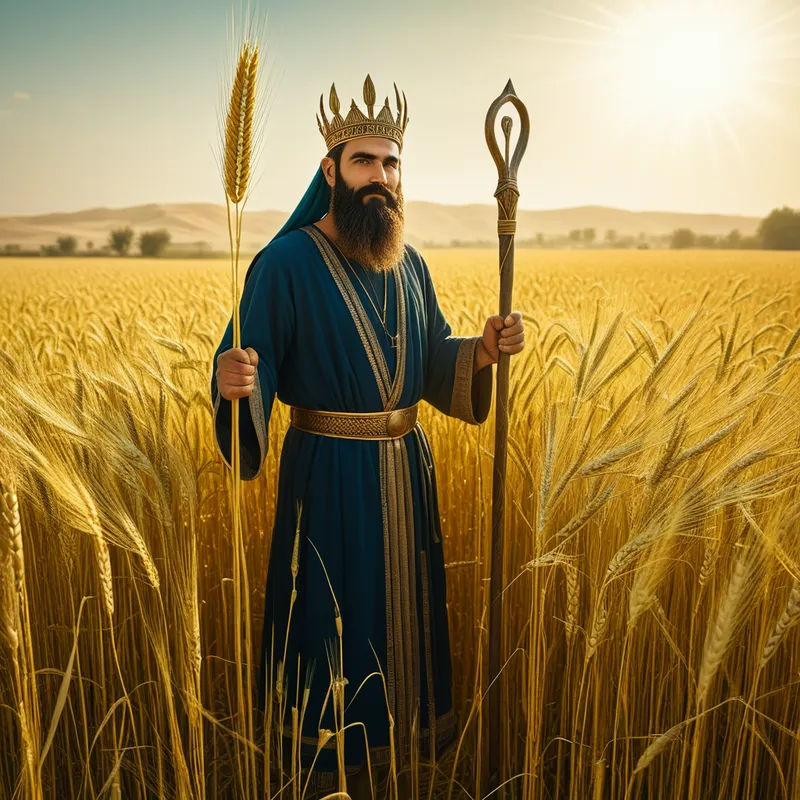
Hear now the tale of the shepherd, the beloved, the one who is taken. In the first light, when [the world](/myths/the-world “Myth from Tarot culture.”/) was green and the twin rivers sang, there lived Tammuz. His voice was the lowing of cattle, his touch the sprouting of the barley. He walked the sun-baked plains, and where his shadow fell, the lambs grew fat and the date palms bent heavy with fruit.
His heart was given to [Inanna](/myths/inanna “Myth from Sumerian culture.”/), Queen of Heaven, whose radiance outshone the stars. Their love was the storm and the calm, a force that quickened the very soil. But the gaze of [the underworld](/myths/the-underworld “Myth from Greek culture.”/) is long, and it fell upon the vibrant shepherd. The year turned, the sun grew fierce and high, and a stillness crept over the land. It was then, at the zenith of life, that [the earth](/myths/the-earth “Myth from Hindu culture.”/) cracked beneath Tammuz’s feet. Not by enemy spear or beast’s claw was he felled, but by a fate woven into the loom of existence itself. The green vitality drained from his limbs, his breath grew shallow as a summer breeze, and he was drawn down—down into the dust, into the realm of Ereshkigal, the somber queen of the Kur.
With him went the world’s breath. The rivers shrank to muddy threads. The grain in the field stood husked and pale, rattling in a hot wind. The ewes cried with empty udders. A great silence, a palpable thirst, settled over Sumer and Akkad. Inanna, clad in the robes of [the sky](/myths/the-sky “Myth from Persian culture.”/), felt the severing in her own soul. Her temples fell empty, her songs turned to laments. Her divine power meant nothing before this raw, human-shaped hole in the world. Her grief became a tempest. She cast aside her regalia and descended, step by terrible step, into the land of no return, to face her dark sister and reclaim what was lost.
In the dust-choked halls below, a bargain was struck, a balance demanded. For life above, a price must be paid below. And so it was decreed that Tammuz would dwell half the year in the embrace of the dark earth, and half in the arms of the bright sky. When the shepherd ascends, climbing from [the pit](/myths/the-pit “Myth from Christian culture.”/) as the first tender shoot forces its way through cracked clay, the world erupts. The rains come. The flocks multiply. The festivals begin with the shrill of pipes and the beat of the tigi drum. And when the sun reaches its peak and begins to wane, he turns his face again to the descent. The people beat their breasts, the wailing women sing the old songs, and the cycle turns, eternal as [the river](/myths/the-river “Myth from Buddhist culture.”/)’s flow.
Cultural Origins & Context
This is not merely a story, but a rhythm etched into the very bones of Mesopotamian civilization. The myth of Tammuz, known in later Akkadian as Dumuzid, is one of humanity’s oldest recorded narratives, appearing in Sumerian laments, hymns, and epic fragments dating back to the third millennium BCE. It was not literature for entertainment, but a sacred script performed. The ritual lamentations for his death, led by professional mourners, were a vital civic and religious duty, coinciding with the brutal, withering heat of late summer.
The myth functioned as a divine explanation for the most urgent of realities: the seasonal cycle of agriculture in an unforgiving landscape. The death of the god caused the drought; his return ensured [the flood](/myths/the-flood “Myth from Biblical culture.”/) and the subsequent harvest. It was a story told not just with words, but with the body of society—through public processions, the setting of his empty throne, and the ecstatic celebrations of his return. It gave a name, a face, and a heroic narrative to the terrifying, impersonal forces of decay and regeneration upon which all life depended.
Symbolic Architecture
Beneath the agricultural [allegory](/symbols/allegory “Symbol: A narrative device where characters, events, or settings represent abstract ideas or moral qualities, conveying deeper meanings through symbolic storytelling.”/) lies a profound symbolic [architecture](/symbols/architecture “Symbol: Architecture in dreams often signifies structure, stability, and the framing of personal identity or life’s journey.”/). Tammuz represents the embodied [spirit](/symbols/spirit “Symbol: Spirit symbolizes the essence of life, vitality, and the spiritual journey of the individual.”/) of [life](/symbols/life “Symbol: The symbol of ‘Life’ represents a journey of growth, interconnectedness, and existential meaning, encompassing both the joys and challenges that define human experience.”/) itself—not as an abstract principle, but as a vulnerable, beautiful, and ultimately mortal [presence](/symbols/presence “Symbol: Presence in dreams often signifies awareness or acknowledgment of something significant in one’s life.”/). He is the [soul](/symbols/soul “Symbol: The soul represents the essence of a person, encompassing their spirit, identity, and connection to the universe.”/) of the green world, the [anima](/symbols/anima “Symbol: The feminine archetype within the male unconscious, representing soul, creativity, and connection to the inner world.”/) mundi, which must periodically be sacrificed to the dark, [unconscious depths](/symbols/unconscious-depths “Symbol: The hidden, primordial layers of the psyche containing repressed memories, instincts, archetypes, and collective wisdom beyond conscious awareness.”/) to be renewed.
The god must die so that the grain may live; the conscious ego must yield so that the soul may be reborn.
His [relationship](/symbols/relationship “Symbol: A representation of connections we have with others in our lives, often reflecting our emotional state.”/) with Inanna is pivotal. She is not a passive [observer](/symbols/observer “Symbol: An observer represents contemplation, self-awareness, and the act of witnessing one’s experiences.”/) but the active force of [connection](/symbols/connection “Symbol: Connection symbolizes relationships, communication, and bonds among individuals.”/)—love, desire, and ultimately, [grief](/symbols/grief “Symbol: A profound emotional response to loss, often manifesting as deep sorrow, yearning, and a sense of emptiness.”/). Her descent is the [journey](/symbols/journey “Symbol: A journey in dreams typically signifies adventure, growth, or a significant life transition.”/) of the conscious, ruling principle into the [underworld](/symbols/underworld “Symbol: A symbolic journey into the unconscious, representing exploration of hidden aspects of self, transformation, or confronting repressed material.”/) of the repressed and the unknown, motivated by profound attachment. The myth suggests that renewal is not automatic; it is compelled by [the force](/myths/the-force “Myth from Science Fiction culture.”/) of feeling, by a love that refuses to let the beloved remain in darkness. The [underworld](/myths/underworld “Myth from Greek culture.”/) [queen](/symbols/queen “Symbol: A queen represents authority, power, nurturing, and femininity, often embodying leadership and responsibility.”/) Ereshkigal represents the ultimate, impersonal ground of being, the necessary counterpart to life and light. The negotiated return—the cyclical compromise—establishes the fundamental law of a [universe](/symbols/universe “Symbol: The universe symbolizes vastness, interconnectedness, and the mysteries of existence beyond the individual self.”/) in [flux](/symbols/flux “Symbol: A state of continuous change, instability, or flow, often representing the impermanent nature of existence and experience.”/), where wholeness requires an [acceptance](/symbols/acceptance “Symbol: The experience of being welcomed, approved, or integrated into a group or situation, often involving validation of one’s identity or actions.”/) of both phases.
The Dreamer’s Resonance
When this myth stirs in the modern dreamer, it rarely appears as a Mesopotamian tableau. Instead, it manifests as the somatic and emotional pattern of the Tammuz cycle. You may dream of a vibrant, creative project that suddenly withers and dies, leaving you in a psychic drought. You may dream of a loved one—or a younger, more vital version of yourself—being pulled into a cave, a basement, or a deep body of [water](/myths/water “Myth from Chinese culture.”/). The dominant feeling is one of fruitless searching and inconsolable grief.
This is the [psyche](/myths/psyche “Myth from Greek culture.”/) signaling a necessary descent. The “Tammuz” in your dream is whatever life-giving energy—a relationship, a passion, an identity—has become exhausted and must retreat into the unconscious (Kur) for a period of gestation. The “Inanna grief” you feel is [the ego](/myths/the-ego “Myth from Jungian culture.”/)’s painful but crucial recognition of this loss. The dream is an invitation to honor that grief, to follow it down, rather than to frantically seek a premature, surface-level revival. It is the body-mind preparing for a period of fallowness, which is the prerequisite for an authentic return.
Alchemical Translation
For the individual on the path of individuation, the Tammuz myth models the alchemy of sacrificial renewal. The first, often unconscious, stage is the “death”: the burnout of a [persona](/myths/persona “Myth from Greek culture.”/), the end of a life chapter, the depression that follows expended effort. This feels like a cruel fate, a descent into aridity.
The conscious work begins with the “Inanna phase”—the courageous descent into one’s own grief, anger, and shadow material to confront the Ereshkigal within. This is shadow-work. It is sitting in the dust of your own underworld, stripped of status and certainty.
The bargain struck in the underworld is the psyche’s hard-won wisdom: to live fully, one must consent to periodic dissolution.
The return is not to the old state, but as a transmuted self. The “Tammuz” that rises is the same life-force, but now tempered by the knowledge of the dark. It carries the memory of the Kur within it. This cycle becomes an internal rhythm, moving between engagement and retreat, expression and reflection, summer and winter of the soul. The goal is not to avoid the descent, but to trust its place in the great, turning wheel of becoming, finding that our deepest losses are often the dark soil from which our most authentic life can grow.
Associated Symbols
Explore related symbols from the CaleaDream lexicon: