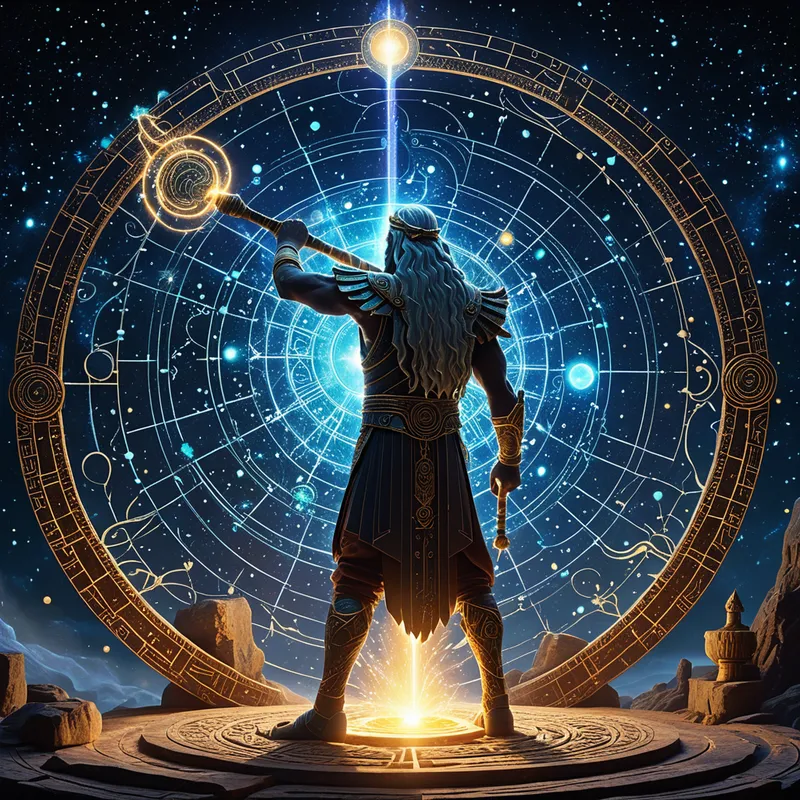
Talisman Myth Meaning & Symbolism
A mythic journey where a fractured soul, guided by forgotten gods, forges a sacred object from the world's chaos, restoring balance within and without.
The Tale of Talisman
Listen, and let the fire’s crackle carry you back. Before cities, before names for all things, the world was a song of raw elements—a chorus of stone, wind, water, and root. But the melody was fraying. The heart of the world, the great Axis Mundi, had grown silent. Its silence bred a dissonance: rivers forgot their courses, seasons bled into one another, and in the hearts of people, a great scattering occurred. The soul, once a single flame, was now a handful of scattered, guttering sparks.
Into this age of the great forgetting walked a figure known only as the Seeker. They were not born a hero, but were made by the ache of the world. Their own mind was a reflection of the outer chaos—a landscape of fragmented memories, conflicting desires, and a deep, echoing loneliness where a center should have been. Driven by an insatiable yearning for a sound they had never heard, the Seeker left the murmuring villages and walked into the throat of the wild.
Their journey was a descent through the layers of the world. They crossed the Desert of Certainty, where the sun bleached all questions white. They forded the River of Murmurs, whose waters whispered every fear they had ever swallowed. In the Forest of Roots and Shadows, they were stripped of their old name, their old story. They were reduced to essence: a being of pure need.
At the nadir of their strength, at a place where three ancient trees grew as one, the Seeker collapsed. It was here, in the humus of their own despair, that the guides appeared. Not as gods in splendor, but as presences in the periphery: the Stone-Bear, whose slow breath spoke of patience; the Sky-Hawk, whose circling gaze saw patterns in the chaos; and the River-Serpent, whose coiled form held the secret of endless change. They did not speak in words, but in impulses—a nudge to pick up a strangely warm river stone, a flash of light on a shard of obsidian, a single, perfect feather drifting against the wind.
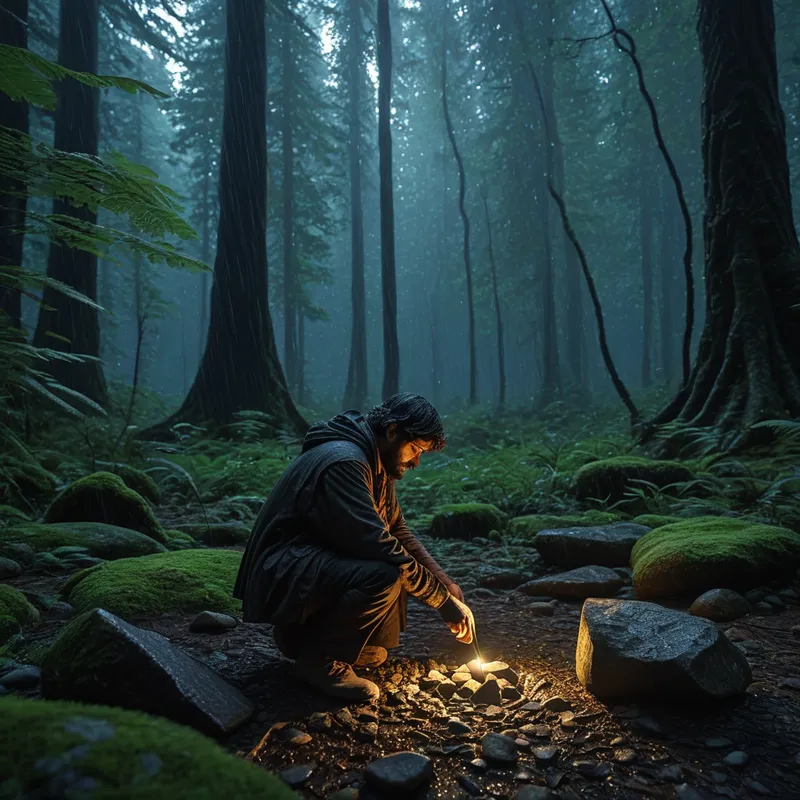
Guided by this silent council, the Seeker gathered. Not with a plan, but with a deep, somatic obedience. A piece of star-fallen iron, a tear of tree resin, a handful of sacred clay from the riverbank. At the dark of the moon, under a sky veiled in cloud, they built a small, crude forge from the stones of the place. They had no hammer but a smooth, heavy rock; no bellows but their own breath. One by one, they offered the gathered fragments to the fire. They did not force. They witnessed. They saw the iron weep, the resin bleed gold, the clay harden into a vessel.
For three nights they tended, and on the dawn of the fourth, as the first light touched the mist, they reached into the ashes. There, cool to the touch, lay an object. It was not beautiful by any craft they knew. It was asymmetrical, fused, strange. It held the grey of the stone, the sheen of the obsidian, the warmth of the iron, the memory of the feather’s curve. It was a whole made of fragments. As their fingers closed around it, a vibration passed through the ground. The Seeker felt a corresponding click within their own chest. The scattered sparks of their soul drew in, not to a single point, but into a constellation. The inner chaos became a patterned dance. And from that still point within them, they heard it—the low, resonant hum of the Axis Mundi, singing once more. They had not found a talisman. They had become the crucible, and in forging one, had reforged themselves.
Cultural Origins & Context
The myth of the Talisman is not the property of any single culture, but a psychic pattern that has emerged, in countless variations, wherever humans have confronted the fundamental problem of fragmentation. We find its echoes in the Nkisi figures of the Congo basin, vessels packed with sacred materials to bind spiritual forces; in the Medicine Bundles of the Plains peoples, personal collections of power objects; in the Hirz of the Islamic world; and in the Consecrated Tool of Western esotericism.
This story was never just a fireside tale. It was a living map, transmitted through ritual, craft, and initiation. It was told by shamans to initiates undergoing vision quests, by metalworkers to apprentices learning to coax spirit from ore, and by elders to those lost in grief or confusion. Its societal function was profoundly therapeutic and cosmological. It provided a narrative for the process of integration—of healing the rift between the individual and the community, the human and the natural world, the conscious mind and the unruly depths of the soul. The myth taught that order is not imposed from above, but assembled from below, from the raw, often broken materials of direct experience.
Symbolic Architecture
At its core, the Talisman myth is a master metaphor for the psyche’s journey toward wholeness, or what Carl Jung termed Individuation. The fractured world is the fragmented Self. The silent Axis Mundi represents the dormant connection to the central, organizing principle of the psyche—the Self.
The Seeker is the conscious ego, initially identified with its own chaos, yet possessing a nascent, compelling urge toward coherence. The journey through desert, river, and forest is the necessary nekyia, the descent into the unconscious. This is not a battle but a dissolution; the ego must be humbled, its certainty stripped away, to become receptive.
The true talisman is not found, but forged in the meeting place between intention and surrender.
The animal guides—Stone-Bear, Sky-Hawk, River-Serpent—are emissaries of the instinctual, unconscious Self. They represent the somatic intelligence, the transcendent function, and the transformative energy that guide the process when the ego relinquishes control. The gathered fragments are the contents of the personal and collective unconscious: traumas (the shard), instincts (the stone), aspirations (the feather), ancestral wisdom (the resin)—all the “useless” or painful parts of one’s history.
The forge is the crucible of the heart, the vessel of intense psychic suffering and focus. The act of forging is the coniunctio oppositorum, the sacred marriage of opposites within the soul. The resulting Talisman symbolizes the newly formed Self—not a perfect, static icon, but a unique, living synthesis of one’s total experience. It is the psychic organ that re-tunes the individual to the fundamental order of existence.
The Dreamer’s Resonance
When this myth activates in the modern dreamscape, it signals a critical phase of psychic integration. The dreamer may find themselves in a cluttered, chaotic room (the fragmented psyche), desperately searching for a lost key or a specific object. They might dream of painstakingly assembling a machine from mismatched parts, or of gathering seemingly worthless trinkets that feel intensely significant.
Somatically, this process often correlates with a felt sense of being “scattered,” ungrounded, or pulled in too many directions. There may be anxiety, a low-grade depression stemming from a lack of inner cohesion, or physical symptoms of stress as the unconscious pressures for integration mount. The dream is the psyche’s attempt to initiate the ritual that waking life has forgotten. It is presenting the task: to stop seeking salvation externally, and to begin the humble, attentive work of gathering and honoring the disparate parts of oneself. The profound feeling upon waking, if the dream is potent, is not of finding, but of having a task—a sacred, personal labor to perform.
Alchemical Translation
For the modern individual, the myth of the Talisman models the alchemical opus of psychic transmutation. Our culture offers endless prefabricated identities (the “perfect” talisman for sale), but the myth insists the true work is opus contra naturam—a work against our learned nature of dissociation. It demands we become our own alchemist.
The first stage, nigredo, is embodied by the Seeker’s despair and the world’s chaos—the acknowledgment of inner darkness, conflict, and fragmentation. This is the essential, painful starting point of any real growth. The gathering of fragments is the albedo, the washing and conscious collection of what has been repressed, rejected, or ignored in ourselves. This requires brutal honesty and gentle curiosity.
Individuation is the craft of making a soul from the shards of a life.
The forge represents the rubedo, the fiery engagement where these collected elements are subjected to the heat of conscious attention and emotional truth. This is the therapy session, the creative act, the meditative vigil, the heartfelt conversation where raw material is transformed. The final act, the retrieval of the cooled Talisman, is the citrinitas, the dawn of a new, integrated consciousness. The ego, now in service to the larger Self, becomes the steward of this inner talisman. It is not that life’s conflicts cease, but that one now possesses an internal, resonant object—a centered, cohesive Self—that can hold the tension of opposites and translate chaos back into a personal, meaningful song. The myth concludes not with the hero saving the world, but with the world’s harmony restored because the hero has first undertaken the sacred craft of saving their own soul from disintegration.
Associated Symbols
Explore related symbols from the CaleaDream lexicon: