Taketori Monogatari Myth Meaning & Symbolism
An old bamboo cutter finds a radiant girl inside a glowing stalk, raising her as his daughter, only to discover she is a celestial being destined to return to the moon.
The Tale of Taketori Monogatari
Listen, and hear a tale not of gods and monsters, but of light found in the humble earth, and of a heart divided between heaven and home.
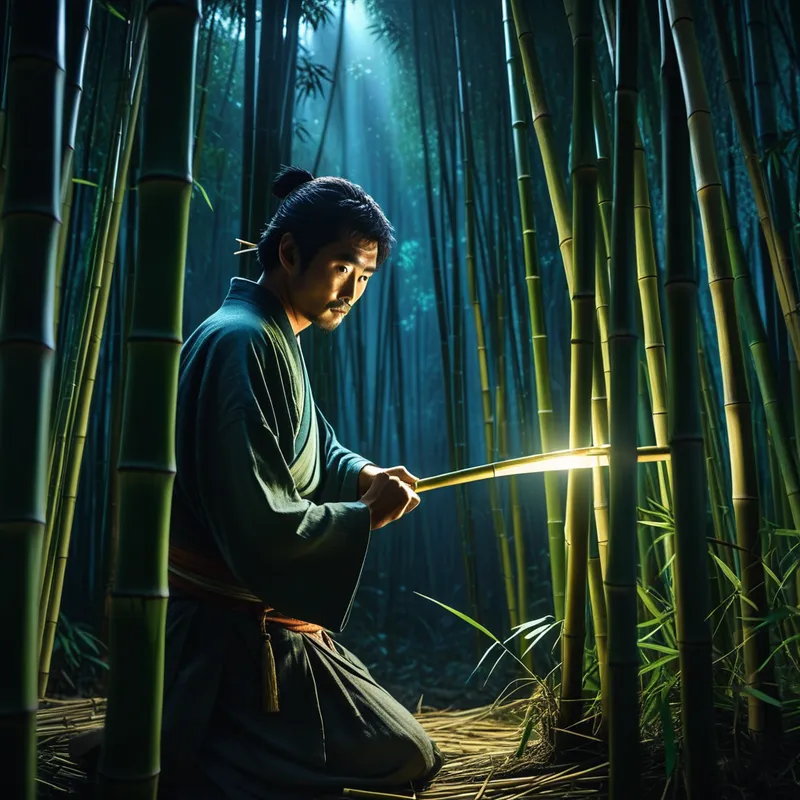
In a time when the world was closer to the spirit realms, there lived an old bamboo cutter, Sanuki no Miyatsuko. His life was simple, his back bent from years of harvesting the tall, whispering stalks. One day, while working in a grove silvered by dawn, he saw a stalk glowing with an inner light, as if it had swallowed a piece of the moon. With a trembling hand, he cut it open. Inside, no pith or fiber, but a tiny, perfect girl, no taller than his thumb, radiant as a pearl. He gathered her, this miraculous child, and carried her home to his wife. They named her Nayotake no Kaguya-hime, the Shining Princess of the Supple Bamboo.
From that day, the old man’s fortunes changed. Every bamboo stalk he cut thereafter held a nugget of gold. He grew wealthy, but his true treasure was the girl, who grew not as mortals do, but swiftly, unfolding into a woman of such breathtaking beauty that her presence seemed to purify the very air. Her fame spread across the land, reaching the ears of powerful men. Five noble suitors arrived, each determined to win her hand. But Kaguya-hime, her spirit touched by melancholy, set them impossible tasks: fetch the stone begging bowl of the Buddha, bring a branch from the jeweled tree of Penglai, procure the legendary fire-rat’s pelt, secure a jewel from a dragon’s neck, find the easy-birth charm shell of the swallow.
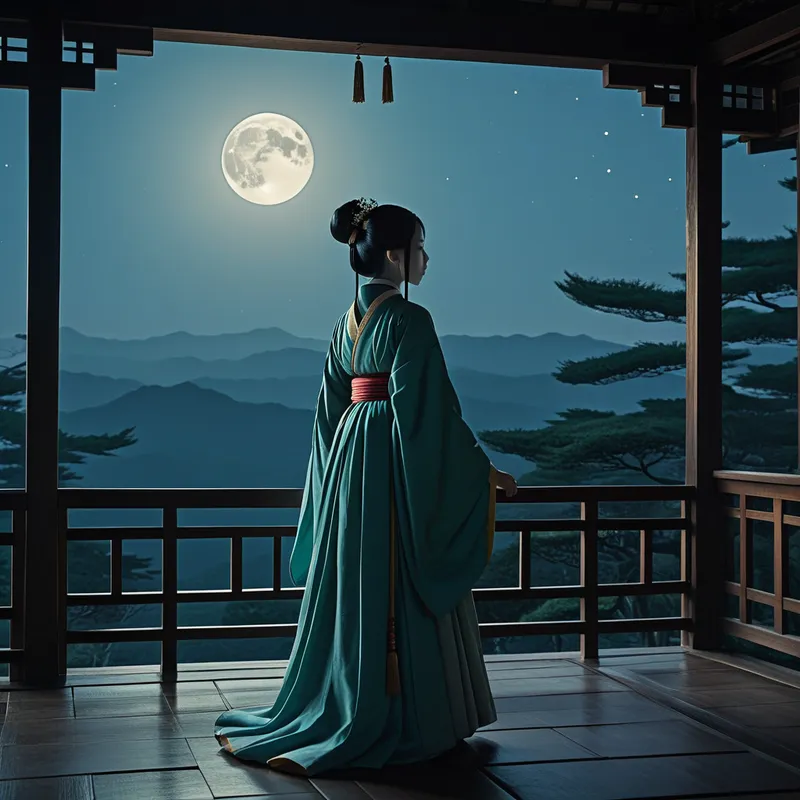
The suitors, in their pride and desperation, returned with forgeries and lies, or met with ruin. Even the Mikado himself, captivated by her, could not sway her heart. For in the deep watches of the night, she would sit on her veranda and weep, gazing at the full moon with an inconsolable longing that her earthly parents could not fathom.
Then came the fateful night. The full moon of the eighth month hung heavy and vast. A celestial procession descended from its silver face—beings of light in robes of cloud, riding in a chariot that floated on mist. They came for her. The truth, held in her heart like a secret wound, was revealed: she was a being of the Moon Capital, sent to this rough world as a temporary exile. Her time was over. The debt of her earthly life, the kindness of her parents, was paid with the gold in the bamboo. She must return, and to return, she must drink the Elixir of Forgetfulness and don the Feather Robe of Forgetfulness.
Her parents clung to her, weeping. Kaguya-hime, her own tears falling, wrote a final letter of love and apology to the Emperor. She gave the Elixir, which grants immortality—the very thing she now rejected—to the old man to deliver. Then, as the feather robe was placed upon her shoulders, all memory of her earthly sorrow, her love, her longing, faded from her eyes, leaving only serene, celestial detachment. She ascended into the chariot, and the procession withdrew into the moon, leaving the old couple prostrate on the earth, clutching at empty moonlight.
Cultural Origins & Context
Taketori Monogatari, “The Tale of the Bamboo Cutter,” is considered the oldest extant monogatari in Japanese literature, dating from the late 9th or early 10th century during the Heian period. It emerged in a culture deeply influenced by imported Chinese cosmology and Buddhism, yet rooted in native Shinto animism, which saw spirit (kami) in natural phenomena like bamboo, mountains, and the moon.
The tale was not a religious scripture but a piece of courtly literature, likely composed by an anonymous aristocrat. It was a story to be read aloud, a sophisticated entertainment that also served a profound societal function. In an era where political marriages were the norm, Kaguya-hime’s defiant rejection of the most powerful suitors, even the Emperor, presented a radical fantasy of autonomy. The story also reflects the Buddhist themes of mujo (impermanence) and the inherent sorrow of attachment to the transient world. It is a foundational text, a narrative seed from which much of Japan’s later literary fascination with melancholy beauty (mono no aware) and otherworldly visitors would grow.
Symbolic Architecture
At its core, the myth is not about a princess but about the human encounter with the numinous—the utterly Other that enters our ordinary world. Kaguya-hime is the archetypal Self symbol, a fragment of wholeness and perfection that manifests within the mundane (the bamboo grove, the family home). Her presence transforms reality, bringing both blessing (gold) and unbearable psychic tension.
The celestial being in the earthly home is the soul’s recognition of its own alienation, its sense of being a stranger in a familiar land.
The five impossible tasks represent the ego’s futile attempts to possess, categorize, or materially secure the transcendent. The suitors fail because the Self cannot be won by worldly striving or cleverness. The Emperor represents secular, temporal authority, which is also ultimately powerless before the call of the transcendent. The true conflict is internal: Kaguya-hime’s longing for the moon is the psyche’s pull toward its origin, a homesickness for a state of pre-conscious unity. The earthly family represents the attachments of the personal complex—love, duty, identity—that bind the soul to individual life.
The most potent symbol is the Feather Robe of Forgetfulness. It is the price of return to undifferentiated wholeness: the complete dissolution of the individual ego and its accumulated experiences, loves, and sorrows. It is the ultimate, terrifying symbol of psychic integration that demands annihilation of the conscious personality.

The Dreamer’s Resonance
When this myth patterns a modern dream, the dreamer is navigating a profound crisis of belonging and identity. To dream of finding a radiant child or precious object in a mundane place (an office, a basement, a field) signals the emergence of a new potential, a nascent Self, often following a period of humble, diligent work (the bamboo cutting).
Dreams of being an alien or a visitor from another world, feeling profoundly out of place despite a comfortable life, resonate with Kaguya-hime’s melancholy. The dreamer may be processing a sense that their current identity is a costume, that a deeper, more essential self is calling from a “place” they cannot name—often related to vocation, spirituality, or authentic purpose.
The climactic dream of being forcibly taken away, or of having to leave loved ones behind for a distant, luminous destination, points to an active, often painful, process of individuation. The psyche is preparing to sacrifice old attachments and identities (the family, the suitors’ offers) to answer a non-negotiable call from the unconscious. The somatic experience is often one of deep grief mixed with a strange, irresistible pull—a heart tearing in two directions.
Alchemical Translation
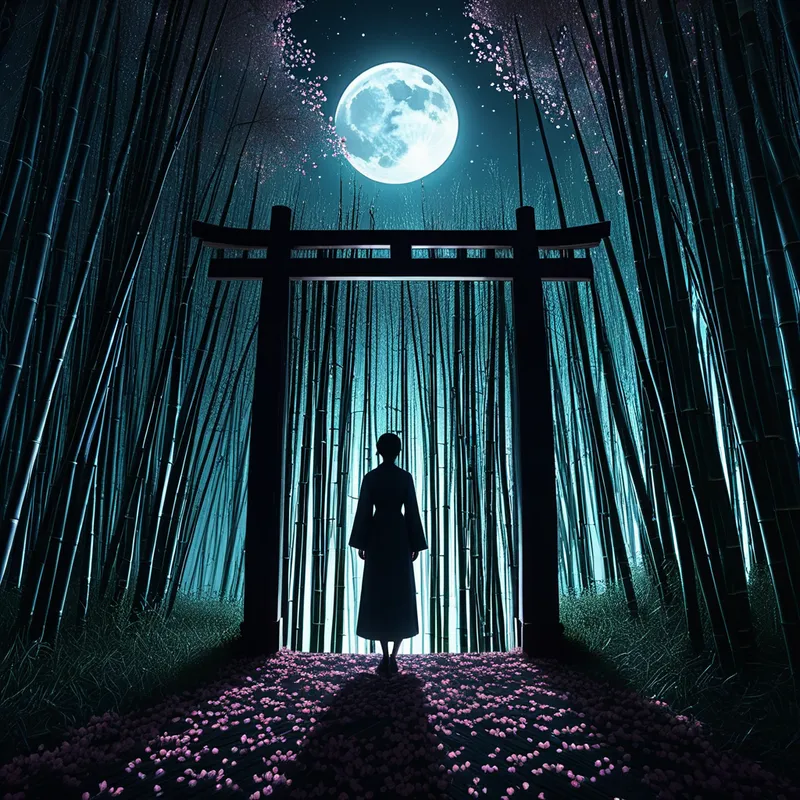
The alchemy of Taketori Monogatari models the most sacred and sorrowful of psychic operations: the conscious sacrifice of the ego to the greater Self. The process begins with the opus of the humble life (the bamboo cutter’s labor), which prepares the vessel to receive the divine spark. The emergence of Kaguya-hime is the albedo, the whitening—the shocking illumination of consciousness by a truth too beautiful and too terrible to integrate.
The years of her growth represent the citrinitas, the yellowing, where the ego builds a life around this numinous presence, enjoying its blessings (the gold) but also suffering the tension it creates. The failed suitors are the ego’s last, grand attempts at inflation, to claim the treasure as its own achievement. Their defeat is a necessary humiliation, a stripping away of false solutions.
The final return to the moon is not a failure, but the rubedo—the reddening. It is the culmination achieved through the sacrifice of what is most loved: the personal, earthly identity.
For the modern individual, this myth does not counsel abandonment of life, but the conscious embrace of impermanence and the acknowledgment of a transcendent value. The “Elixir of Forgetfulness” we must refuse to drink is the temptation to numb ourselves to the pain of growth, to retreat into spiritual bypass or unconsciousness. Instead, we are to be like the old bamboo cutter at the end: heartbroken, grounded on Earth, holding the impossible gift (the Elixir) that connects heaven and earth. Our task is to bear the memory of the encounter, to live with the enduring longing (natsukashisa) for that lost wholeness, and to let that longing, not its fulfillment, guide and deepen our humanity. We become the bridge between realms, forever changed by a beauty we could not keep.
Associated Symbols
Explore related symbols from the CaleaDream lexicon: