Tahmuras the Demon Binder Myth Meaning & Symbolism
The myth of the Shah who subdued the Divs, not by destroying them, but by harnessing their power for civilization.
The Tale of Tahmuras the Demon Binder
Listen, and hear the tale from the time when the world was still half-formed, when the whispers of the Divs rustled in the wilderness and the works of men were fragile things.
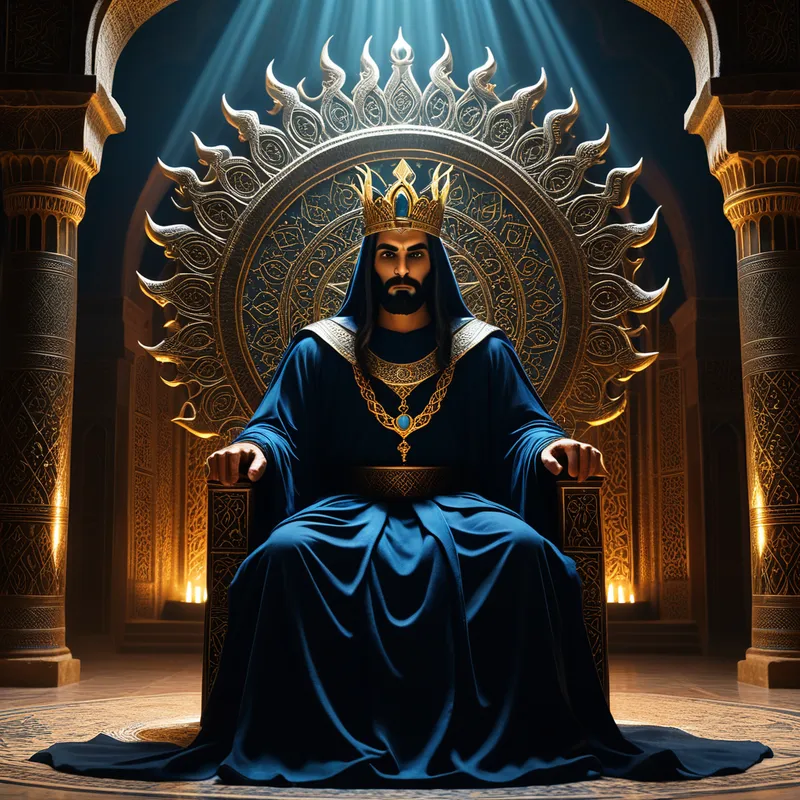
After the great flood, when the first kings walked the earth, there came a Shah named Tahmuras, son of Hushang. He was a ruler of keen mind and a spirit that burned not just with courage, but with a profound curiosity. In his time, the Divs, the brood of Ahriman, did not merely haunt the edges of the world; they strode into its heart. They brought not just fear, but a deeper blight—a chaos that unraveled thought, that turned language to babble, craft to ruin, and fellowship to suspicion. The land groaned under their shadow.
Tahmuras looked upon his people, huddled and fearful, their fields untilled and their fires low. He knew that to fight the Divs with mere sword and shield was to fight the sea with a cup. Their power was of a different order—a power of illusion, of subtle corruption, of the unmaking of order itself. So he turned not to the armory, but to the sacred word. He sought the wisdom of the Amesha Spentas, and through fasting, prayer, and relentless inquiry, he was gifted a knowledge more potent than any blade: the secret of the True Name, and the art of binding.
Armed with this sacred knowledge, Tahmuras did not march to war. He went into the wild places, into the deep caves where the earth’s breath was cold, and onto the wind-scoured plains where nothing grew. There, he called them. He did not shout challenges; he spoke the hidden syllables of their essence, the true names that were the architecture of their being. One by one, the Divs came—not in submission, but in furious, compelled attendance. They swirled around him, a storm of fang and shadow, of terrifying visage and deafening roar, seeking to break his will with fear.
But Tahmuras stood firm, a still point in the chaos. He spoke the words of binding, weaving a net not of rope, but of meaning and command. The furious storms condensed into forms. The howls resolved into voices that could be understood. He bound them, not in chains of iron, but in covenants of purpose. “You who unravel,” he declared, his voice echoing with authority, “shall now weave. You who corrupt language shall teach its secrets. You who break shall now build.”
And so it was. The demon who muddled thought was set to teach the art of writing. The demon who twisted speech was compelled to reveal the hidden roots of language. Others were bound to impart the crafts of dyeing cloth, of mining gems from the deep earth, of building with stone and timber. The very forces of chaos were harnessed and turned to the service of Asha—Order. Tahmuras did not destroy his enemies; he educated them. He became known not as Tahmuras the Demon-Slayer, but as Dīvband, the Binder of Demons, and his reign was the dawn of civilization.
Cultural Origins & Context
This myth is preserved in the foundational text of Persian epic poetry, the Shahnameh (“The Book of Kings”) written by the poet Ferdowsi in the 10th century CE. Ferdowsi drew upon much older Zoroastrian mythological and historical traditions, compiling and poeticizing stories that had been passed down orally for millennia. In the Zoroastrian cosmological struggle between the forces of light, order, and truth ([Ahura Mazda](/myths/ahura-mazda “Myth from Persian culture.”/)) and the forces of darkness, chaos, and falsehood (Angra Mainyu or Ahriman), the Divs are the malignant offspring of the latter.
The societal function of this myth is profound. It is not merely a fantastical story of a hero, but a charter myth for civilization itself. It answers the question: how did humanity move from a state of primal fear and vulnerability to one of culture, art, and technology? The answer provided is not a gift from the gods alone, but the active, courageous, and intelligent engagement of a human king with the very sources of chaos. It legitimizes kingship as a role requiring spiritual and intellectual mastery, not just martial prowess. The myth was told to inspire rulers to be wise and transformative, and to remind the people that the foundations of their culture—writing, craft, language—were won through a heroic act of psychic integration.
Symbolic Architecture
At its core, the myth of Tahmuras is a masterclass in the [psychology](/symbols/psychology “Symbol: Psychology in dreams often represents the exploration of the self, the subconscious mind, and emotional conflicts.”/) of [integration](/symbols/integration “Symbol: The process of unifying disparate parts of the self or experience into a cohesive whole, often representing psychological wholeness or resolution of internal conflict.”/). The Divs represent the unintegrated contents of the personal and collective [shadow](/symbols/shadow “Symbol: The ‘shadow’ embodies the unconscious, repressed aspects of the self and often represents fears or hidden emotions.”/)—the chaotic, disruptive, feared, and rejected aspects of the psyche. These are not just personal failings, but archetypal forces of raw creativity, instinctual power, and amoral [energy](/symbols/energy “Symbol: Energy symbolizes vitality, motivation, and the drive that fuels actions and ambitions.”/) that, left unconscious, act out destructively.
The true hero does not annihilate the monster; he discovers its true name and gives it a sacred task.
Tahmuras’s [journey](/symbols/journey “Symbol: A journey in dreams typically signifies adventure, growth, or a significant life transition.”/) is the journey of [consciousness](/symbols/consciousness “Symbol: Consciousness represents the state of awareness and perception, encompassing thoughts, feelings, and experiences.”/) facing the unconscious. His tools—the “True Name” and the “art of binding”—symbolize the power of conscious understanding and intentionality. To know the true name of something is to comprehend its essential [nature](/symbols/nature “Symbol: Nature symbolizes growth, connectivity, and the primal forces of existence.”/), to see past its terrifying [projection](/symbols/projection “Symbol: The unconscious act of attributing one’s own internal qualities, emotions, or shadow aspects onto external entities, people, or situations.”/). Binding is the act of relating to that energy, of forming a conscious [relationship](/symbols/relationship “Symbol: A representation of connections we have with others in our lives, often reflecting our emotional state.”/) with it, rather than being possessed by it or repressing it. The transformation of demons into teachers is the alchemical goal: the prima materia of [chaos](/symbols/chaos “Symbol: In Arts & Music, chaos represents raw creative potential, uncontrolled expression, and the breakdown of order to forge new artistic forms.”/) is transmuted into the gold of cultural and psychological [achievement](/symbols/achievement “Symbol: Symbolizes success, mastery, or reaching a goal, often reflecting personal validation, social recognition, or overcoming challenges.”/). The myth posits that our greatest gifts—[language](/symbols/language “Symbol: Language symbolizes communication, understanding, and the complexities of expressing thoughts and emotions.”/), art, technology—are born from the conscious harnessing of our most primal and potentially destructive energies.
The Dreamer’s Resonance
When this myth stirs in the modern psyche, it often manifests in dreams of confronting chaotic, overwhelming, or “demonic” forces. This could be a dream of being pursued by shadowy figures, of a workplace or home descending into inexplicable disorder, or of a terrifying entity that cannot be outrun. The somatic feeling is one of dread and paralysis. The Tahmuras pattern emerges not in the content of the fear, but in the dream’s turning point.
The dreamer may find themselves stopping, turning to face the chaos, and beginning to speak to it, or to name its components. They might pick up a book, a pen, or a tool. This is the psyche’s innate intelligence attempting the binding. The process is one of moving from a somatic state of panic (sympathetic nervous system overload) to one of focused engagement (the executive function of the prefrontal cortex). The dream signals that a previously autonomous complex—a bundle of rage, shame, creative blockage, or instinctual energy—is ripe for integration. It is no longer content to merely haunt; it demands to be seen, named, and given a function within the larger economy of the self.

Alchemical Translation
For the individual on the path of individuation, Tahmuras provides a precise model for psychic transmutation. The first step is Confrontation: one must consciously acknowledge the existence of an inner “demon”—a pattern of addiction, a burst of irrational rage, a debilitating anxiety, or a creative force that feels too wild to control. The temptation is to slay it (repression) or be slain by it (possession).
The second, crucial step is Naming: This is the deep, non-judgmental inquiry. What is this, really? When did it first appear? What need does it represent? What power is locked within its chaotic form? This is the search for the “True Name,” the core truth of the complex.
The final, transformative step is Binding and Re-purposing: This is the active work of integration. The rage, once named as a response to powerlessness, can be bound into the service of setting firm boundaries. The chaotic creative energy, once understood as a fear of judgment, can be bound into a disciplined artistic practice. The addictive pattern, seen as a quest for numbness, can be redirected into a pursuit of authentic connection or spiritual depth.
Individuation is the civilizing of the inner wilderness. We do not exile our demons; we appoint them as ministers in the kingdom of the self.
The myth assures us that our darkest, most chaotic elements hold the very secrets to our advancement. The goal is not a sterile peace, but a dynamic, creative order built upon a conscious relationship with the full spectrum of our being. Tahmuras teaches that our sovereignty is earned not by the absence of inner conflict, but by the wisdom to enlist all our forces in the great work of becoming whole.
Associated Symbols
Explore related symbols from the CaleaDream lexicon:
- Demon — The personified force of chaos, the unintegrated shadow content of the psyche that must be confronted and related to, not destroyed.
- Order — The divine principle of Asha that Tahmuras serves, representing the conscious structure and meaning imposed upon primal chaos.
- Language — The primary tool of the binding; the sacred art taught by the bound demons, symbolizing the power of conscious articulation to shape reality and integrate the unknown.
- Hero — Not as a warrior of destruction, but as a sovereign of integration, whose courage lies in facing the unknown with wisdom and transformative purpose.
- Shadow — The collective term for the repressed, feared, or demonic aspects within, which Tahmuras courageously brings into the light of consciousness.
- Key — The secret knowledge or “True Name” that unlocks the nature of the demon, allowing for its transformation from adversary to ally.
- Craft — The tangible outcome of the binding; the civilized arts and skills that arise when chaotic energy is harnessed and directed with intention.
- Chaos — The raw, undifferentiated primal state, the necessary raw material from which all creative order is forged through the heroic act of binding.
- Mastery — The achieved state of Tahmuras, representing not domination over others, but sovereign self-command and the ability to orchestrate inner forces.
- Stone — The foundational material of civilization, worked by the harnessed demons, symbolizing the enduring structures we build from integrated psychic material.
- Light — The illuminating power of consciousness and sacred knowledge that Tahmuras wields, allowing him to see and name what was once only fearful darkness.