
Sylph Myth Meaning & Symbolism
The story of the Sylph, a being of pure air, embodying the soul's struggle for liberation from earthly bonds to achieve a higher state of consciousness.
The Tale of Sylph
Listen, and let [the wind](/myths/the-wind “Myth from Various culture.”/) carry you to a time before machines, when [the world](/myths/the-world “Myth from Tarot culture.”/) was a conversation of elements. In the high, lonely towers where stone meets sky, the seekers of the hidden fire labored. Their crucibles bubbled with the secrets of earth and [water](/myths/water “Myth from Chinese culture.”/), their furnaces roared with [the passion](/myths/the-passion “Myth from Christian culture.”/) of flame. But one secret remained elusive, dancing just beyond the soot-stained glass: the secret of the Air.
Her name was not spoken, for she had no name that human tongue could hold. She was the sigh between thoughts, the chill on a sunlit peak, the invisible hand that turns the weathervane. The alchemists called her Sylph. She was not born; she coalesced from the longing of the atmosphere itself, a daughter of emptiness and potential. Her realm was the liminal space—the mountain pass where eagles cry, the silent eye of the hurricane, the cold, thin air where breath becomes prayer.
For ages, she danced her solitary dance, weaving clouds and scattering seeds, untouched and untouchable. Below, in the realm of Gnomes and Undines, a great heaviness had settled. The human soul, it was said, had grown dense, shackled by melancholy and the gross mud of matter. It could no longer remember flight. A whisper traveled on the storm: only the essence of the Sylph, the [quintessence](/myths/quintessence “Myth from Alchemical culture.”/) of air, could refine the soul’s leaden weight into spiritual gold.
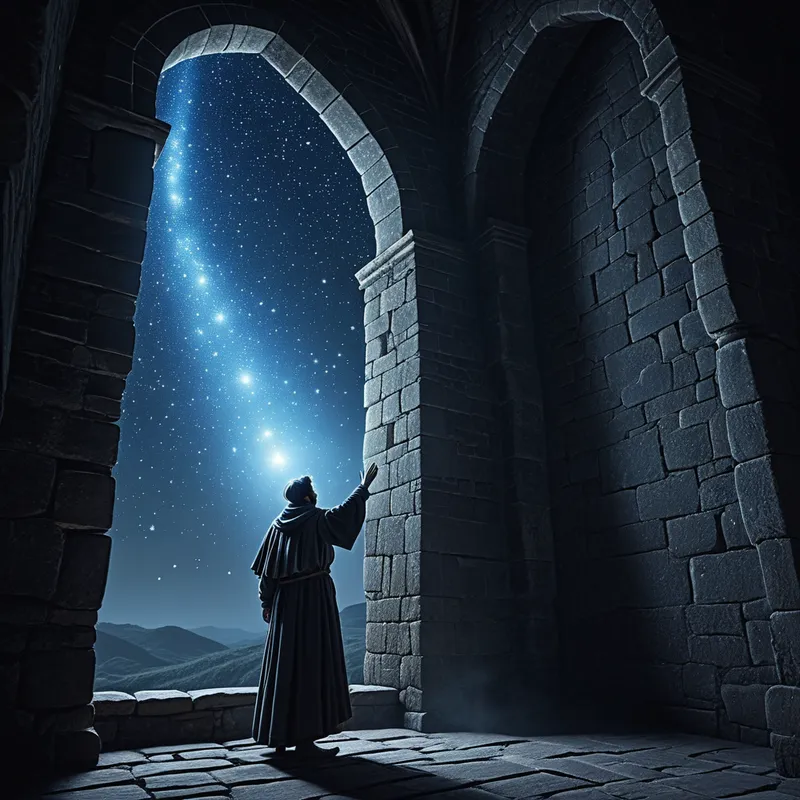
The greatest of the seekers, a man with eyes like twilight, heard this whisper. He forsook the common pursuits of gold-making. Instead, he sought to court the intangible. He climbed to where the world fell away, to a tower lashed by eternal winds. There, he did not work with fire or alembic. He worked with silence. He stilled his churning mind, his earthly desires, his very breath, until his own spirit became a vessel of quiet anticipation.
For years, he was a statue in the gale, a folly to the world below. Then, on a night when [the moon](/myths/the-moon “Myth from Tarot culture.”/) was a sliver and the stars were icy pinpricks, she came. Not with a roar, but with a cessation. The wind died. The cold became absolute and clear. And in that pristine stillness, a form shimmered into being—not a body, but a suggestion of one, woven from moonglow and the memory of birdsong. She was terrible in her beauty, for her gaze saw not his flesh, but the turbulence of his soul: his pride, his fear, his clinging to name and form.
The conflict was not of clashing swords, but of opposing natures. His human warmth sought to capture, to understand, to possess the mystery before him. Her airy essence could only exist in freedom. To touch her was to disperse her. To name her was to bind her. He reached out, not with his hand, but with his longing—a longing so pure it had become a kind of emptiness itself.
And in that moment, the miracle. She did not flee. She flowed into that crafted emptiness. There was no capture, but a merging. The seeker did not gain a spirit; he became, for an eternal instant, the space through which spirit moves. He saw the world not as solid things, but as currents, relationships, and songs of force. He saw the chains of his own soul dissolve like mist in a sunrise. Then, as dawn tinged [the horizon](/myths/the-horizon “Myth from Various culture.”/), the vision faded. The Sylph was gone, leaving only a profound clarity in the air and in his heart. He descended, not with a formula, but with a knowing smile. He had not conquered the air; he had learned to breathe with the cosmos.
Cultural Origins & Context
This mythic understanding of the Sylph springs not from ancient folklore, but from the revolutionary mind of Paracelsus (1493-1541). In his seminal work, Liber de Nymphis, sylphis, pygmaeis et salamandris et de caeteris spiritibus, he systematized the belief in elemental beings. For Paracelsus, these were not mere fairy tales but necessary, intelligent inhabitants of a living cosmos, each governing a realm of nature and human experience.
The Sylph myth was passed down among alchemists, Rosicrucians, and later esoteric traditions not as a children’s story, but as a technical allegory. It was a “theory” of the [psyche](/myths/psyche “Myth from Greek culture.”/) disguised as natural philosophy. Its societal function was dual: for the learned, it explained the nature of air, thought, and disease (which Paracelsus believed could be caused by aerial “influences”); for the initiate, it was a coded map for spiritual ascent. The story was told in whispers in laboratories and encoded in cryptic texts, serving as both a scientific hypothesis and a mystical roadmap, bridging the gap between the material and the spiritual in an age straining to do just that.
Symbolic Architecture
The Sylph is the archetypal [symbol](/symbols/symbol “Symbol: A symbol can represent an idea, concept, or belief, serving as a powerful tool for communication and understanding.”/) of the [animus](/symbols/animus “Symbol: In Jungian psychology, the masculine inner personality in a woman’s unconscious, representing logic, action, and spiritual guidance.”/) in its most transcendent form—not as a contrasexual inner figure, but as [the principle](/symbols/the-principle “Symbol: A fundamental truth, law, or doctrine that serves as a foundation for a system of belief, behavior, or reasoning, often representing moral or ethical standards.”/) of intellect, [spirit](/symbols/spirit “Symbol: Spirit symbolizes the essence of life, vitality, and the spiritual journey of the individual.”/), and freedom itself. She represents the part of the psyche that yearns to transcend the personal, the historical, and the gravitational pull of the complexes.
The Sylph does not live in the air; she is the condition of spaciousness within the mind. To seek her is to seek the void that makes perception possible.
Her elusive [nature](/symbols/nature “Symbol: Nature symbolizes growth, connectivity, and the primal forces of existence.”/) symbolizes pure [consciousness](/symbols/consciousness “Symbol: Consciousness represents the state of awareness and perception, encompassing thoughts, feelings, and experiences.”/), which can never be made an object of itself. [The alchemist](/myths/the-alchemist “Myth from Various culture.”/)’s [tower](/symbols/tower “Symbol: The tower symbolizes protection, aspirations, and isolation, representing both stability and the longing for higher achievement.”/) is the disciplined, isolated ego-[structure](/symbols/structure “Symbol: Structure in dreams often symbolizes stability, organization, and the framework of one’s life, reflecting how one perceives their environment and personal life.”/) necessary to attempt such a lofty encounter. The long vigil of [stillness](/symbols/stillness “Symbol: A profound absence of motion or sound, often representing inner peace, creative potential, or existential pause in artistic contexts.”/) is the arduous process of quieting the inner [dialogue](/symbols/dialogue “Symbol: Conversation or exchange between characters, representing communication, relationships, and narrative flow in games and leisure activities.”/)—the vrittis of [yoga](/symbols/yoga “Symbol: Yoga symbolizes balance, harmony, and the integration of body and mind, representing personal discipline and spiritual growth.”/)—to perceive the substrate of thought itself. The final, non-possessive merging is [the ego](/myths/the-ego “Myth from Jungian culture.”/)’s temporary surrender to [the Self](/myths/the-self “Myth from Jungian culture.”/), achieving a state of objective, detached [awareness](/symbols/awareness “Symbol: Conscious perception of self, surroundings, or internal states. Often signifies awakening, insight, or heightened sensitivity.”/). The Sylph’s refusal to be bound is a critical warning: spiritual [inflation](/symbols/inflation “Symbol: A dream symbol representing feelings of diminishing value, loss of control, or expansion beyond sustainable limits in one’s life or psyche.”/)—[the ego](/myths/the-ego “Myth from Jungian culture.”/) identifying with the transcendent function—is the ultimate [danger](/symbols/danger “Symbol: The symbol of ‘Danger’ often indicates a sense of threat or instability, calling for caution and awareness.”/). One does not become the wind; one learns to set a sail.
The Dreamer’s Resonance
When the motif of the Sylph glides into modern dreams, it signals a profound psychological process: the urge for psychic distillation. The dreamer may be feeling suffocated by emotional weight (the realm of the Undine), stuck in practical burdens (the domain of the Gnome), or burned by passions (the fire of [the Salamander](/myths/the-salamander “Myth from Alchemical culture.”/)). The Sylph appears as an answer—a call to rise above.
Somatic sensations accompanying such dreams often involve breathlessness, lightness, or a feeling of elevation. One might dream of flying unaided, of being in a transparent skyscraper, or of chasing or being chased by something invisible and wind-like. Psychologically, this is the Self prompting the ego to release identification with heavy, concretized problems and to adopt a broader, more impersonal perspective. It is the process of gaining “air,” of finding the cognitive and emotional space around a problem. The frustration of the Sylph always remaining just out of reach mirrors the dreamer’s own resistance to letting go of the dense, familiar identity that the problem sustains.

Alchemical Translation
In the alchemy of individuation, the Sylph myth models the sublimatio operation. In [the laboratory](/myths/the-laboratory “Myth from Alchemical culture.”/), sublimatio is the process where a solid, heated, turns directly into a vapor without passing through a liquid stage, later to condense again in a purified form. Psychologically, this is the transmutation of base, “solid” instincts and fixations into a volatile spirit—insight, inspiration, and objective consciousness.
The crucible for this operation is not fire, but attention. The heat is the friction of sustained self-observation. The purified substance that condenses is not a new belief, but a new way of seeing.
The modern individual enacts this myth by engaging in practices that create “tower space”: meditation, contemplation, immersion in art or nature, or any discipline that intentionally creates a gap between stimulus and reaction. The “courtship” of the Sylph is the patient refinement of thought, learning to distinguish between the noise of the psyche and the silent, observing awareness behind it. The triumphant resolution is not a permanent state of enlightenment, but a moment of realization—a glimpse of one’s own nature as consciousness, not content. One returns to the “earth” of daily life, like the alchemist descending from his tower, carrying not a trophy, but a transformed relationship to the very air one breathes. The leaden literalism of suffering has been, for a moment, sublimated into the gold of mindful presence.
Associated Symbols
Explore related symbols from the CaleaDream lexicon: