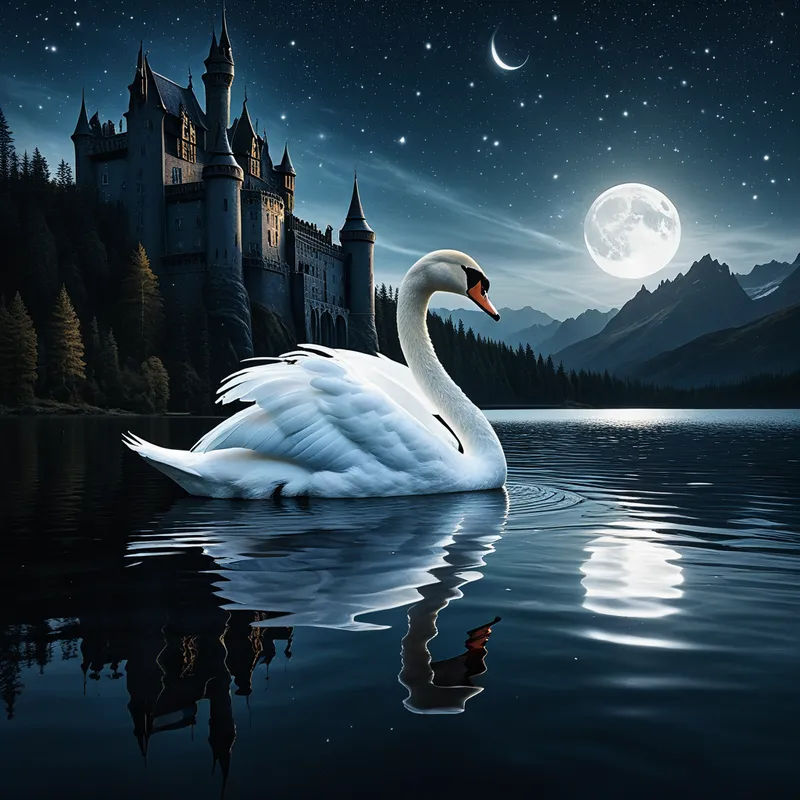
Swan Lake Parallel Myth Meaning & Symbolism
A mythic tale of a soul split between realms, seeking wholeness through a perilous journey across the mirrored waters of existence.
The Tale of Swan Lake Parallel
Listen. There is a lake that is not a lake, a mirror that is not glass. In the time before memory, when the world’s breath was still one sigh, there existed the Primal Unity. From its still center, a vibration arose—a question of itself. And in asking, it cracked.
From this fissure poured two waters: one of radiant day, one of velvet night. They did not mix, but lay beside each other, forming the Twin-Sourced Mere. Upon the day-water, a shape formed: a being of sublime grace, a swan of blinding white. This was Anahata, whose every feather sang a note of pure being. But the song was lonely, echoing over the water with no answer.
For in the night-water, a reflection stirred. Not a mere copy, but a sibling born of the same crack. From the dark mirror surface rose a second swan, its plumage the deep hue of a starless midnight. This was Chayya. Where Anahata sang, Chayya was silent. Where Anahata moved with solar certainty, Chayya flowed with lunar mystery. They were the same soul, cleaved, gazing at one another across the impossible, shimmering seam where day-water met night-water.
A law hung over the Mere: they could never touch. To cross the seam was to unmake the waters, to return to the silent, unknowable Unity from which they came—a kind of death. Yet, in each glance across that luminous divide, a memory flickered: a memory of wholeness. The longing became a torment. Anahata’s song turned to a lament; Chayya’s silence deepened into a profound ache.
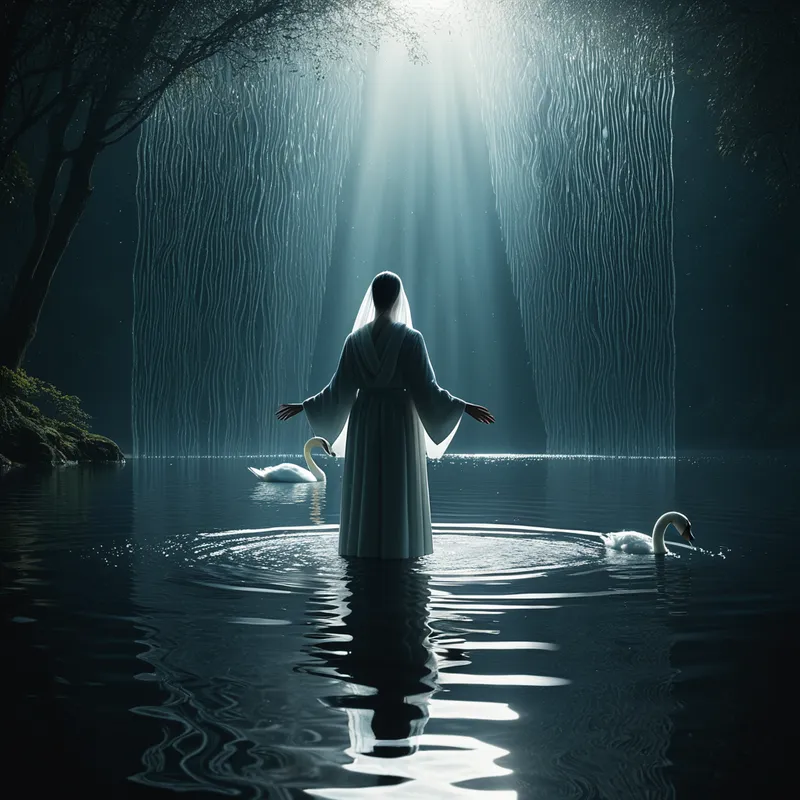
Then came the Stranger-Key, a wanderer from the solid world who stumbled upon the Mere. Seeing only the radiant Anahata, they were captivated by the beauty and the sorrow. “Why do you grieve?” they asked. Anahata spoke of the reflection, the sibling-self just beyond reach. Moved by a courage not their own, the Stranger-Key did a forbidden thing. They took a vessel of day-water and poured it, slowly, onto the night-water’s side.
The seam shimmered, wavered. For a single, breathless moment, the waters swirled—day into night, night into day. In that chaos, Anahata and Chayya did not rush together. Instead, they each turned inward. Anahata dove into the now-darkened day-water, and Chayya rose into the now-illuminated night-water. They each journeyed into the realm of the other.
What they found was not an opposite, but their own missing half. Anahata, in the depths, found its own silence and depth. Chayya, in the heights, found its own voice and light. The lake did not become one homogenous pool. Instead, the seam remained, but now it pulsed like a vein, a living boundary through which essence could flow. When they surfaced, they did not become one swan. They became two, forever distinct, yet now when Anahata sang, Chayya’s silence hummed the harmony. They circled one another, a celestial dance of recognition, their parallel existence now a dialogue, not a prison. The Stranger-Key, having spent their purpose, faded, becoming but a ripple in the perpetual, now-connected waters.
Cultural Origins & Context
The myth of the Swan Lake Parallel is a polycultural rhizome, appearing not as a single, owned narrative but as a recurring pattern in the folklore of seafaring, lacustrine, and desert-oasis peoples. It is not the property of a specific priestly class but a story told by firelight, by grandmothers, by solitary herders watching double sunsets on still waters. Its transmission is oral, but its medium is often environmental: the storyteller points to the actual lake, the still pond, or even a bowl of water catching the moon, saying, “See? There it is.”
Its societal function is profound yet subtle. In cultures with strict dualities—day/night, tribe/outsider, sacred/profane—the myth serves as a psychic pressure valve. It does not erase the necessary boundaries that hold society together, but it poetically argues that those boundaries are permeable membranes, not impenetrable walls. It is a story for the adolescent feeling alienated from themselves, for the community navigating a treaty with a neighboring tribe, for the artisan who must understand both the raw material and the finished form. It legitimizes the experience of inner conflict not as a flaw, but as the signature of a soul large enough to contain multitudes.
Symbolic Architecture
At its heart, the myth maps the psyche’s fundamental structure. The Twin-Sourced Mere is the Self in its full, paradoxical scope. Anahata and Chayya are not good and evil. They are the Persona and the Shadow, the articulated and the silent, the seen and the unseen.
The reflection is not your enemy; it is your unfinished self, waiting across the abyss of your own perception.
The uncrossable seam represents the terrifying, necessary boundary of consciousness. To have no boundary is psychosis—a return to the undifferentiated Unity. But to make that boundary absolute is neurosis—the lament of Anahata, the ache of Chayya. The Stranger-Key is the catalytic element of life itself—an accident, a crisis, a love, a loss—that destabilizes our rigid self-definition. It is the “pour” that muddies the clear distinctions we cling to.
The crucial, often missed, alchemy is that wholeness is not achieved by the destruction of the seam, nor by one side conquering the other. It is achieved by each venturing into the territory of the other. Consciousness must dare to dive into the unconscious murk. The shadow must dare to articulate itself in the light. The resolution is not fusion, but resonant dialogue.
The Dreamer’s Resonance
When this myth stirs in the modern dreamscape, it rarely appears as a literal lake with swans. Its signature is a feeling of profound, poignant duality. You may dream of meeting a double who wears your face but with different eyes. You may be in a house with an identical, mirrored floor above or below you. You may be trying to speak to someone through thick, distorting glass.
Somatically, the dreamer often reports a sensation of being “pulled in two directions” upon waking, or a tightness in the chest—the somatic seat of Anahata. These dreams cluster at life thresholds: before a marriage or commitment (integrating the lone self with the partnered self), during a career change (the known professional identity versus the latent potential), or in the wake of trauma that has split one’s sense of “before” and “after.”
The psychological process is one of recognition without identification. The dream ego is confronted with its counterpart, its parallel existence. The terror or longing in the dream is the psyche’s immune response to a necessary, impending integration. The dream is not instructing the dreamer to “become” their shadow, but to begin the perilous, respectful process of turning toward it, of learning its language.

Alchemical Translation
The individuation journey modeled here is not a heroic conquest, but a sacred courtship. The modern individual, identified wholly with their “Anahata”—their accomplishments, their curated self, their daytime rationality—feels an inexplicable melancholy, a sense of being followed by a silent twin. The alchemical work begins with the invitation of the Stranger-Key: a voluntary act of disruption. This is the therapy session, the journaling, the creative act, the conscious decision to engage with what has been repressed.
The goal is not to erase the seam, but to learn to breathe through it, to allow the osmosis of soul.
The “pour” is the courageous, messy act of letting one’s conscious values (the day-water) interact with the unconscious material (the night-water). In that temporary chaos, the ego dives down. It must explore its own depths—its rages, its childish needs, its archaic fears. Simultaneously, the shadow is invited up. It is given form through art, through confession, through conscious acknowledgment.
The result is the “Parallel” state. One does not become a monolithic, “perfect” being. Instead, one becomes a conscious ecosystem. The productive ambition (Anahata) is now tempered and deepened by an understanding of rest and mystery (Chayya). The creative passion (Chayya) is now focused and given sustainable form by discipline (Anahata). They circle each other in an eternal dance. The individual gains the capacity to hold contradiction, to be both strong and vulnerable, disciplined and spontaneous, individual and relational. The lake of the self remains dual-sourced, but the waters are now alive with a circulating current—the flow of a life that is no longer at war with itself, but engaged in a profound and lifelong conversation.
Associated Symbols
Explore related symbols from the CaleaDream lexicon: