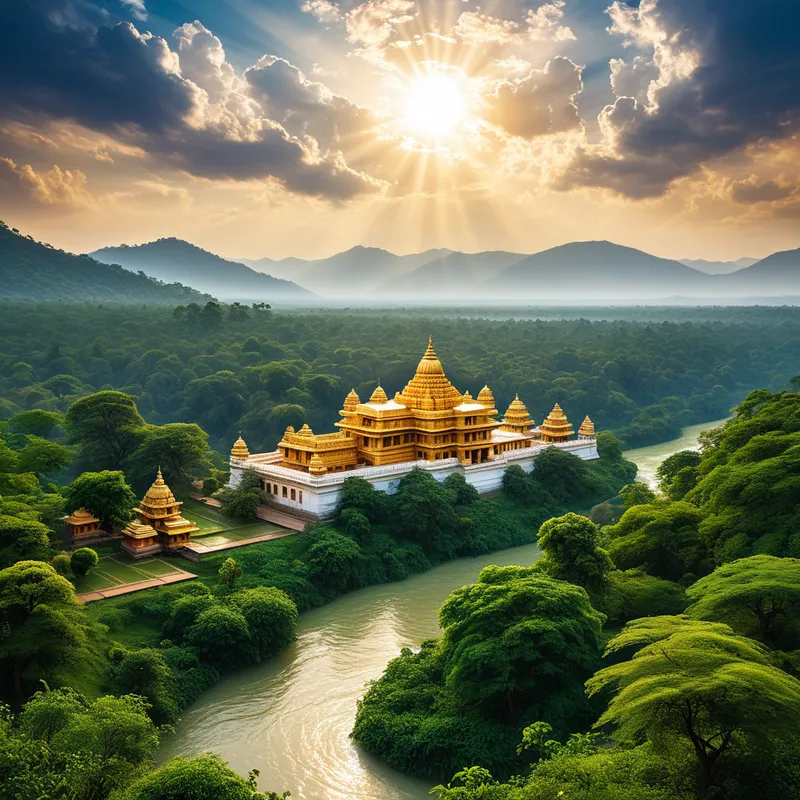
Svarga Loka Myth Meaning & Symbolism
The myth of the heavenly realm of Svarga Loka, a paradise of pleasure and reward, and its deeper meaning as a psychological state of achieved harmony.
The Tale of Svarga Loka
Listen, and let your spirit ascend. Beyond the seven veils of the sky, beyond the path of the sun and the orbit of the moon, lies a realm where the air itself is nectar. This is Svarga Loka, the world of light, the celestial city of Indra.
Its gates are not of iron, but of dawn’s first light, guarded not by soldiers but by the virtue of those who approach. To enter, a soul must be light, its karmic ledger inscribed with deeds of courage, truth, and sacrifice. The path is the Akasha Ganga, a river of stars, and one crosses it not by boat, but by the strength of one’s own merit.
Within, the senses are not denied, but perfected. Here, sight drinks from palaces that Vishvakarma carved from living crystal and gold, where pillars are made of lapis lazuli and courtyards are paved with pearls. The air carries the perfume of eternal blossoms from the Kalpavriksha, a scent that is the very essence of fulfillment. Sound is the domain of the Gandharvas, whose melodies weave the fabric of time into ragas of joy, and the Apsaras, whose dance is the visual form of that music, a geometry of grace that delights the eyes of gods and sages alike.
At the heart of this realm sits Indra upon his throne, the Airavata by his side, a beast white as monsoon clouds. In his hand rests the Vajra, forged from the bone of the sage Dadichi, a weapon of ultimate authority that is both a destroyer of darkness and a protector of cosmic order, Dharma. His court is a parliament of the divine, where Agni flickers in the braziers, and Vayu stirs the silken banners.
But Svarga is not static. It is a prize, a consequence. Heroes like Yayati ascended here through penance and prowess, only to learn that its joys, though profound, are tethered to time. The nectar of the gods, Amrita, grants agelessness, but not eternity. For even Svarga Loka resides within the great cycles of Yuga. Its splendor is maintained by the continuous sacrifice, the endless upholding of Dharma by gods and mortals alike. When that duty wanes, the palaces dim, the music falters, and the great Asuras rise from the depths to lay siege to its gates, initiating the eternal dance of conflict and restoration. The resolution is never final; it is a breath—the inhalation of peace, the exhalation of struggle, within the everlasting lungs of the cosmos.
Cultural Origins & Context
The myth of Svarga Loka is not a single story but a pervasive cosmological layer woven into the fabric of Hindu thought, finding its earliest structured expressions in the Vedas, particularly the Rigveda. It was elaborated in the grand narratives of the Itihasas and the Puranas. This myth was passed down not merely for entertainment but as a functional cosmology. It was recited by priests during Yajnas to map the invisible heavens, sung by bards to illustrate the tangible rewards of righteous living (Dharma), and contemplated by sages as an allegory for states of consciousness.
Its societal function was multifaceted. For the warrior, it promised a hero’s welcome. For the householder, it validated a life of duty. For the philosopher, it posed a critical question: Is a paradise of sensory and social perfection the ultimate goal? Thus, Svarga Loka served as both an incentive and a benchmark—a glorious, yet ultimately provisional, resting place on the soul’s longer journey toward Moksha. It grounded the cosmic order in a vividly imagined geography, making abstract principles of karma and dharma viscerally real and desirable.
Symbolic Architecture
Svarga Loka is not merely a place, but a symbol of a psychic state achieved. It represents the pinnacle of successful ego-formation and social integration—a consciousness where desires are harmonized, efforts are rewarded, and one sits in the “seat of the ruler” of one’s own internal kingdom.
The celestial city is the psyche in a state of earned harmony, where the waters of the unconscious (the Mandakini river) flow clear and nourishing, and the light of consciousness (Indra) governs without tyranny.
The Kalpavriksha symbolizes the imagination’s boundless potential to manifest content from the unconscious. The Gandharvas and Apsaras represent the aesthetic and emotional faculties in their most refined form—art and beauty as inherent to a fulfilled psyche. Crucially, Indra’s Vajra, born from sacrifice (Dadichi’s bone), signifies that this state of order is not passive. It is maintained by the disciplined, sometimes fierce, application of discernment (the thunderbolt) to shatter impulses of chaos or inertia. The ever-present threat of the Asuras symbolizes the perpetual shadow, the unresolved complexes and primal desires that constantly test the integrity of this hard-won inner peace.

The Dreamer’s Resonance
When Svarga Loka appears in modern dreams, it rarely manifests as a literal heavenly city. Instead, one dreams of finding a perfectly organized, beautiful home they never knew they owned; of receiving a prestigious award in a grand hall; of being at a sublime party where everyone is fascinating and welcoming. This is the psyche experiencing a “Svarga moment”—a deep, somatic sense of reward, acceptance, and harmonious belonging.
The psychological process at work is one of validation and integration. The dreamer is likely assimilating a period of significant effort or moral struggle. The body may feel light, euphoric. However, if the dream carries a subtle anxiety—if the halls feel too empty, the music slightly off-key, or a hidden door suggests something beyond the splendor—it signals the soul’s intuition that this state, while glorious, is not final. It is the ego enjoying its kingdom, while the Self whispers of a journey yet unfinished. The dream becomes a diagnostic of one’s current spiritual valuation: are we mistaking social success or inner harmony for the ultimate goal?
Alchemical Translation
The alchemical journey modeled by Svarga Loka is the stage of Coagulatio—the condensation of spirit into a stable, glorious form. It is the creation of the “Philosopher’s Stone” of the personality: a well-functioning, respected, and pleasurable selfhood. The myth guides the individual through the process of building a competent ego, mastering the outer world, and reaping the legitimate rewards of discipline and virtue.
To reach your personal Svarga is to successfully rule the territory of your own life, to cultivate your inner garden until it bears the fruit of your deepest labors.
Yet, the myth’s deepest alchemy lies in its implicit warning against fixation. Svarga is a station, not a terminus. The true transmutation occurs when one, like the sage who enjoys Svarga but is not bound by it, realizes that even the most golden cage is still a cage. The nectar of Amrita grants longevity to the current form, but liberation (Moksha) requires dissolving the form itself. Thus, the ultimate psychic transmutation is to honor the ruler within, to enjoy the palace of one’s achievements, and then to hear the call from beyond its walls—the call to surrender the very throne, the very self, that one has worked so diligently to perfect. The paradise of reward becomes the launching platform for the journey into the formless, where the individual soul discovers it was never separate from the architect of all the Lokas, the divine ground of being itself.
Associated Symbols
Explore related symbols from the CaleaDream lexicon: