Surtr Myth Meaning & Symbolism
The fire giant Surtr, from the land of flame, will engulf the world in fire at Ragnarök, ending the old cosmos to make way for the new.
The Tale of Surtr
Hear now a tale not of beginnings, but of the end. A tale whispered by the wind through the roots of the Yggdrasil, carried on the smoke from forges deep in the earth. It is the tale of Surtr, the one who waits.
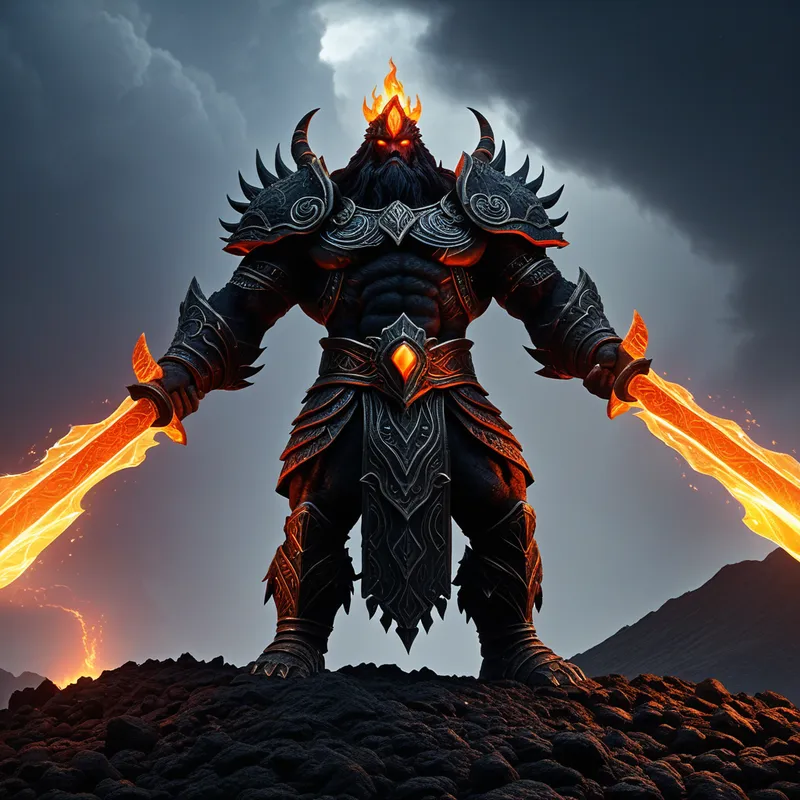
Far to the south, beyond the reach of sun or moon, lies Múspell. It is a land where the ground is not earth, but cracked and glowing stone; where rivers run not with water, but with liquid fire. The air shimmers with heat, and the only music is the crackle of eternal flame. Here, at the border of this impossible realm, stands its guardian. He is not a god of Æsir or Vanir. He is older, a being of the world’s first fires. His name is Surtr, and he is made of the stuff of that land—blackened basalt for skin, magma for blood, and a crown of living flame upon his head. In his hand he holds a sword brighter than the sun, a weapon with no name men know, that burns with a light that blinds.
For ages uncounted, he has stood his silent watch. But he is waiting. He listens for the sound he knows will come: the echoing howl of Garmr unchained, the crowing of the rust-red rooster at Hel’s gate. He waits for the Ragnarök.
And when that day dawns—a day of no dawn, but of a sun swallowed and a moon devoured—Surtr stirs. The ground of Múspell trembles as he takes his first step north. Behind him, all the sons of Múspell, a host of fire giants, rally to the light of his sword. They march, and where they tread, the very air ignites. They cross the bridge Bifröst, and it shatters under their heat, a rainbow turned to steam and ash.
They come to the great plain, Vígríðr. Here, the gods make their last stand. Odin falls to the wolf. Thor slays the serpent and drowns in its venom. The great battles rage, a cacophony of doom. But Surtr does not join their fray. He moves with a dreadful, singular purpose.
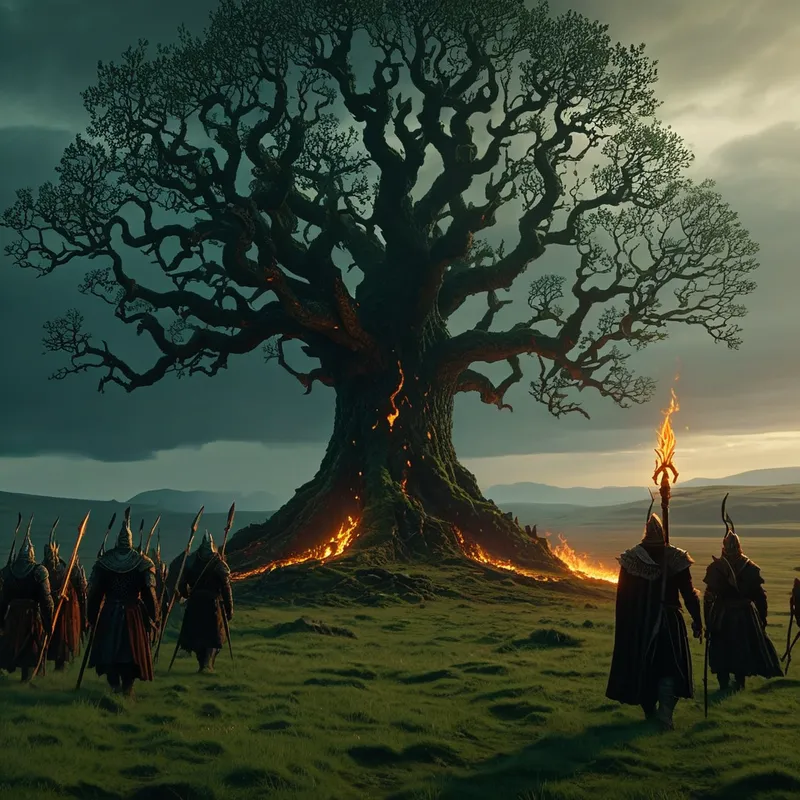
He raises his sword. Its light, which once merely illuminated, now consumes. He sweeps it across the earth. The fire does not burn; it unmakes. It touches the great tree Yggdrasil, and its branches become torches. It sweeps over the plains, and the soil turns to glass. It licks at the oceans, and they boil into vast, white shrouds of steam. The stars themselves go dark, snuffed out like embers in a gale. Surtr’s fire is the final word, the all-consuming flame that reduces the nine worlds to a silent, swirling chaos of ash and cinder. He is the end of all stories.
And in that absolute end, when the last echo of the old world fades in the heat-haze, the flames at last begin to subside. The fires of Surtr do not rage forever. They burn until their work is done. And when they recede, they reveal not just barren waste, but a new earth, green and fresh, rising from the sea. His is the terrible, necessary fire that clears the ground for what must come next.
Cultural Origins & Context
The primary source for the myth of Surtr is the Prose Edda, written by Snorri Sturluson in the 13th century, drawing from older poetic traditions like the Völuspá. These texts were penned in Christianized Iceland, meaning the myths were already relics of a fading pagan worldview. Surtr’s role, however, feels primal, likely rooted in pre-Viking Age conceptions of volcanic and geothermal fury—forces vividly apparent in the Icelandic landscape itself.
The myth was not mere entertainment. It was a cosmological anchor. Norse cosmology was cyclical, not linear. Worlds were born from the void (Ginnungagap), and they were destined to die by fire and water, only to be reborn. Surtr was the agent of that necessary death. His story was told to explain the ultimate fate of the cosmos, reinforcing a worldview where even the gods were subject to a fixed, inescapable destiny (örlög). It served as a sobering reminder of the transience of all order, all glory, and all life, fostering a cultural ethos of courage and fatalistic resolve in the face of an ultimately doomed, yet meaningful, struggle.
Symbolic Architecture
Surtr is not a villain in a simplistic sense. He is an archetypal force of absolute, catalytic destruction. He represents the necessary end that precedes any true beginning. His fire is not merely punitive; it is purgative.
The flame that destroys the world is the same flame that forges the new one in its womb of ash.
Symbolically, Surtr is the embodiment of the unavoidable crisis. He is the bankruptcy that ends a futile venture, the severe illness that shatters an old identity, the profound betrayal that burns away naive trust. He is the psychological “point of no return.” His dwelling in Múspell, at the southern extreme, places him in opposition to the icy realm of Niflheimr from which life emerged. He is the concluding counterpart to that initial creative freeze—the final heat-death that resets the cycle.
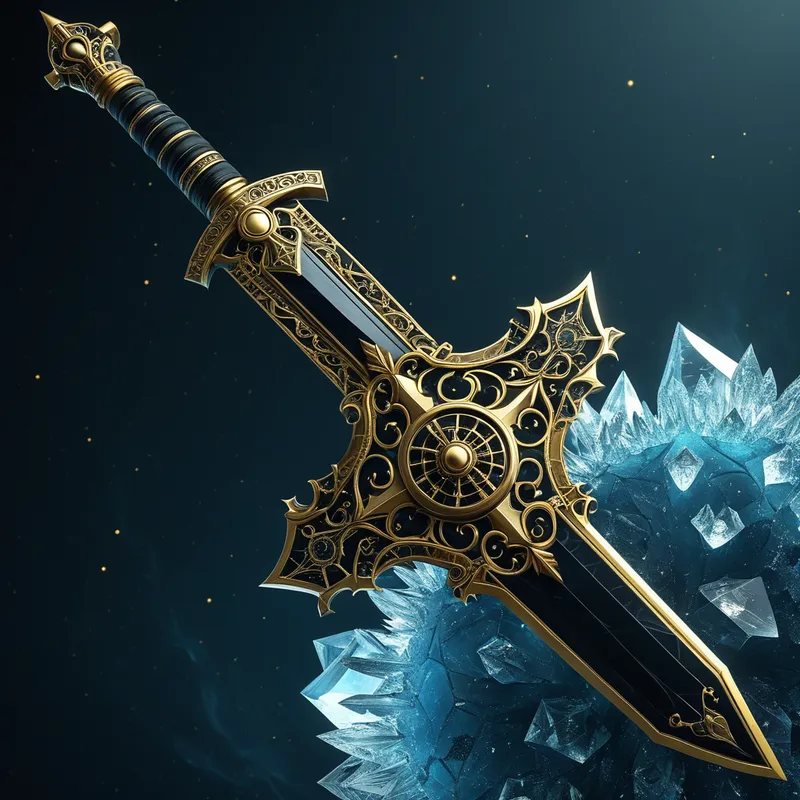
His nameless, blazing sword is the instrument of this irrevocable change. It is the incisive truth that cuts through illusion, the decisive action that ends stagnation. Surtr does not negotiate; he executes destiny. In this, he is the ultimate örlög-made-manifest, a force beyond the moral categories of gods and men, serving a function that is as essential to the cosmic order as creation itself.
The Dreamer’s Resonance
When the pattern of Surtr erupts in the modern psyche, it often manifests in dreams of overwhelming, apocalyptic fire. This is not a dream of a cozy hearth, but of wildfires consuming neighborhoods, of the sun falling from the sky, or of being trapped in a landscape that is steadily, inexorably burning from the edges inward.
Somatically, the dreamer may awaken with a racing heart, a feeling of intense heat, or profound anxiety. Psychologically, this signals that a foundational structure of the psyche—a long-held belief, a defining relationship, a career identity, a core self-narrative—has reached its expiration date. The unconscious is not predicting a literal end, but broadcasting a necessary psychic Ragnarök. The ego, like the gods on Vígríðr, is mustering its defenses, but the dream indicates these defenses are doomed. The fire cannot be fought; it must be endured and its purpose understood. The dream is a brutal announcement: the old world within you must end.
Alchemical Translation
In the alchemical process of individuation—the journey toward psychological wholeness—Surtr represents the crucial stage of calcinatio or nigredo taken to its absolute extreme. It is the fire that reduces all complex, solidified elements of the personality to their essential, primal state.
To be reborn, one must first consent to the total incineration of what one has been.
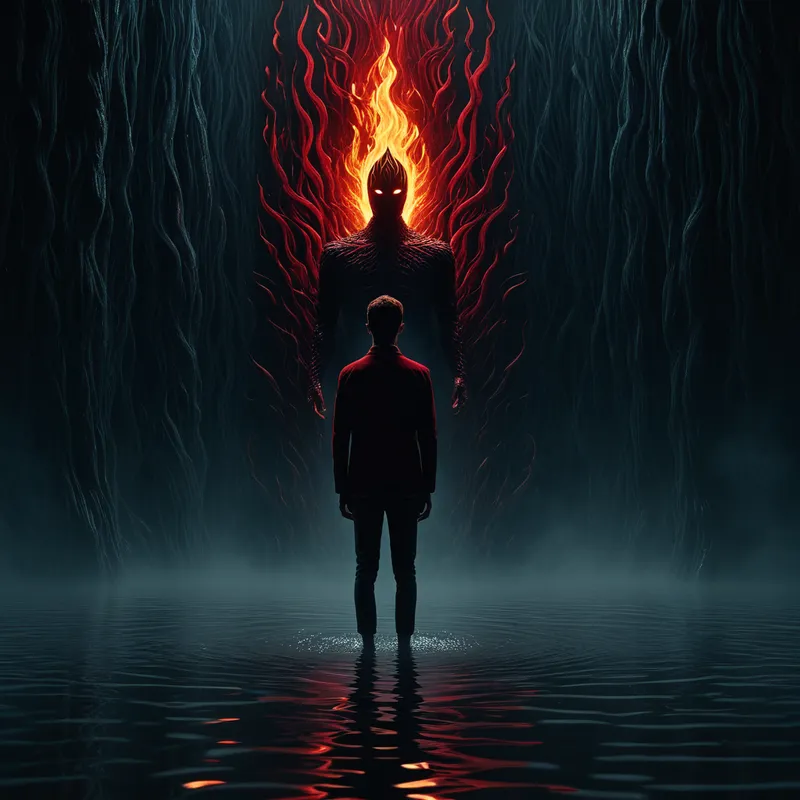
The modern individual facing a “Surtr moment” is not called to play the hero who defeats the giant. That is the ego’s fantasy, and it always fails. Instead, the task is to identify with the process itself. One must find the courage to stand at the center of the conflagration and understand: this fire is not an enemy, but a brutal, purifying agent of the Self. It is burning away the outmoded, the inauthentic, the compromises that have built up like deadwood over a lifetime.
The triumph is not in survival, but in surrender to the transformative function of the destruction. The ego-identity must “die” in these flames so that a more authentic alignment can emerge from the “green earth” that appears after the fire cools. This is the myth’s ultimate psychological teaching: profound renewal is often preceded not by gentle change, but by catastrophic, all-consuming endings. To integrate Surtr is to make peace with the necessary endings in our own lives, to wield the sword of truthful severance ourselves, and to trust that from the ashes of what we let burn, a clearer, truer self can take root.
Associated Symbols
Explore related symbols from the CaleaDream lexicon: