Surt Myth Meaning & Symbolism
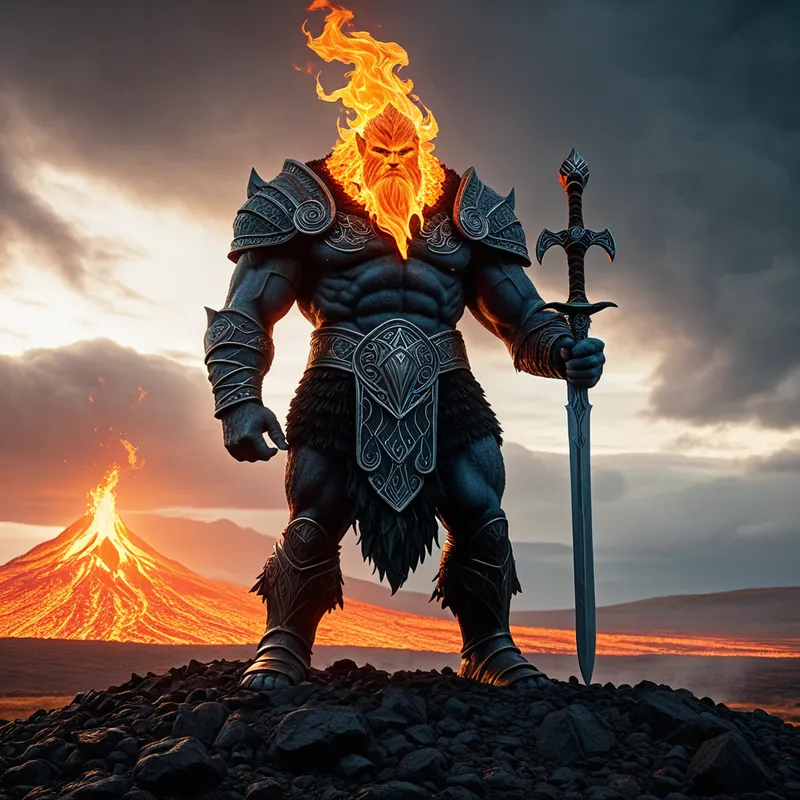
The fire giant Surt wields a flaming sword to end the world at Ragnarök, a myth of total destruction as the necessary precursor to renewal.
The Tale of Surt
Listen, and hear the tale of the end that is a beginning. In the south, beyond the reach of gods and men, lies [Muspelheim](/myths/muspelheim “Myth from Norse culture.”/). It is not a place for living flesh; it is a realm of primal, roaring flame, of stone that flows like [water](/myths/water “Myth from Chinese culture.”/) and air that shimmers with heat. And from this forge of creation’s opposite, he comes. He is Surt, the Black One. His form is of living cinder and cooled magma, his eyes are pits of sunfire, and in his hand he holds a sword that has no name, for it is not a [thing](/myths/thing “Myth from Norse culture.”/) made but a piece of [the world](/myths/the-world “Myth from Tarot culture.”/)’s first light, captured and sharpened into an edge that can cut destiny itself.
For ages uncounted, he has stood sentinel at the border of his blazing realm, silent and immovable as a mountain. The gods in Asgard speak his name in whispers, a dread syllable carried on the cold wind from the north. They know the prophecy carved into the roots of [Yggdrasil](/myths/yggdrasil “Myth from Global/Universal culture.”/): the sun will grow dark, summers will cease, and a winter three times the length of a lifetime will grip the world in a fist of ice. This is [Fimbulwinter](/myths/fimbulwinter “Myth from Norse culture.”/). And when the cold has bitten deepest, when brother turns on brother and all oaths are broken, then will the watchfulness of Surt end.
He will move.
[The earth](/myths/the-earth “Myth from Hindu culture.”/) will tremble as he strides forth, not alone, but at the head of the sons of Muspel. Their march is the crackling of continents aflame. [The rainbow bridge](/myths/the-rainbow-bridge “Myth from Global/Universal culture.”/), Bifröst, will shatter beneath their heat. He will come to the plain called Vígríðr, where the gathered gods make their final stand. Odin will face the wolf [Fenrir](/myths/fenrir “Myth from Norse culture.”/). Thor will battle the world-serpent [Jörmungandr](/myths/jrmungandr “Myth from Norse culture.”/). And Surt will seek the shining god, [Freyr](/myths/freyr “Myth from Norse culture.”/). A tragic meeting—for [Freyr](/myths/freyr “Myth from Norse culture.”/), in his folly, once gave away his sword of victory. Now, weaponless, the god of sunshine and fertile rain will stand before the embodied sun of dissolution.
There will be no parley. No grand duel of skill. Surt’s sword sweeps, a crescent of annihilation. Freyr falls. And this is but the prelude. For Surt’s purpose is not conquest, but conclusion. His fire is not for a throne, but for a tomb. When the last god has fallen and the last monster perished, Surt will cast his flame across [the nine worlds](/myths/the-nine-worlds “Myth from Norse culture.”/). He will set the very branches of Yggdrasil alight. The seas will boil, the soil will turn to glass, [the sky](/myths/the-sky “Myth from Persian culture.”/) itself will burn and blacken. All things—the glorious halls of Asgard, the humble homes of [Midgard](/myths/midgard “Myth from Norse culture.”/), the frozen wastes of Jötunheim—will be consumed, reduced to ash and smoke, sinking into a silent, steaming abyss.
This is [Ragnarök](/myths/ragnark “Myth from Norse culture.”/). The Twilight of the Gods. And in that absolute silence, after the final ember of Surt’s fire has cooled upon a dead world, the myth whispers… of green shoots pushing through the ash.
Cultural Origins & Context
The myth of Surt and Ragnarök is preserved primarily in two 13th-century Icelandic texts: the Poetic Edda and the Prose Edda by Snorri Sturluson. These were Christian-era recordings of a much older, oral tradition. The skalds—Norse poets and storytellers—would have recited these tales in halls, not as mere entertainment, but as a sacred cosmology. In a world perceived as fundamentally hostile, bounded by ice and fire, the myth of an inevitable, cataclysmic end served a profound societal function. It was not a story of despair, but of grim acceptance and defined heroism.
Knowing the world would end not by chance, but in a foretold, dramatic climax, framed every action with ultimate significance. A warrior’s courage, an oath-keeper’s loyalty, even a farmer’s resilience through the long winter—all were rehearsals for Vígríðr. The myth provided a narrative container for the existential anxieties of a culture living on the edge of survival. It taught that even the gods are subject to fate (örlög), and that the highest virtue is to face that fate with clear eyes and unwavering resolve, just as the Æsir march to their doom. Surt, as the agent of this inescapable destiny, is the ultimate personification of a world-view that saw creation and destruction as an eternal, cyclical, and impersonal process.
Symbolic Architecture
Surt is not evil in a moral sense; he is an archetypal force. He represents [the principle](/symbols/the-principle “Symbol: A fundamental truth, law, or doctrine that serves as a foundation for a system of belief, behavior, or reasoning, often representing moral or ethical standards.”/) of [entropy](/symbols/entropy “Symbol: In arts and music, entropy represents the inevitable decay of order into chaos, often symbolizing creative destruction, impermanence, and the natural progression toward disorder.”/), the necessary [dissolution](/symbols/dissolution “Symbol: The process of breaking down, dispersing, or losing form, often representing transformation, release, or the end of a state of being.”/) that makes [room](/symbols/room “Symbol: A room in a dream often symbolizes the self, representing personal space, mental state, or aspects of one’s identity.”/) for new creation. His fire is the antithesis of the ordered, structured world of the gods (Asgard) and humans (Midgard). It is pure, unconsumable [energy](/symbols/energy “Symbol: Energy symbolizes vitality, motivation, and the drive that fuels actions and ambitions.”/) that reduces complex forms back to their primordial state.
The sword of Surt is the incisive truth that destroys illusion. It is the crisis that burns away the inessential, leaving only the irreducible core.
Psychologically, Surt symbolizes the repressed, volcanic content of the unconscious that threatens to erupt and dismantle a fragile ego-[structure](/symbols/structure “Symbol: Structure in dreams often symbolizes stability, organization, and the framework of one’s life, reflecting how one perceives their environment and personal life.”/) (the ordered world). He is the [shadow](/symbols/shadow “Symbol: The ‘shadow’ embodies the unconscious, repressed aspects of the self and often represents fears or hidden emotions.”/) of the entire psychic [system](/symbols/system “Symbol: A system represents structure, organization, and interrelated components functioning together, often reflecting personal or social order.”/)—not just an individual’s, but a culture’s. When a [life](/symbols/life “Symbol: The symbol of ‘Life’ represents a journey of growth, interconnectedness, and existential meaning, encompassing both the joys and challenges that define human experience.”/), a [relationship](/symbols/relationship “Symbol: A representation of connections we have with others in our lives, often reflecting our emotional state.”/), or a belief [system](/symbols/system “Symbol: A system represents structure, organization, and interrelated components functioning together, often reflecting personal or social order.”/) becomes too rigid, too out of touch with its foundational energies, the “fire from Muspelheim” begins to stir. The [Fimbulwinter](/symbols/fimbulwinter “Symbol: Fimbulwinter represents a cataclysmic winter preceding the end of the world, embodying themes of destruction, transformation, and renewal.”/)—the long, sterile [period](/symbols/period “Symbol: Periods in dreams can symbolize cyclical patterns, renewal, and the associated emotions of loss or change throughout life.”/) of depression, stagnation, or meaninglessness—often precedes this inner Ragnarök. It is the deep freeze that comes when the old ways of being can no longer generate psychic warmth.
The Dreamer’s Resonance
To dream of Surt, or of his all-consuming fire, is to experience the somatic premonition of a profound psychological death. This is not a nightmare of random fear, but a specific archetypal event in the dreamer’s inner landscape.
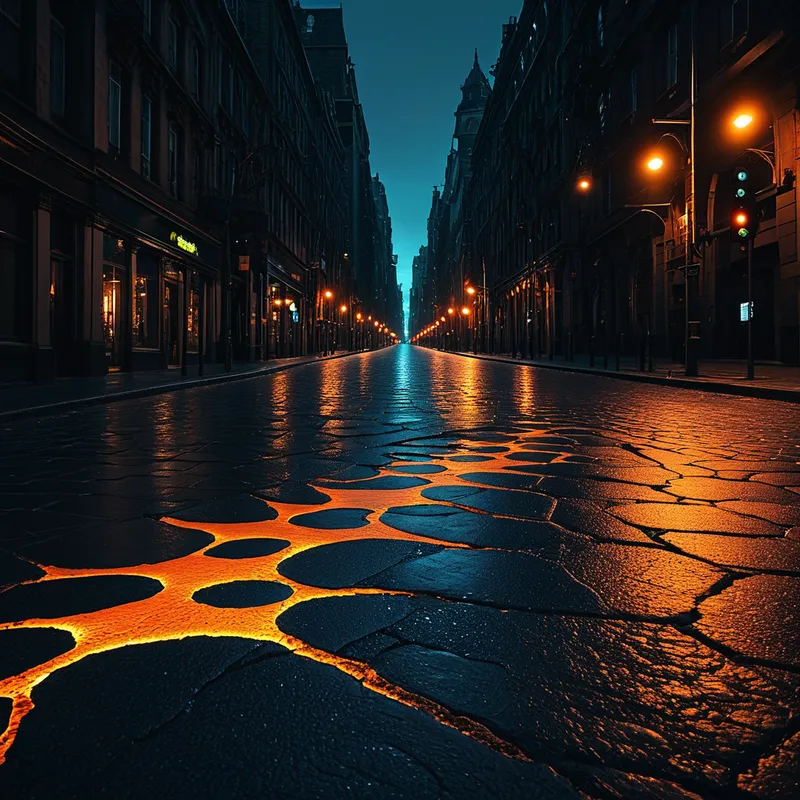
You may dream of your house—the symbol of [the self](/myths/the-self “Myth from Jungian culture.”/)—burning down, but with a sense of awe rather than pure terror. You may see a familiar cityscape being overtaken by slow, inevitable lava flows. The body’s resonance during such dreams is key: it can be a feeling of immense heat, of pressure building in the chest or head, or conversely, a strange, detached calm as you witness the destruction. This dream signals that a foundational structure of your identity—a long-held career identity, a core belief about relationships, a narrative of who you are—has reached its [terminus](/myths/terminus “Myth from Roman culture.”/). The [psyche](/myths/psyche “Myth from Greek culture.”/) is initiating its own Ragnarök because the old order can no longer contain the soul’s energy. The dream is the unconscious declaring, “This must end.”
Alchemical Translation
The alchemical process mirrored in Surt’s myth is calcinatio—reduction by fire. In [the vessel](/myths/the-vessel “Myth from Alchemical culture.”/) of the self, all the complex alloys of personality, the attachments, the compromises, and the false selves, are subjected to extreme heat. This is a brutal but necessary stage of individuation.
The green land that rises from the sea after Ragnarök does not grow in spite of the fire; it is nourished by the ashes. The new self is built from the nutrients of the burned-old.
For the modern individual, the “[triumph](/myths/triumph “Myth from Roman culture.”/)” of Surt within is not a victory to be won, but a process to be surrendered to. It is the courage to allow a total breakdown—of a life plan, a cherished identity, a worldview—without intervening to save it. This is the rebel archetype in its most absolute form: rebelling against the tyranny of one’s own outworn existence. The fire giant’s march is the painful, liberating journey of letting everything burn that is not truly you. The goal is not to become Surt, but to pass through his fire. To stand, like the surviving gods in the new myth, on the Idavoll plain of a renewed psyche, where the grass is greener because the ground has been purified by an unimaginable flame. The sword that destroys the world is, in the alchemy of the soul, the same instrument that cuts the cord to a doomed past, freeing the essential spark for a new beginning.
Associated Symbols
Explore related symbols from the CaleaDream lexicon: