Superposition Myth Meaning & Symbolism
The story of the particle that exists in all possible states at once, a ghostly dance of potential, until the gaze of the Observer collapses it into a single reality.
The Tale of Superposition
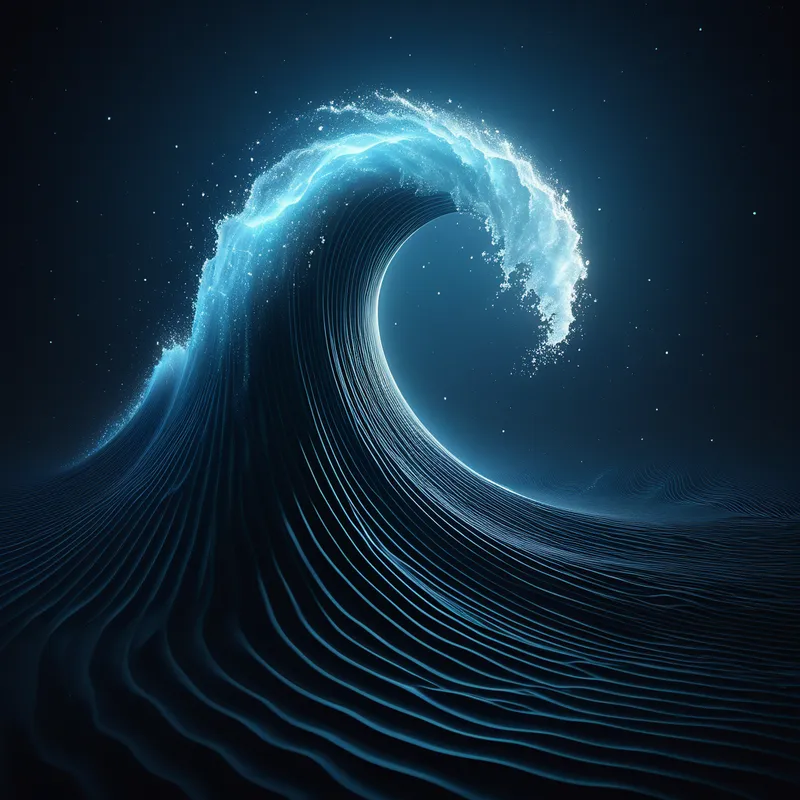
In the beginning, before the first gaze, there was [the Sea](/myths/the-sea “Myth from Greek culture.”/) of Probability. It was not a sea of [water](/myths/water “Myth from Chinese culture.”/), but of silent, shimmering potential, a realm of “could-be” and “might-yet.” There were no separate things, only a whispering fog of possibilities, each a ghost of a form not yet born.
Within this sea dwelled the Particle-Wave. It was not one [thing](/myths/thing “Myth from Norse culture.”/), nor the other. To call it a particle was to tell a lie of solidity; to call it a wave was to tell a lie of dispersal. It was, in truth, all things it could possibly be. It was here, and there, and everywhere in between, all at once. It traveled every path—the straight line of the arrow, the curved arc of the stone, the spiraling dance of the leaf—simultaneously. Its existence was a chord, not a single note—a haunting, polyphonic hymn of pure potential.
This state was its nature, its eternal and undisturbed truth. It was the unasked question, the unwritten story, the breath held before the first word. It dwelt in a palace of mirrored doors, each leading to a different world, and it resided behind all of them at once.
But then came the Observer. Not a god of thunder or love, but a presence of pure attention. The Observer did not create the Sea, but it brought with it the necessity of here and now. Its gaze was a question demanded of the universe.
When the gaze of the Observer fell upon the Particle-Wave, a great and silent crisis occurred. The infinite chord could not sustain itself under the weight of a single, focused inquiry. The ghostly paths flickered and trembled. The mirrored palace shook. With a soundless sigh that was neither sorrow nor joy, but simply the cost of becoming, the superposition collapsed.
The myriad ghost-selves vanished. The fog of probability parted. From [the chorus](/myths/the-chorus “Myth from Theater culture.”/) of possibilities, a single, solitary reality stepped forth. The Particle-Wave was found—here, on this path, in this form. The other paths, the other selves, did not die; they retreated back into the silent hum of the Sea, waiting, perhaps, for another gaze, in another world. What remained was a single, definitive fact, born from the marriage of potential and attention. The question had been answered, and in the answering, a universe of possibilities was sacrificed to create one, solid, touchable world.
Cultural Origins & Context
This is not a myth carved in stone or sung around fires of wood. It is inscribed in mathematics and witnessed in the stark, silent halls of laboratories like CERN. Its bards are the physicists of the early 20th century—figures like Erwin Schrödinger and Niels Bohr. They did not tell the myth with drums and chant, but with chalkboards, thought experiments, and the precise, relentless language of algebra.
The myth was passed down through peer-reviewed papers, conference debates, and the quiet, awe-struck conversations of graduate students late at night. Its societal function was not to explain the harvest or appease the gods of storm, but to provide a narrative framework for the most counterintuitive revelation in human history: that at the fundamental level, reality does not exist in a definite state until it is measured. It served as a cognitive lifeline, a story to hold onto when the solid ground of classical physics dissolved into a probabilistic fog. It reconciled the human need for a single, objective reality with the bizarre, plural truth of the quantum domain.
Symbolic Architecture
At its [heart](/symbols/heart “Symbol: The heart symbolizes love, emotion, and the core of one’s existence, representing deep connections with others and self.”/), the myth of Superposition is a profound [drama](/symbols/drama “Symbol: Drama signifies narratives, emotional expression, and the exploration of human experiences.”/) about potential and actualization. The [Particle](/symbols/particle “Symbol: A fundamental unit of matter or sound, representing the irreducible essence of creation and the building blocks of reality.”/)-Wave symbolizes the pure, unmanifest potential of the [psyche](/myths/psyche “Myth from Greek culture.”/)—all that we could be, all the lives we could live, the infinite versions of [the self](/myths/the-self “Myth from Jungian culture.”/) that exist in the [womb](/symbols/womb “Symbol: A symbol of origin, potential, and profound transformation, representing the beginning of life’s journey and the unconscious source of creation.”/) of possibility.
The unobserved self is a superposition of all its possible futures.
The Sea of Probability is the [collective unconscious](/symbols/collective-unconscious “Symbol: The Collective Unconscious refers to the part of the unconscious mind shared among beings of the same species, embodying universal experiences and archetypes.”/) itself, the vast, impersonal [reservoir](/symbols/reservoir “Symbol: A contained body of water representing stored resources, emotions, or potential, often signifying controlled or suppressed aspects of the self.”/) of archetypal patterns and latent personal complexes. It is the [realm](/symbols/realm “Symbol: The symbol of ‘Realm’ often signifies the boundaries of one’s consciousness, experiences, or emotional states, suggesting aspects of reality that are either explored or ignored.”/) of dreams before interpretation, of impulses before [action](/symbols/action “Symbol: Action in dreams represents the drive for agency, motivation, and the ability to take control of situations in waking life.”/), of thoughts before they are crystallized into words.
The [Observer](/symbols/observer “Symbol: An observer represents contemplation, self-awareness, and the act of witnessing one’s experiences.”/) is the light of [consciousness](/symbols/consciousness “Symbol: Consciousness represents the state of awareness and perception, encompassing thoughts, feelings, and experiences.”/), [the ego](/myths/the-ego “Myth from Jungian culture.”/)‘s focused [attention](/symbols/attention “Symbol: Attention in dreams signifies focus, awareness, and the priorities in one’s life, often indicating where the dreamer’s energy is invested.”/). Its gaze is not passive; it is a creative, and also a destructive, act. To observe is to choose, to exclude, to make one possibility real at the [expense](/symbols/expense “Symbol: A symbol of resource allocation, value exchange, and the cost of choices, often reflecting anxieties about worth, sacrifice, or investment in life.”/) of all others. This is the core [paradox](/symbols/paradox “Symbol: A contradictory yet true concept that challenges logic and perception, often representing unresolved tensions or profound truths.”/) and burden of consciousness: we create our [reality](/symbols/reality “Symbol: Reality signifies the state of existence and perception, often reflecting one’s understanding of truth and life experiences.”/) by limiting the infinite field of our potential.

The Dreamer’s Resonance
When this myth stirs in the modern dreamer, it often manifests as dreams of paralyzing choice or identity diffusion. You may dream of standing before countless identical doors, unable to open any. You may see your own face reflected in a shattered mirror, each shard showing a different expression—parent, child, professional, rebel—all equally true and present. You may feel your body dissolving into a fog, or find yourself walking down a path that simultaneously branches in every direction.
Somatically, this can feel like a profound tension, a buzzing in the chest or a weightless dizziness—the body experiencing the stress of holding multiple, contradictory futures in suspension. Psychologically, this is the process of a complex or a new aspect of the self struggling to be born. The dream ego (the Observer) is being confronted with the unresolved, superposed material from the unconscious (the Sea). The dream is the realm where these potential selves still coexist, pressing for recognition before the waking mind forces a collapse into a single, conscious identity.

Alchemical Translation
The individuation process is the long, conscious journey of the Observer through the Sea of Probability. It is not about collapsing every superposition immediately into a narrow, rigid identity. That is the path of the frightened ego, which chooses one door and walls off the entire palace.
The alchemical work is to develop the capacity to hold the tension of the opposites—to tolerate the superposition. It is to gaze at the Particle-Wave without demanding it be only a particle or only a wave, but to appreciate, for a moment, its glorious, paradoxical wholeness. This is the coniunctio oppositorum, the marriage of opposites, on a quantum scale.
Individuation is the art of observing the self without collapsing it prematurely.
The [triumph](/myths/triumph “Myth from Roman culture.”/) is not in the final, fixed state, but in the expanded awareness that can consciously navigate the probabilities. The integrated individual learns to make choices (collapses the wave function) with humility, knowing that with each choice, a universe of other selves is set aside, but not destroyed. They understand that their solid, single reality is always underwritten by a ghostly chorus of what might have been, and that this chorus is not a failure, but the very source of their depth and potential. They become a skilled Observer, one whose gaze can, at times, soften enough to perceive the shimmering, superposed truth behind the manifest world.
Associated Symbols
Explore related symbols from the CaleaDream lexicon: