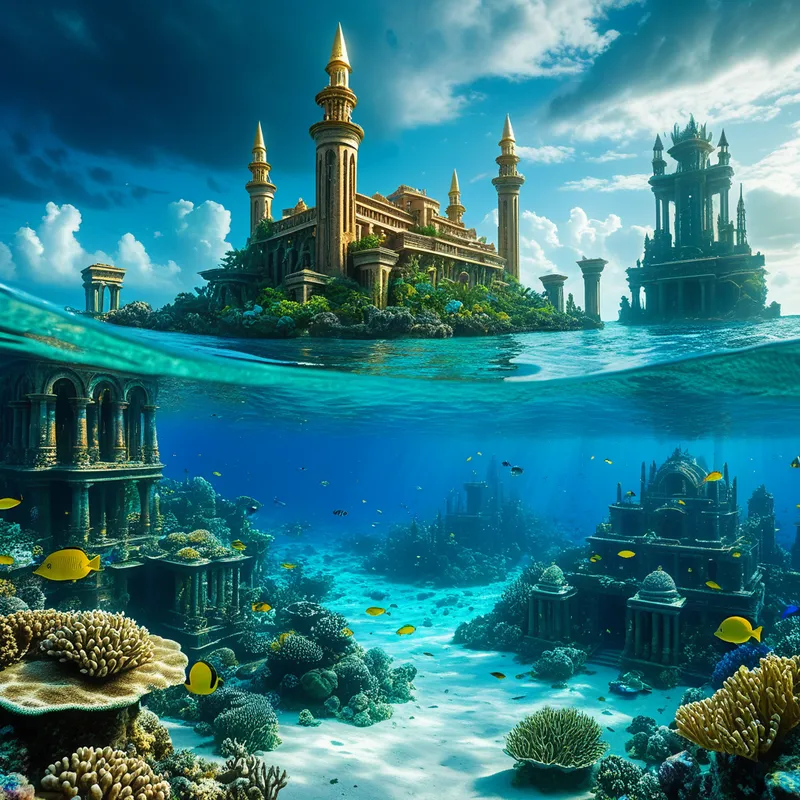
Sunken Cities Myth Meaning & Symbolism
A universal myth of cities lost beneath the waves, representing forgotten knowledge, divine judgment, and the treasures of the collective unconscious.
The Tale of Sunken Cities
Listen, and hear the whisper of the deep. It does not speak in words, but in the groan of shifting stone and the sigh of [water](/myths/water “Myth from Chinese culture.”/) filling empty halls. Once, they stood. Not one, but many. Places of such pride, such knowledge, such ringing metal and clattering looms that their names became legend: Atlantis, the ringed city of [Poseidon](/myths/poseidon “Myth from Greek culture.”/)’s children; Ys, the jewel of the Breton coast, protected by a mighty dyke and a single silver key; Dwarka, the golden fortress of the divine charioteer, [Krishna](/myths/krishna “Myth from Hindu culture.”/).
Their stories differ, yet [the sea](/myths/the-sea “Myth from Greek culture.”/)’s chorus is the same. In Atlantis, it began with a tremor in the blood of its people. They had tamed lightning in crystals and charted the paths of stars, but they forgot the rhythm of [the earth](/myths/the-earth “Myth from Hindu culture.”/). Their ambition became a weight, and the pillars of [the world](/myths/the-world “Myth from Tarot culture.”/) groaned beneath them. [The sea](/myths/the-sea “Myth from Greek culture.”/) did not attack; it merely answered the invitation of the sinking land. In one day and one night of terrible fire and unimaginable flood, the concentric circles of the city were pulled down, the screams of its people swallowed by the roar of collapsing ocean.
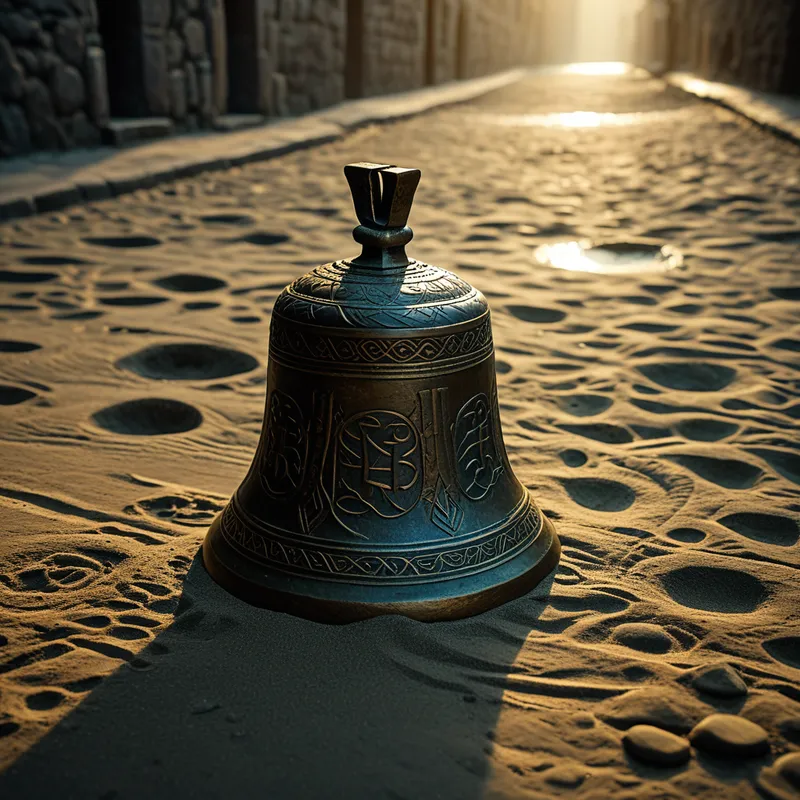
In the land of Brittany, the sin was not of empire, but of a stolen moment. For Ys was protected from the hungry waves only by a great dyke, and the key to its sea gate hung around the neck of its king, Gradlon. His daughter, Dahut, possessed by a reckless passion, stole the key for a lover cloaked in crimson. The gate was opened at high tide. The king awoke to the sound of the ocean’s victory cry, fleeing on his magical horse with his daughter clinging behind, until a divine voice commanded him to cast the sin-bearer into the waves to save himself. He did, and the waters pursued her, leaving only the mournful toll of the city’s bells beneath the bay.
And in the sacred texts of India, Dwarka’s end was an act of cosmic closure. After the great war and the passing of Krishna, the splendid city, built by divine decree, had fulfilled its purpose. The ocean rose not in anger, but as a reverent shroud, reclaiming the divine footprint from the mortal world. The waves took the glittering towers softly, as one might extinguish a lamp after a ceremony, leaving only memory and the promise that what was lost to sight was not lost to existence.
Cultural Origins & Context
The myth of the sunken city is not owned by one people; it is a haunting heirloom of humanity, found from the misty coasts of Cornwall (Lyonesse) to the islands of Japan (Ryūgū-jō). It is a story told by fishermen who glimpse strange shapes in the deep, by farmers whose plows turn up shells far from the shore, and by poets trying to name the ache for a lost [golden age](/myths/golden-age “Myth from Universal culture.”/).
These tales functioned as foundational parables. For Plato, Atlantis was a philosophical device—a cautionary tale of a utopia corrupted by hubris, used to illustrate his ideas on ideal governance and divine retribution. In Celtic Brittany, the story of Ys was a stark moral lesson about piety, paternal authority, and the consequences of sinful desire, often told to reinforce social and religious norms. In the Indian tradition, Dwarka’s submersion is a theological point, illustrating the transient nature of even divinely-established earthly manifestations and the inscrutable will of the cosmos. Passed down through epic poetry, local folklore, and sacred scripture, these stories gave communities a shared language for catastrophe, a reason for geographical mysteries, and a symbolic container for the universal fear of loss.
Symbolic Architecture
Psychologically, the [sunken city](/symbols/sunken-city “Symbol: A Sunken City signifies vast, hidden potential and deep-seated emotions, often embodying what lies beneath the surface of consciousness or societal awareness.”/) is not a place, but a state. It represents a complex within the [psyche](/myths/psyche “Myth from Greek culture.”/)—a once-conscious [structure](/symbols/structure “Symbol: Structure in dreams often symbolizes stability, organization, and the framework of one’s life, reflecting how one perceives their environment and personal life.”/) of [identity](/symbols/identity “Symbol: Identity represents the sense of self, encompassing personal beliefs, cultural background, and social roles.”/), belief, or capability that has been overwhelmed by the unconscious.
The [city](/symbols/city “Symbol: A city often symbolizes community, social connection, and the complexities of modern life, reflecting the dreamer’s relationships and societal integration.”/) itself symbolizes the organized, civilized, and complex achievements of the conscious ego: law, art, technology, and society. Its sinking signifies a catastrophic [regression](/symbols/regression “Symbol: A psychological or spiritual return to earlier states of being, often involving revisiting past patterns, memories, or developmental stages for insight or healing.”/), a failure of [adaptation](/symbols/adaptation “Symbol: The process of adjusting to new conditions, often involving psychological or physical change to survive or thrive.”/) where the conscious [attitude](/symbols/attitude “Symbol: Attitude symbolizes one’s mental state, perception, and posture towards life, influencing emotions and actions significantly.”/) cannot withstand the rising tide of repressed [material](/symbols/material “Symbol: Material signifies the tangible aspects of life, often representing physical resources, desires, and the physical world’s influence on our existence.”/)—instincts, emotions, or forgotten traumas. The [water](/symbols/water “Symbol: Water symbolizes the subconscious mind, emotions, and the flow of life, representing both cleansing and creation.”/) is the primordial, undifferentiated unconscious itself, both creative and destructive.
The sunken city is the psyche’s own museum, holding the artifacts of who we once tried to be.
The cause of the sinking is the critical [symbol](/symbols/symbol “Symbol: A symbol can represent an idea, concept, or belief, serving as a powerful tool for communication and understanding.”/). Was it hubris (Atlantis), a failure of guardianship or a succumbed temptation (Ys), or a natural, purposeful [conclusion](/symbols/conclusion “Symbol: A conclusion can symbolize resolution, closure, and the finality of experiences or decisions.”/) to a cycle (Dwarka)? Each cause points to a different psychological [fault](/symbols/fault “Symbol: A fault signifies an imperfection or error, often representing feelings of guilt or inadequacy in dreams.”/) line. The [treasure](/symbols/treasure “Symbol: A hidden or valuable object representing spiritual wealth, inner potential, or divine reward.”/) said to remain in the city—lost [knowledge](/symbols/knowledge “Symbol: Knowledge symbolizes learning, understanding, and wisdom, embodying the acquisition of information and enlightenment.”/), golden bells, divine weapons—represents the latent potential and invaluable psychic [energy](/symbols/energy “Symbol: Energy symbolizes vitality, motivation, and the drive that fuels actions and ambitions.”/) that resides in these submerged complexes, waiting for reclamation.
The Dreamer’s Resonance
When the sunken city appears in a modern dream, the dreamer is encountering a profound sense of personal archaeology. The somatic experience is often one of weight, slow motion, and muffled sound—the feeling of being submerged in one’s own emotional or historical depths.
To dream of walking its silent streets is to explore a neglected aspect of [the self](/myths/the-self “Myth from Jungian culture.”/). Perhaps it is a lost talent abandoned for practicality, a childhood passion drowned by duty, or a traumatic memory that forced a part of the personality to submerge for survival. The dreamer might feel awe at the preserved beauty, fear of the dark water above, or grief for the loss. This is the psyche initiating a process of recollection. The dream is not a command to rebuild the city as it was, but to dive, to witness, and to retrieve specific symbols—the equivalent of the legendary bell or scroll—that are needed for the dreamer’s current life. It is an invitation to integrate a lost wholeness.

Alchemical Translation
The myth of the sunken city models the [solutio](/myths/solutio “Myth from Alchemical culture.”/) stage of psychic alchemy—the dissolution of rigid forms into the fluid potential of the unconscious. This is not a failure, but a necessary phase in the individuation process.
The conscious ego, identified with its shining towers (its career, its [persona](/myths/persona “Myth from Greek culture.”/), its rigid beliefs), must experience this sinking. [The flood](/myths/the-flood “Myth from Biblical culture.”/) is a crisis—a depression, a failure, a betrayal—that washes away the unsustainable structures. This is a terrifying but sacred descent. The goal of alchemy is not to avoid the drowning, but to learn to breathe underwater; to find that the true self is not the city, but the awareness that can navigate both the surface and the deep.
Individuation requires the courage to lose the map of the known world and learn the currents of the inner sea.
The [triumph](/myths/triumph “Myth from Roman culture.”/) in these myths is never the city’s physical restoration. It is Gradlon’s survival to found a new kingdom, or the sage’s retrieval of Atlantis’s wisdom for a new age, or the devotee’s faith that Dwarka exists in a higher reality. Psychically, this translates to the emergence of a new attitude. [The ego](/myths/the-ego “Myth from Jungian culture.”/), having acknowledged its drowned chapters, is no longer brittle but resilient, informed by the depths. The treasure brought up from the sunken city becomes [the cornerstone](/myths/the-cornerstone “Myth from Biblical culture.”/) of a more authentic life, built not on the fear of sinking, but on the knowledge of what lies beneath. The city remains below, a foundational part of the whole, and its silent bells now ring in the rhythm of a deeper, more integrated soul.
Associated Symbols
Explore related symbols from the CaleaDream lexicon: