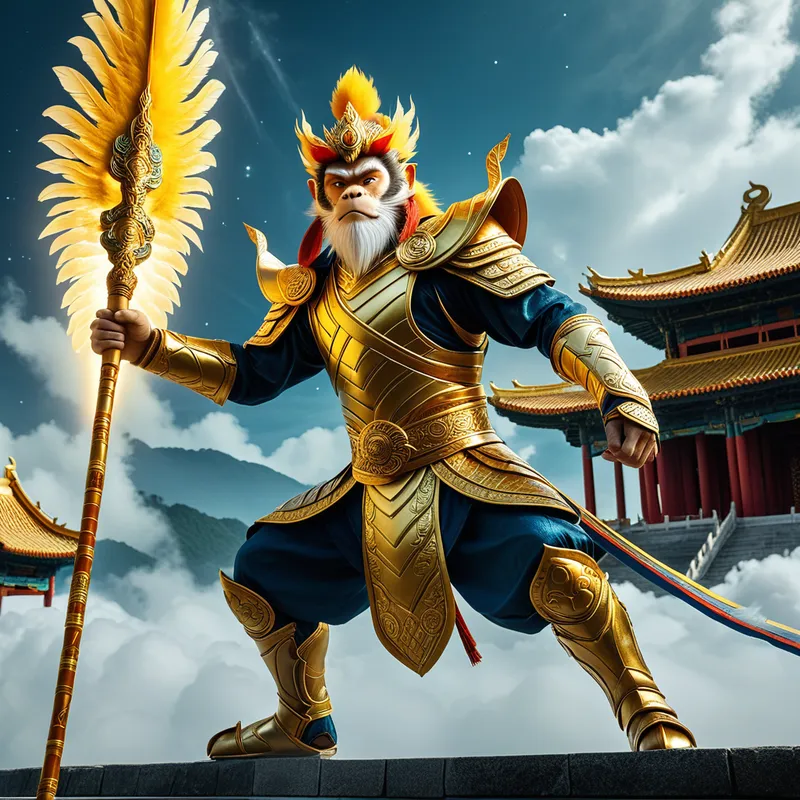
Sun Wukong Myth Meaning & Symbolism
A stone-born monkey defies heaven, gains immense power, is subdued, and embarks on a sacred journey to find his true place in the cosmic order.
The Tale of Sun Wukong
Listen, and hear the tale of the stone that dreamed.
From a stone atop the Mountain of Flowers and Fruit, kissed by heaven’s wind and earth’s essence, he was born. Not with a cry, but with a beam of light that pierced the clouds, startling the Jade Emperor on his throne. This was Sun Wukong, the Monkey King. He ruled his mountain kingdom in bliss, but a chill of mortality touched his heart. He would not fade. He sought the way of the eternal.
Across seas and continents, he found a sage. He learned the arts: the seventy-two earthly transformations, the cloud somersault that carried him ten thousand miles in a single leap. He returned, a lord of power. From the undersea palace of the Dragon King Ao Guang, he took his birthright—the Ruyi Jingu Bang, a pillar that could shrink to a needle or stretch to the stars. In the ledgers of the underworld, he scrawled out his name and the names of all his kind, defying death itself.
Heaven trembled. To placate this chaos, the Jade Emperor offered a title: Keeper of the Heavenly Horses. A clerk’s post. When Wukong learned the truth, his wrath was a storm. He ate the Peaches of Immortality, drank the celestial wine, devoured the Pills of Longevity. He was invincible, a whirlwind of gold and fury in the halls of heaven. No warrior could subdue him.
Until Buddha came. Wukong, boasting he could leap beyond the Buddha’s palm, somersaulted to the ends of creation. He marked a mountain as his proof. But those five pillars were but the fingers of the Buddha’s hand. He had never left. As punishment, the mountain of the five elements fell upon him, burying him for five hundred years.
There, in the dark and the weight, his story might have ended. But a call came. A monk, Tang Sanzang, journeyed west for sacred scriptures. He needed a protector. Wukong was freed, but a golden band was placed upon his head. With a chant, it tightened, a ring of fire around his wild mind. Master and disciple, the refined and the raw, began their pilgrimage. Wukong fought demons not just of the road, but of his own nature—his pride, his impatience, his rage. He was cast out, he returned. He was misunderstood, he persevered. Through eighty-one trials, the rebel learned devotion. At journey’s end, having conquered the final illusions, the Buddha smiled. The rebellious monkey was transformed, achieving the title he had always sought but never understood: Dou Sheng Fo. The stone-born dreamer had found his true place, not by conquering heaven, but by mastering the chaos within.
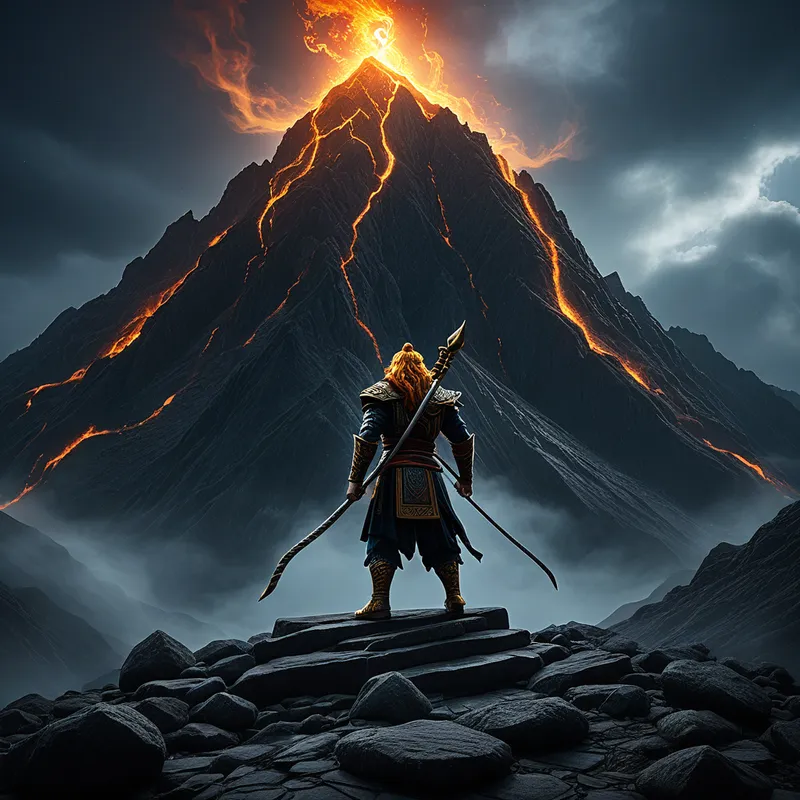
Cultural Origins & Context
The epic of Sun Wukong is the vibrant heart of the 16th-century novel Journey to the West, attributed to Wu Cheng’en. However, his roots dig deeper into the soil of Chinese folklore, Daoist alchemy, and Buddhist parable. He is a folk hero who evolved, a trickster figure from oral traditions who was grafted onto a grand religious narrative. The novel itself served as a vehicle for popularizing Buddhist teachings in a wildly entertaining form, a sacred journey wrapped in a picaresque adventure.
Told in tea houses, performed in operas, and eventually broadcast to millions, the story functioned on multiple levels. For the common people, it was a thrilling tale of an underdog challenging a rigid, bureaucratic heaven—a cathartic fantasy of rebellion. For the scholarly and religious, it was an allegory for the spiritual path: the monk (Tang Sanzang) represents the seeking consciousness, while his disciples, especially Wukong, embody the raw psychic forces (mind, emotion, will) that must be disciplined and integrated to achieve enlightenment. The story is a cultural crucible, blending indigenous Chinese cosmology with imported Buddhist philosophy, creating a uniquely Chinese model of spiritual ascent.
Symbolic Architecture
Sun Wukong is the archetypal unintegrated libido, the raw, creative, and rebellious life force that precedes consciousness. He is the prima materia of the soul—brilliant, powerful, and dangerously chaotic.
The stone birth is not a beginning of life, but the emergence of consciousness from the unconscious, mineral depths of the psyche.
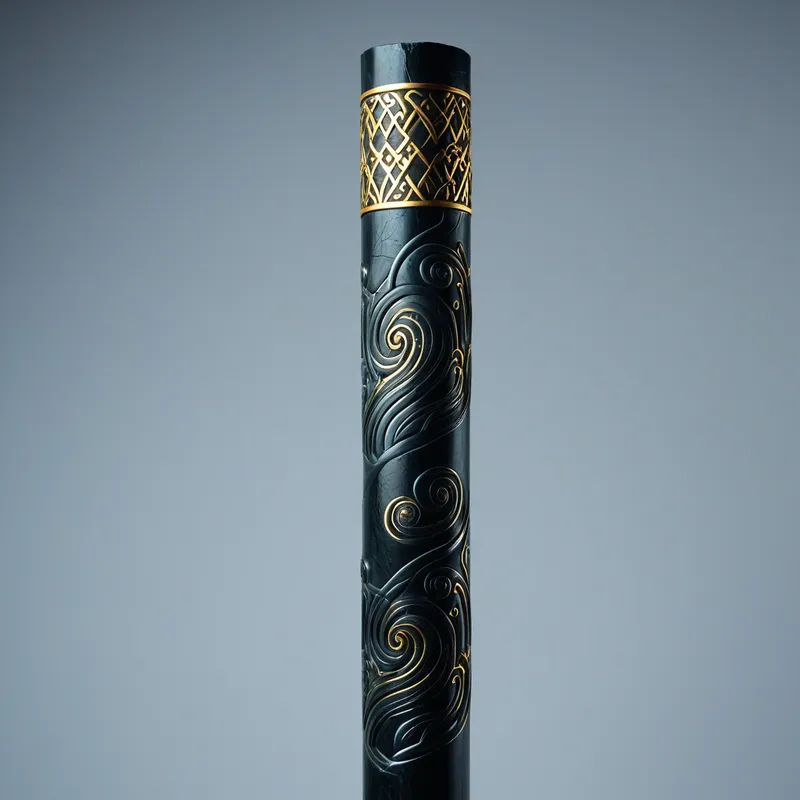
His magical abilities symbolize the boundless potential of the untamed mind: the transformations are its adaptability, the cloud somersault its capacity for instant fantasy and evasion. The Ruyi Jingu Bang is a profound symbol of the empowered will. It comes from the sea (the unconscious), adjusts to any situation (as-you-will), and is a tool for both destruction and protection. It is the spine of the individual, the axis of one’s personal power.
His rebellion in heaven is the necessary, inflationary inflation of the ego. It must test its strength against the established order (the super-ego, societal norms, parental complexes) to discover its limits. The mountain that crushes him is the inevitable confrontation with a reality principle greater than egoic desire—the law of consequence, the structure of the cosmos itself. The imprisonment is the dark night of the soul, where grandiosity is humbled into potential.
The pilgrimage is the process. The golden band is the binding agreement to a higher purpose, the conscious suffering (the headache) that arises when one’s wild nature conflicts with one’s chosen path. The demons are not just external obstacles, but projections of the pilgrim’s own unresolved shadows—greed, lust, deception, pride—which must be faced and overcome.
The Dreamer’s Resonance
When Sun Wukong appears in the modern dreamscape, he signals a profound activation of the rebel archetype within the psyche. The dreamer may be experiencing a powerful, restless energy that feels both exhilarating and destructive.
Dreaming of boundless leaps or shape-shifting may reflect a feeling of being uncontained by life’s roles, a desire to escape limitations. Dreaming of being trapped under a weight, yet still able to speak and see, often mirrors a somatic experience of intellectual or creative constraint—knowing one’s power but feeling crushed by responsibility, bureaucracy, or depression. The golden band tightening is a classic anxiety dream motif, representing the tension between a fierce desire for autonomy and an internalized authority (a job, a relationship, a moral code) that induces psychic pain when crossed.
These dreams point to a critical stage: the raw, inventive, and rebellious spirit (the inner Monkey King) is demanding recognition. It is no longer content to be buried. The psyche is initiating its own journey to the west, seeking to integrate this formidable energy into a cohesive Self.
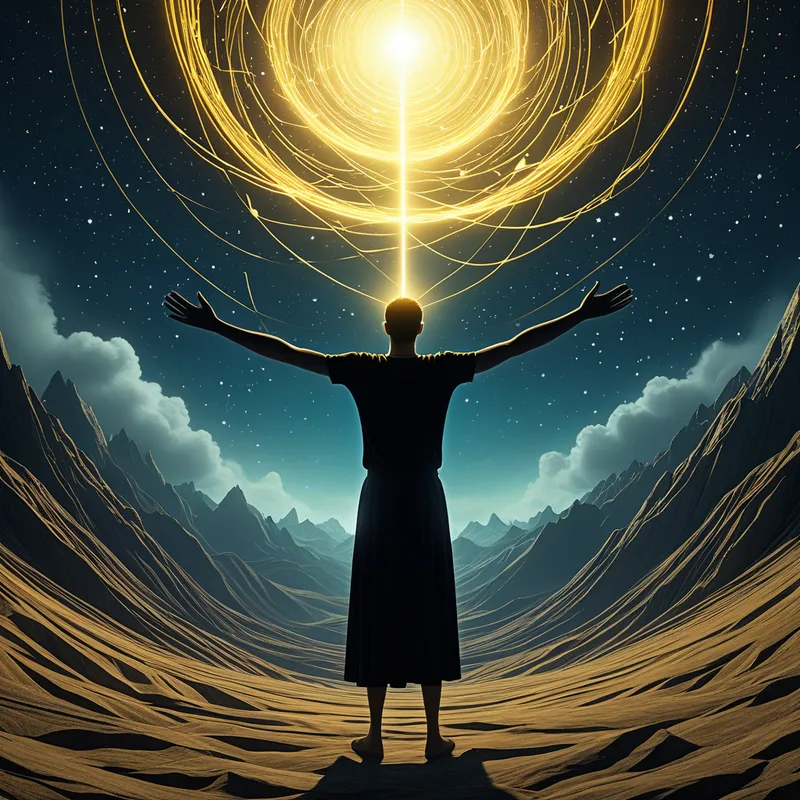
Alchemical Translation
The myth of Sun Wukong is a complete map of individuation. It begins with the nigredo, the blackening: the emergence of the chaotic, stone-born consciousness (the birth of a complex, a new awareness, a disruptive talent). This is followed by the inflationary albedo, the whitening: the acquisition of powers, the rebellion, the brilliant but misguided attempt to make the ego the center of the universe (professional success without wisdom, intellectual pride).
The mountain is not a prison, but the alchemical vessel where the raw stone is cooked under pressure into something capable of holding a sacred purpose.
The crushing under the Five Elements Mountain is the necessary mortificatio, the death of pure egoic inflation. This period of enforced stillness—which could manifest as burnout, failure, or deep introspection—is where the material is prepared for transformation. The call of the monk is the emergence of the Self, the organizing principle of the psyche that promises meaning beyond the ego’s gratification.
The pilgrimage is the arduous citrinitas, the yellowing, and final rubedo, the reddening. Here, the golden, solar energy of Wukong (active consciousness, the hero function) is placed in service to the pale, lunar consciousness of the monk (receptivity, faith, the spiritual principle). Each demon slain is a complex integrated; each reconciliation with the master is a reconciliation between will and wisdom. The golden band becomes not a torture device, but the conjunctio, the sacred marriage between limitless potential and compassionate discipline.
Achieving the title of Dou Sheng Fo is the culmination. The rebellious life force is not eradicated, but enlightened. The power that once sought to rule heaven is now the power that protects the sacred journey of consciousness itself. The individual no longer has a rebellious spirit; they are the integrated rebel, whose defiance is now directed not at external heavens, but at the inner demons that obstruct the path to wholeness. The stone has become the Buddha.
Associated Symbols
Explore related symbols from the CaleaDream lexicon: