Summit of Vulture Peak Myth Meaning & Symbolism
The Buddha silently holds up a flower, transmitting the ineffable truth of reality to a single disciple who understands, birthing a wordless lineage.
The Tale of Summit of Vulture Peak
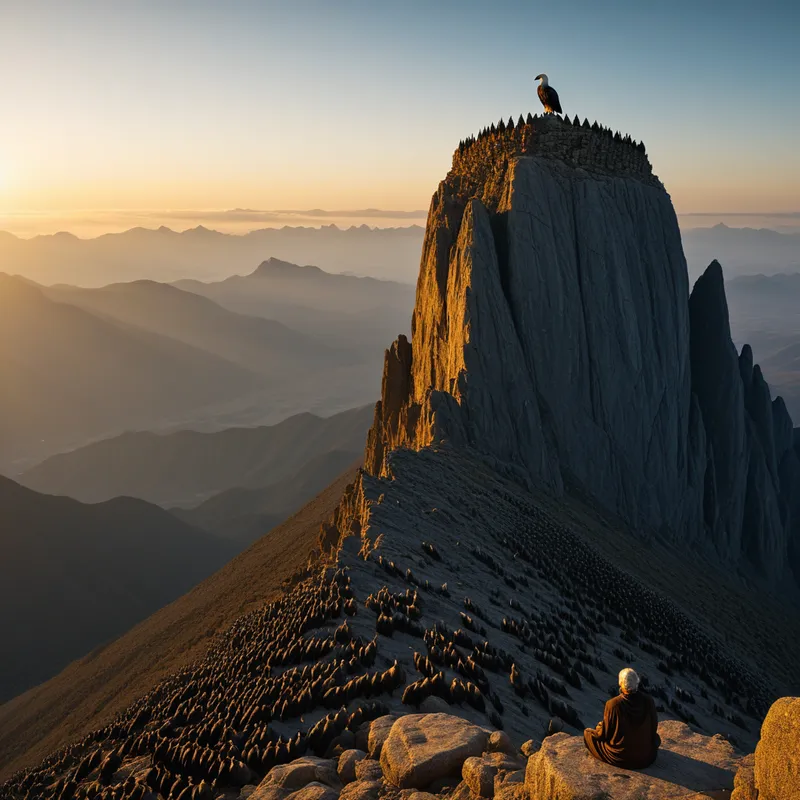
Listen. The air on the Vulture Peak is thin, sharp with the scent of pine and cold stone. The assembly is vast—thousands of bhikkhus, kings, and deities have gathered, their robes a sea of ochre and white rustling in the high wind. They have come for the Dharma, for the nectar of the Tathagata’s words, which turn the wheel of the law and cut through the world’s sorrow. Silence falls, heavier than the mountain itself. All eyes are on the one seated on the lion-throne of rock.
Shakyamuni Buddha does not speak. He does not open the sutras of conditioned origination or the paths to cessation. His face is a still pool reflecting an infinite sky. Minutes stretch like lifetimes. The confusion in the assembly is a palpable hum—a rustle of robes, a cleared throat, the unasked question hanging in the air: Why does he not teach?
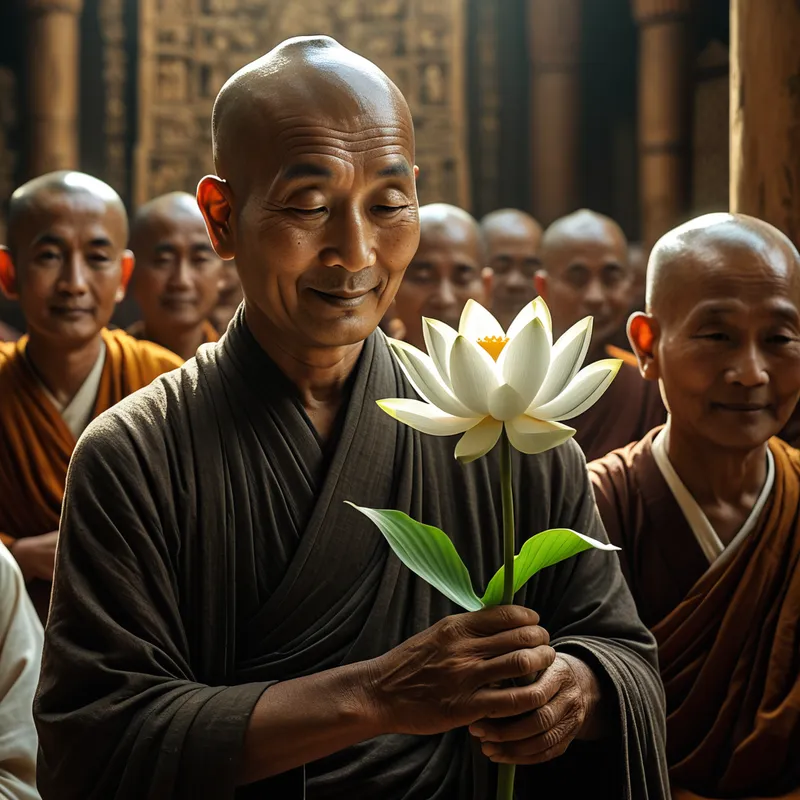
Then, a movement, simple and devastating. Slowly, with a grace that holds all time, the Buddha raises his right hand. Between his finger and thumb, he holds a single flower. It is not a grand blossom, but a simple, perfect white bloom, dew still clinging to its petals, a fragile universe unto itself. He holds it aloft, turning it slightly, saying everything by saying nothing.
The sea of faces is a map of bewilderment. Learned scholars frown, trying to parse the doctrinal meaning. Devotees search for a hidden sign. The silence deepens, becoming an abyss into which all concepts fall. Then, from the front of the assembly, a sound breaks the stillness—not a word, but a soft, human exhalation. It is the elder Mahakashyapa. He has not moved, but his weathered face, lined with years of rigorous practice, undergoes a transformation. The stern lines soften. His eyes, which have witnessed decades of striving, now sparkle with a recognition so deep it bypasses the mind entirely. A smile blossoms on his lips—a slight, profound, and utterly knowing smile.
The Buddha’s gaze meets Mahakashyapa’s. In that glance, the cosmos turns. “I possess the Treasury of the True Dharma Eye, the ineffable mind of Nirvana,” the Buddha declares, his voice now filling the peak, “and I transmit it to Mahakashyapa.” No scripture was recited. No philosophy debated. On that windy summit, with a flower and a smile, the wordless heart of reality was passed from one awakened mind to another. The vultures circling high above were the only witnesses to this silent thunder.
Cultural Origins & Context
This story, known as “The Flower Sermon,” is a foundational koan within the Chan and Zen traditions. It is first recorded in the 11th-century Chinese text The Jingde Record of the Transmission of the Lamp, a compilation meant to authenticate the lineage of masters. Its function was not historical documentation in a modern sense, but mythological authentication. It served as the primordial “proof” of the direct, mind-to-mind transmission outside of orthodox scriptures, establishing the legitimacy of the Zen patriarchal lineage that traced itself back to Mahakashyapa.
The setting on Vulture Peak (Griddhakuta) is significant, as it was a real and frequent teaching site for the historical Buddha. By placing this wordless event there, the myth sanctifies the location as the birthplace of a transcendental, esoteric tradition within the broader Buddhist framework. It created a cultural and spiritual “origin story” for a path that valued experience over exegesis, sudden awakening over gradual study, and the intimate recognition between teacher and disciple over public doctrine.
Symbolic Architecture
The myth is a masterclass in symbolic economy. Every element is a door to the ineffable.
The Vulture Peak itself is not just a setting but a symbol of the aspirant’s journey. It is high, remote, and austere—a place where the mundane world falls away, and only the essential remains. The vulture, a consumer of corpses, represents the transcendent insight that feeds on the death of illusion, of the conceptual self.
The flower is the entire Dharma, blooming without cause, perfect in its suchness, requiring no explanation to be what it is.
The Flower is the central icon. It represents reality in its pristine, unconditioned state—beautiful, transient, and complete in itself. It is the thusness (tathata) of all phenomena, pointing to a truth that is perceived, not constructed by words. The Buddha’s act of holding it up is the ultimate teaching: reality is right here, right now, in this very perception.
Mahakashyapa’s Smile is the human response to that revelation. It is the moment of satori, the sudden, intuitive understanding that shatters the seeker’s mind. His smile signifies recognition, not acquisition. He does not get something new; he recognizes what was always, intimately his own nature. The transmission is not of an object but of a confirmation.
The Confused Assembly symbolizes the intellect, the grasping mind that seeks truth in concepts, words, and linear teachings. Their bewilderment is our own when faced with the absolute, which cannot be captured in the net of thought.
The Dreamer’s Resonance
When this myth pattern stirs in the modern dreamer, it speaks to a profound psychological crossroads. To dream of being on a high, stark peak signifies a state of existential isolation or a culmination of a long, arduous effort. The dreamer may feel they have reached a “peak” of understanding in their life, career, or therapy, only to find a puzzling silence or a simple, baffling image at the summit.
Dreaming of holding or being shown a singular, potent object—a flower, a stone, a key—in a context where words fail, points to the unconscious presenting a symbol of integration that bypasses the ego’s narrative. The somatic feeling is often one of awe mixed with frustration: “I see it, but I don’t understand it intellectually.” This is the psyche’s version of the Flower Sermon. The conflict between the longing for a clear explanation and the direct, wordless impact of the symbol is the core tension.
If the dreamer, in the dream, suddenly gets it and smiles—a deep, peaceful, knowing smile—it signals a moment of profound psychic alignment. It is the Self communicating directly to the conscious ego, a moment of intra-psychic “transmission” where a complex is dissolved not through analysis, but through recognition. The feeling upon waking is often one of deep peace and unshakable certainty, even if the “meaning” cannot be articulated.
Alchemical Translation
Psychologically, the myth models the final, crucial phase of individuation: the reception of the Self’s authority. The long journey of analysis, confronting the shadow, and engaging with anima/animus is the arduous climb to the summit—the assembly of all one’s learned parts.
The alchemical gold is not manufactured; it is recognized in the base material when the heat of striving ceases.
The Buddha figure represents the archetypal Self, the central, organizing principle of the psyche that transcends the ego. His silence is the exhaustion of the ego’s projects. He stops “teaching” the ego how to be. Instead, he simply presents reality—the flower, the symbol of the integrated psyche in its natural state.
The ego, represented by the assembly, is confused because it expects a final, complex instruction. It wants one more concept to master. But the Self offers no concept, only a direct image of wholeness. Mahakashyapa represents that part of the ego-complex which is capable of surrender, of letting go of the need to know in order to simply see. His smile is the ego’s joyful capitulation to the Self, the moment it realizes its true function is not to rule but to witness.
For the modern individual, the “Alchemical Translation” is this: after all the work, the reading, the therapy, and the striving, there comes a point where one must stop trying to become whole and simply recognize the inherent wholeness that has been present all along. The transmission is internal. It is the moment your own deepest being “smiles” at your life, not because it is perfect, but because it is authentically, irreducibly yours. The peak is not a place of achievement, but of revelation. The vultures are not omens of death, but guardians of the truth that feeds on all that is false.
Associated Symbols
Explore related symbols from the CaleaDream lexicon: