Sudarshana Chakra Myth Meaning & Symbolism
The story of the divine disc, forged from cosmic light, that serves as the ultimate weapon of discernment, cutting through chaos to restore sacred order.
The Tale of Sudarshana Chakra
Listen. In the time before time, when the universe was a single, unbroken breath held in the dark, a sound stirred. It was the sound of a mountain being churned from the depths of the milky ocean. Not a mountain of stone, but a mountain of light, of potential, of all things that are and could be. From this churning, from the agony and ecstasy of gods and demons pulling on the great serpent Vasuki, treasures emerged. [The moon](/myths/the-moon “Myth from Tarot culture.”/), the wish-fulfilling cow, the goddess of fortune. But the final, most terrifying treasure was a wheel of such pure, concentrated reality it could not be held.
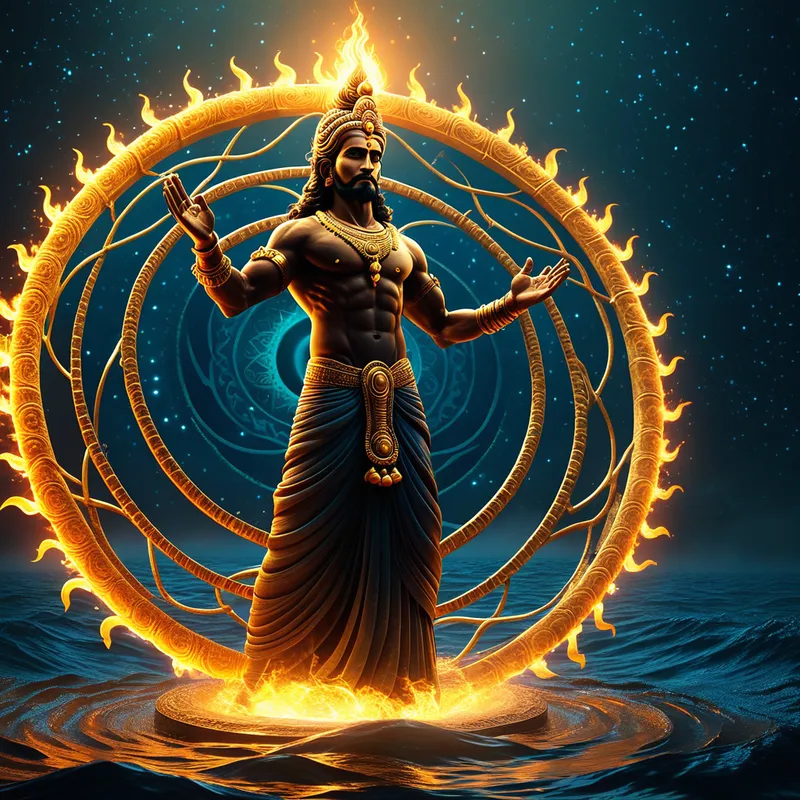
It was not forged in a furnace, but crystallized from the very essence of [Vishnu](/myths/vishnu “Myth from Hindu culture.”/)‘s will. It was the distillation of cosmic law, of dharma itself, given form as a weapon. They called it Sudarshana Chakra. It rested in the palm of [Vishnu](/myths/vishnu “Myth from Hindu culture.”/), who rests upon the endless coils of [the world](/myths/the-world “Myth from Tarot culture.”/)-serpent [Shesha](/myths/shesha “Myth from Hindu culture.”/) in the ocean of causality. It was calm, a jewel-like disc. But when the order of the worlds was threatened, when a demon grew so powerful he thought himself the axis of creation, when chaos and arrogance threatened to unravel the woven [threads of fate](/myths/threads-of-fate “Myth from Greek culture.”/)—then the Chakra awoke.
It would leave Vishnu’s finger with a sound like the tearing of [the sky](/myths/the-sky “Myth from Persian culture.”/)‘s fabric. It became a sun, a wheel of fire with a thousand spokes, each a ray of unanswerable truth. It hummed with the primordial mantra of creation and destruction. It pursued its target across the three worlds—through the heavens, across [the earth](/myths/the-earth “Myth from Hindu culture.”/), into the darkest nether-realms—not with malice, but with the inevitability of a mathematical equation solving itself. It did not hate the demon; it simply recognized him as a flaw in the pattern, an error in the code of the cosmos that needed correction. With a flash that was both blinding and illuminating, it would sever. Not just the head from the body, but the illusion from the truth, [the ego](/myths/the-ego “Myth from Jungian culture.”/) from the soul, the chaotic desire from the divine plan. And then, its work done, steaming with the heat of its purpose, it would return, settling back onto Vishnu’s finger, a silent, perfect circle once more. The universe would exhale. Order was restored.
Cultural Origins & Context
The Sudarshana Chakra is not a myth with a single, linear story. It is a pervasive symbol woven into the vast tapestry of Hindu Puranic literature, appearing across countless narratives in texts like the Mahabharata, the Vishnu Purana, and the Bhagavata Purana. Its origin story, as part of the cosmic churning of the ocean, places it at the very foundation of the world’s manifest treasures. This was not a tale told merely for entertainment; it was a theological and philosophical anchor.
Passed down by priests (purohits) and storytellers (kathakas), the Chakra served a critical societal function. In a culture deeply concerned with dharma (righteous order) and the perpetual struggle against adharma (chaos), the Sudarshana Chakra was the ultimate guarantor. It visually and narratively reinforced the idea that the cosmos has a self-correcting mechanism. No tyranny, no matter how powerful, is absolute. The divine order, though sometimes patient, possesses an instrument of flawless, surgical [justice](/myths/justice “Myth from Tarot culture.”/). It comforted the populace and warned rulers: there is a higher law, and it has a very sharp edge.
Symbolic Architecture
At its core, the Sudarshana [Chakra](/symbols/chakra “Symbol: In Hindu and yogic traditions, chakras are energy centers along the spine that govern physical, emotional, and spiritual well-being.”/) is a [symbol](/symbols/symbol “Symbol: A symbol can represent an idea, concept, or belief, serving as a powerful tool for communication and understanding.”/) of transcendent discernment. It is not a blunt [instrument](/symbols/instrument “Symbol: An instrument symbolizes creativity, communication, and the means by which one expresses oneself or influences the world.”/) of rage, but a precise tool of wisdom.
The wheel does not create the path; it reveals it by cutting away all that is not the path.
Its circular, spinning form represents the cyclical [nature](/symbols/nature “Symbol: Nature symbolizes growth, connectivity, and the primal forces of existence.”/) of time (kala) and the [universe](/symbols/universe “Symbol: The universe symbolizes vastness, interconnectedness, and the mysteries of existence beyond the individual self.”/) itself. Its center is the unmoving [axis](/symbols/axis “Symbol: A central line or principle around which things revolve, representing stability, orientation, and the fundamental structure of reality or consciousness.”/), the still point of [consciousness](/symbols/consciousness “Symbol: Consciousness represents the state of awareness and perception, encompassing thoughts, feelings, and experiences.”/)—Brahman, or Vishnu’s own unwavering resolve. The spokes are the radiating paths of dharma, the manifold ways order expresses itself. The razor-sharp rim is the discriminating intellect (buddhi) that separates [truth](/symbols/truth “Symbol: Truth represents authenticity, honesty, and the quest for knowledge beyond mere appearances.”/) from falsehood, self from not-self.
Psychologically, it represents the faculty of clear, uncompromising judgment that resides beyond the personal ego. It is the “sword of discrimination” (viveka) in its most potent, archetypal form. The [demon](/symbols/demon “Symbol: Demons often symbolize inner fears, repressed emotions, or negative aspects of oneself that the dreamer is struggling to confront.”/) it pursues and severs is not an external [enemy](/symbols/enemy “Symbol: An enemy in dreams often symbolizes an internal conflict, self-doubt, or an aspect of oneself that one struggles to accept.”/), but the internal [demon](/symbols/demon “Symbol: Demons often symbolize inner fears, repressed emotions, or negative aspects of oneself that the dreamer is struggling to confront.”/) of ignorance (avidya), the inflated ego that believes itself to be separate and supreme. The Chakra’s [pursuit](/symbols/pursuit “Symbol: A chase or being chased in dreams often reflects unresolved anxieties, unfulfilled desires, or internal conflicts demanding attention.”/) across all three worlds mirrors the [psyche](/myths/psyche “Myth from Greek culture.”/)‘s [journey](/symbols/journey “Symbol: A journey in dreams typically signifies adventure, growth, or a significant life transition.”/)—it will [chase](/symbols/chase “Symbol: Dreaming of a chase often symbolizes avoidance of anxiety or confrontation, manifesting as fleeing from something threatening or overwhelming in one’s waking life.”/) a destructive complex through the [heights](/symbols/heights “Symbol: Represents ambition, fear, or spiritual elevation. Often symbolizes life challenges or a desire for perspective.”/) of our ideals, the plains of our daily [life](/symbols/life “Symbol: The symbol of ‘Life’ represents a journey of growth, interconnectedness, and existential meaning, encompassing both the joys and challenges that define human experience.”/), and into the hellish [depths](/symbols/depths “Symbol: Represents the subconscious, hidden emotions, or foundational aspects of the self, often linked to primal fears or profound truths.”/) of our repressed [shadow](/symbols/shadow “Symbol: The ‘shadow’ embodies the unconscious, repressed aspects of the self and often represents fears or hidden emotions.”/), until it is resolved.
The Dreamer’s Resonance
When this mythic pattern stirs in the modern unconscious, it often manifests in dreams of spinning wheels, brilliant lights, or being pursued by—or wielding—a tool of immense, precise power. The somatic feeling is one of intense, focused energy, a humming vibration in the chest or head, often paired with a sense of impending, necessary severance.
The dreamer is likely in a psychological state where a long-tolerated “chaos” has reached a critical mass. This could be a toxic relationship, a self-deceptive narrative, a career built on false premises, or a bundle of compulsive behaviors. The psyche is mobilizing its own “Sudarshana Chakra”—the innate capacity for ruthless truth-telling. The anxiety in the dream is the ego’s resistance to this inner surgery; the awe and relief upon the “cut” is the soul recognizing its liberation from a parasitic pattern. The dream is an announcement: the time for compromise with your personal demon is over. The faculty of discernment has been activated.
Alchemical Translation
The individuation process, the journey toward psychic wholeness, requires precisely the operation modeled by the Sudarshana Chakra. It is the alchemical [separatio](/myths/separatio “Myth from Alchemical culture.”/), the essential stage where the pure must be divided from the impure.
Individuation is not about adding more to the self, but about the courageous subtraction of all that is not the self.
First, we must recognize our personal “demon”—the inflated complex, the golden shadow of a talent turned tyrannical, or the leaden weight of a victim identity that secretly enjoys its power. We often believe we are this complex. The Chakra’s first lesson is that we are not; we are the consciousness from which it can be distinguished.
The “churning of the ocean” is the initial, often turbulent, work of therapy, meditation, or crisis that brings this complex to the surface. The “ignition” of the Chakra is the moment of profound insight, where we see the truth with blinding clarity, unpolluted by sentiment or fear. The “pursuit” is the hard, ongoing work of integrating this insight, applying this new discrimination to every corner of our lives, not letting the old pattern hide. Finally, the “return” of the Chakra to Vishnu’s hand symbolizes the internalization of this faculty. Discernment is no longer a sporadic, dramatic event, but a constant, calm attribute of the centered Self. The weapon is at rest because its truth has become the fabric of our being. We achieve not a sterile perfection, but a dynamic order where chaos is met not with panic, but with the serene, certain spin of understanding.
Associated Symbols
Explore related symbols from the CaleaDream lexicon: