Stupa Myth Meaning & Symbolism
A sacred reliquary born from cosmic reverence, the Stupa is a mountain, a mandala, and a map of the enlightened mind, containing the Buddha's essence.
The Tale of Stupa
In the time after the Great Passing, when the Buddha had entered Parinirvana, a profound silence fell upon [the world](/myths/the-world “Myth from Tarot culture.”/). [The earth](/myths/the-earth “Myth from Hindu culture.”/) itself seemed to hold its breath. His disciples, the [Sangha](/myths/sangha “Myth from Buddhist culture.”/), were adrift on a sea of grief, their guiding light extinguished. The king of the Mallas, rulers of the land where the Awakened One breathed his last, decreed that his sacred remains be honored.
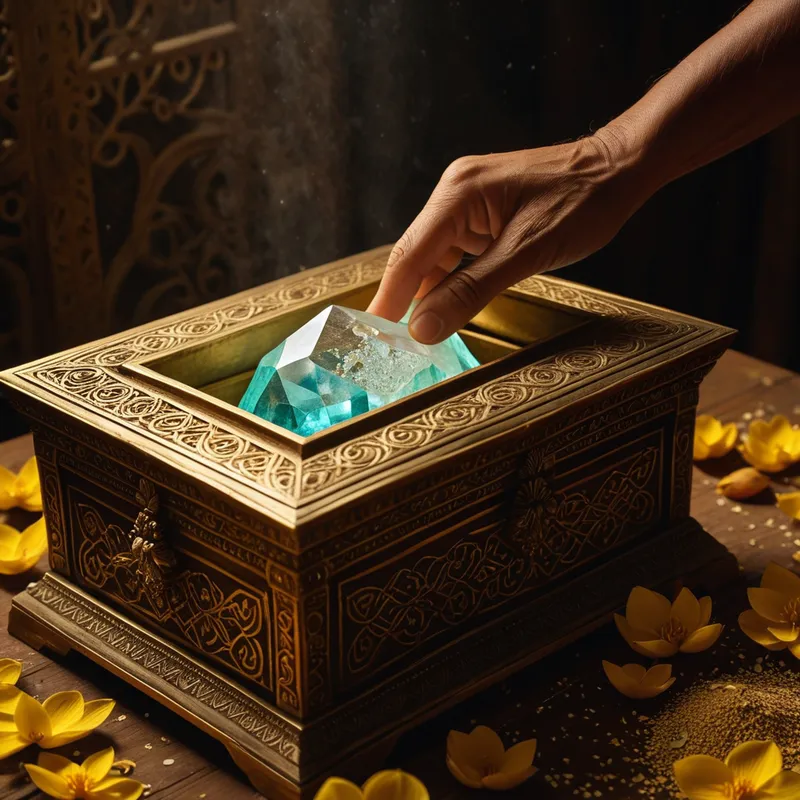
From the funeral pyre, which burned with a fragrant, smokeless flame, there remained not ash, but relics. These were not mere bones; they were crystalline, [pearl](/myths/pearl “Myth from Chinese culture.”/)-like, and radiant—sarira—imbued with the essence of his realization. A great conflict arose! Seven kings and republics, each claiming a right born of devotion, marched their armies to claim these jewels of consciousness. The air crackled with the potential for war over the physical vestiges of the one who taught peace.
A wise brahmin named Dona stepped into the center of the gathering storm. He raised his hands before the assembled kings and generals. “Will you spill blood,” he cried, his voice cutting through the tension, “over he who spilled none? Shall conflict be his final legacy?” His words hung in the air, heavy as monsoon clouds. He proposed a solution of sacred division. The relics were to be shared, distributed equally among the claimants, so that the Dharma might be seeded far and wide.
And so it was done. With reverence that stilled the clatter of armor, the relics were divided. Each king received his portion, his face illuminated not by [triumph](/myths/triumph “Myth from Roman culture.”/), but by awe. They returned to their lands not with spoils of war, but with a solemn duty. “Build,” whispered the memory of [the Buddha](/myths/the-buddha “Myth from Buddhist culture.”/). “Build not a monument to a man, but a vessel for the truth. A point where earth reaches for [the sky](/myths/the-sky “Myth from Persian culture.”/), where the mind can turn inward and find its own pinnacle.”
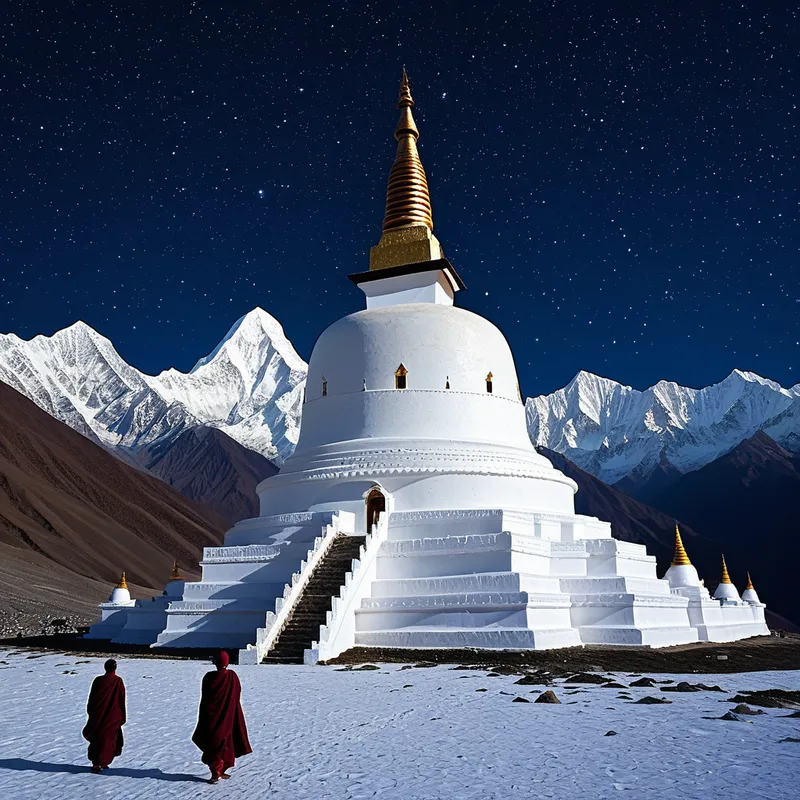
Thus, across the Jambudvipa, the first stupas rose. They were built as cosmic mountains, their bases square and firm as the stable earth, their domes perfect as the vault of heaven, their spires a needle threading the world of form to the formless. At their heart, in chambers of stone and precious metal, the luminous relics were enshrined. And the people came. They did not come to worship, but to remember. They walked in slow, mindful circles around the great mounds, their footsteps tracing the path of the sun, the cycle of life, and the turning of the samsaric wheel toward its cessation. The Stupa stood silent, a teacher without words, containing the end of all journeys within its form.
Cultural Origins & Context
The mytho-historical origins of the stupa are deeply entwined with the foundational narrative of the Buddha’s passing, as preserved in the Sutta Pitaka. This was not merely an architectural brief; it was a societal and psychological response to a cosmic event—the departure of the ultimate teacher. The story served a critical function: it transformed paralyzing grief into structured veneration and provided a tangible focus for a devotion that explicitly rejected a permanent, personal god.
The tale was passed down by the monastic community as part of the Jataka and historical vamsa literature, but its primary custodians were the lay communities. It was told at construction sites, during festivals like Vesak, and by guides to pilgrims. Its societal function was multifaceted. It legitimized the stupa as a sacred site, encouraged royal patronage (dana) as a supreme merit-making activity, and provided a shared narrative that united diverse Buddhist cultures from Sri [Lanka](/myths/lanka “Myth from Hindu culture.”/) to the Himalayas. The stupa became the physical anchor of the Sangha in a landscape, a beacon for pilgrimage, and a constant, silent sermon on [impermanence](/myths/impermanence “Myth from Buddhist culture.”/) and enlightened potential.
Symbolic Architecture
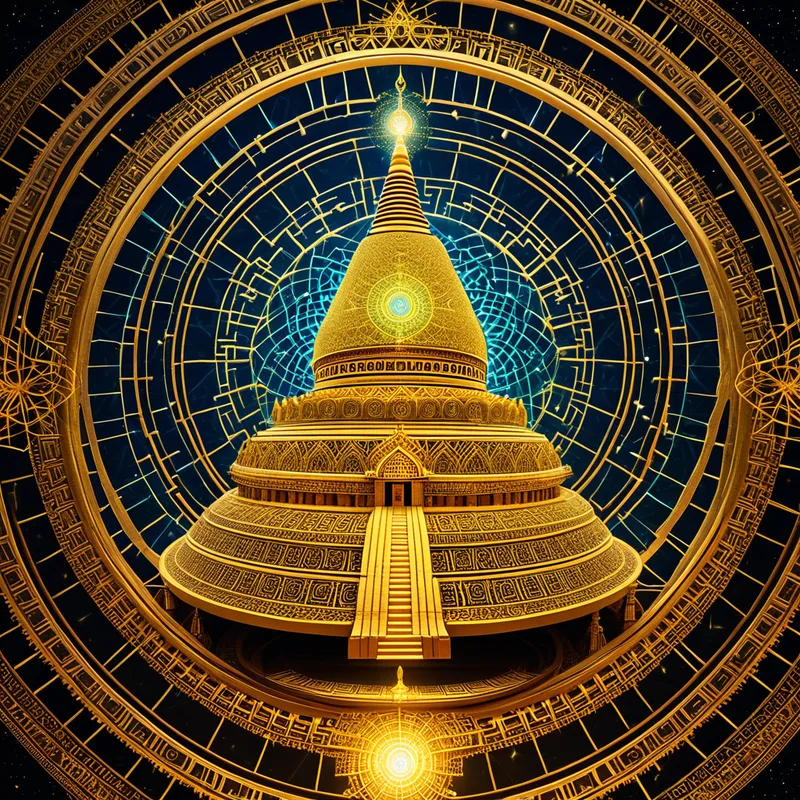
The [stupa](/symbols/stupa “Symbol: A Buddhist monument representing enlightenment, the Buddha’s mind, and the path to spiritual awakening through its architectural symbolism.”/) is not a building; it is a three-dimensional [mandala](/symbols/mandala “Symbol: A sacred geometric circle representing wholeness, the cosmos, and the journey toward spiritual integration.”/) and an anatomical map of enlightened [consciousness](/symbols/consciousness “Symbol: Consciousness represents the state of awareness and perception, encompassing thoughts, feelings, and experiences.”/). Every element is a profound [symbol](/symbols/symbol “Symbol: A symbol can represent an idea, concept, or belief, serving as a powerful tool for communication and understanding.”/).
Its square base represents the [earth](/symbols/earth “Symbol: The symbol of Earth often represents grounding, stability, and the physical realm, embodying a connection to nature and the innate support it provides.”/) and [stability](/symbols/stability “Symbol: A state of firmness, balance, and resistance to change, often represented by solid objects, foundations, or steady tools.”/), the [foundation](/symbols/foundation “Symbol: A foundation symbolizes the underlying support systems, values, and beliefs that shape one’s life, serving as the bedrock for growth and development.”/) of mindfulness. The hemispherical [dome](/symbols/dome “Symbol: A dome symbolizes shelter, protection, and the boundaries we place around our personal lives, as well as aspirations toward the divine or higher consciousness.”/) (anda) symbolizes the [water](/symbols/water “Symbol: Water symbolizes the subconscious mind, emotions, and the flow of life, representing both cleansing and creation.”/) element, the [womb](/symbols/womb “Symbol: A symbol of origin, potential, and profound transformation, representing the beginning of life’s journey and the unconscious source of creation.”/) of the [universe](/symbols/universe “Symbol: The universe symbolizes vastness, interconnectedness, and the mysteries of existence beyond the individual self.”/), and the perfected, boundless mind of a [Buddha](/symbols/buddha “Symbol: The image of Buddha embodies spiritual enlightenment, peace, and a quest for inner truth.”/). Upon this rests the harmika, a square railing representing the [palace](/symbols/palace “Symbol: A palace symbolizes grandeur, authority, and the pursuit of one’s ambitions or dreams, often embodying a desire for stability and wealth.”/) of the gods, [the threshold](/myths/the-threshold “Myth from Folklore culture.”/) between worlds. From this rises the [spire](/symbols/spire “Symbol: A tall, tapering structure pointing skyward, symbolizing aspiration, spiritual connection, and reaching beyond earthly limits.”/) (yashti), often composed of thirteen diminishing rings, signifying the stages (bhumis) of [the Bodhisattva](/myths/the-bodhisattva “Myth from Buddhist culture.”/) [path](/symbols/path “Symbol: The ‘path’ symbolizes a journey, choices, and the direction one’s life is taking, often representing individual growth and exploration.”/), piercing through ignorance. At the very top rests the jewel or [moon](/symbols/moon “Symbol: The Moon symbolizes intuition, emotional depth, and the cyclical nature of life, often reflecting the inner self and subconscious desires.”/)-[disc](/symbols/disc “Symbol: A disc often symbolizes cycles, continuity, and wholeness, reflecting the interconnectedness of experiences and the self.”/), representing the ultimate attainment of Bodhi.
The Stupa is the universe in contraction and the mind in expansion. It is the cosmic axis made local, inviting the pilgrim to internalize the cosmos.
Psychologically, it represents the complete, integrated Self. The relics at its [heart](/symbols/heart “Symbol: The heart symbolizes love, emotion, and the core of one’s existence, representing deep connections with others and self.”/) are the indestructible, luminous core of consciousness—our own innate potential for awakening, often buried under the “earth” of our habits and delusions. The [structure](/symbols/structure “Symbol: Structure in dreams often symbolizes stability, organization, and the framework of one’s life, reflecting how one perceives their environment and personal life.”/) itself models the process of containing and transforming psychic [energy](/symbols/energy “Symbol: Energy symbolizes vitality, motivation, and the drive that fuels actions and ambitions.”/): raw, scattered experience (the earth) is gathered, contained, refined, and ultimately directed toward a transcendent point (the jewel).
The Dreamer’s Resonance
When a stupa appears in a modern dream, it rarely arrives with its cultural context intact. It manifests as a profound symbol from the deep unconscious, signaling a process of psychic integration and containment. The dreamer may find themselves circling it, drawn to its silent, imposing presence. This circumambulation mirrors the somatic process of centering—the mind and body seeking a stable axis amidst internal chaos.
A ruined or crumbling stupa may indicate a felt loss of inner sanctity, a core belief system or sense of meaning that has been neglected or damaged. Dreaming of discovering a relic within oneself, perhaps in the place of a heart, points directly to the awakening of what Jung called the “treasure hard to attain,” the discovery of one’s intrinsic value and purpose. The sheer scale of the stupa in a dream landscape can evoke both awe and intimidation, reflecting the dreamer’s relationship with the vast, often overwhelming, architecture of their own [psyche](/myths/psyche “Myth from Greek culture.”/). The act of building or repairing a stupa in a dream is a powerful sign of active individuation—the conscious labor of constructing a cohesive Self.
Alchemical Translation
The myth of the Stupa provides a masterful model for the alchemical process of individuation. The initial state is one of fragmentation and potential conflict—the disparate “kingdoms” of our psyche (complexes, sub-personalities) warring over a central, transformative truth (the relic/Self). The wise intervention (the brahmin Dona) is [the ego](/myths/the-ego “Myth from Jungian culture.”/)‘s capacity for reflection and negotiation, preventing psychic civil war and opting for integration over possession.
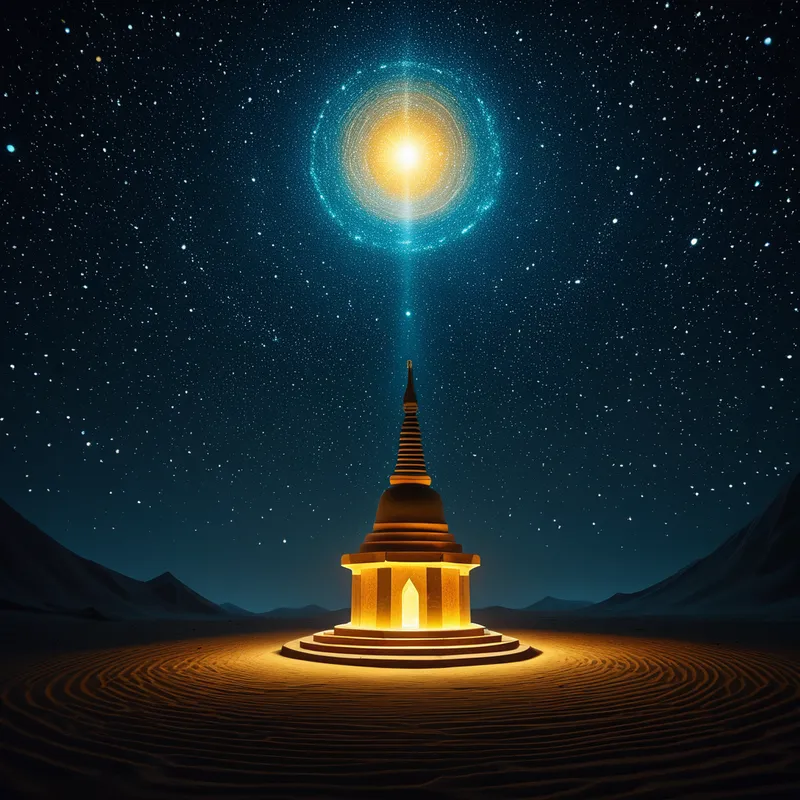
The construction of the stupa is the alchemical opus itself. It is the deliberate, patient work of structuring the psyche. The base represents the [prima materia](/myths/prima-materia “Myth from Alchemical culture.”/)—the raw stuff of our life experiences and the body. The dome is the [vas hermeticum](/myths/vas-hermeticum “Myth from Alchemical culture.”/), the sealed vessel where transformation occurs, where opposites are held in tension. The ascending spire is the process of sublimation—refining base instincts and identifications into ever-higher, more integrated states of awareness.
To walk the path around the Stupa is to perform the circumambulation of the Self. Each step is a letting go, each circuit a refinement, until the center is not a place you walk around, but the ground upon which you stand.
The final jewel is the [lapis philosophorum](/myths/lapis-philosophorum “Myth from Alchemical culture.”/), [the Philosopher’s Stone](/myths/the-philosophers-stone “Myth from Alchemical culture.”/)—the realized, indivisible Self that is both the culmination of the journey and the relic that was present at the beginning. For the modern individual, the myth teaches that enlightenment or wholeness is not an abstract idea to be grasped, but a structure to be built, a sacred space to be created within the very architecture of one’s being. It is the containment of our scattered relics—our memories, traumas, joys, and potentials—into a coherent, purposeful, and transcendent form.
Associated Symbols
Explore related symbols from the CaleaDream lexicon: