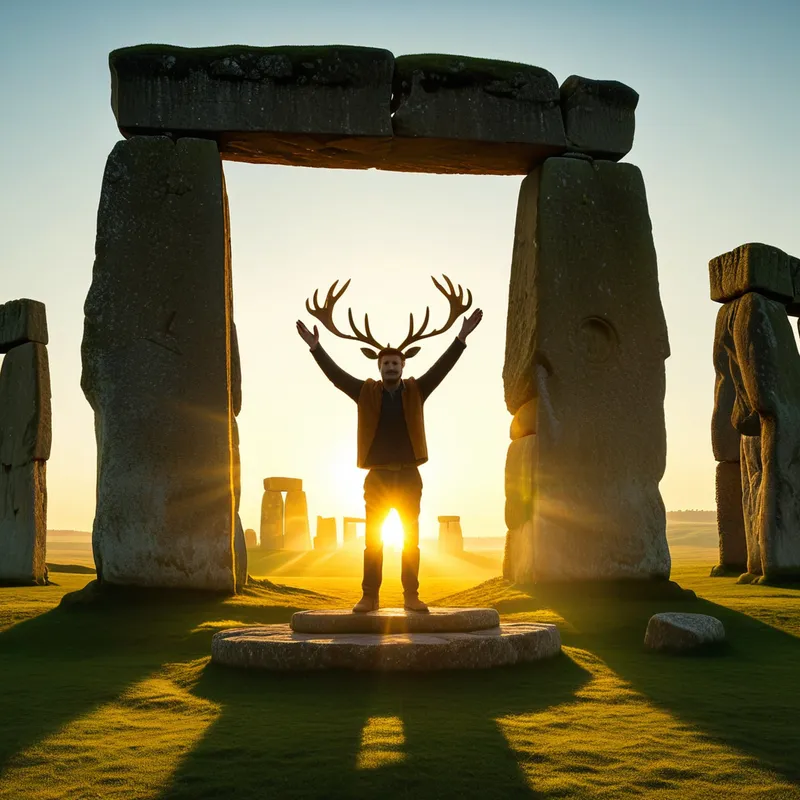
Stonehenge Alignments Myth Meaning & Symbolism
A tale of a Sun King's sacrifice, binding the cycles of heaven and earth in stone, to save his people from an eternal, devouring winter.
The Tale of Stonehenge Alignments
Listen. Listen to [the wind](/myths/the-wind “Myth from Various culture.”/) that moans through the grey sarsens. It carries a memory older than kings, older than the first seed sown in this chalky earth. In the time before time was measured, when [the world](/myths/the-world “Myth from Tarot culture.”/) was a cloak of deep forest and deeper shadow, a great wrong was done.
The people knew the sun as Lugh, the shining one, the king of the high sky. Each year, he grew strong in the summer, warming the land, and grew weak in the winter, retreating to his hidden hall. This was [the way](/myths/the-way “Myth from Taoist culture.”/). But one year, the winter did not end. The cold was a beast with teeth of ice. The sun, Lugh, grew pale and thin, his light a feeble grey smear behind endless cloud. The Druids read the omens in the flight of frozen birds and the stilled hearts of sacred springs. They saw the truth: the great wheel of the year had cracked. The sun was lost, adrift in the heavens, and the world was slipping into an eternal, silent night.
The people despaired. Their king, a man named Rioghan, who carried the blood of Lugh in his veins, felt their fear as a cold stone in his own belly. He climbed the sacred hill, the place where [the sky](/myths/the-sky “Myth from Persian culture.”/) touched [the earth](/myths/the-earth “Myth from Hindu culture.”/), and for three days and three nights, he fasted and called out to the spirit of the land, the Cailleach of the white stones.
On the third night, as the stars wheeled in a cold, clear frenzy, she answered. Not with a voice, but with a vision that burned behind his eyes. He saw the skeleton of the sky—the path of the sun at its birth at midsummer, its death at midwinter, the dance of [the moon](/myths/the-moon “Myth from Tarot culture.”/) at its extremes. He saw that these paths were not random; they were the great bones of order, and the sun had slipped from its socket. To mend it, a king’s spirit must become the pin that holds heaven to earth.
Rioghan understood the price. He returned to his people, his eyes holding the light of distant stars. He commanded them to bring the great blue stones from the sacred mountains in the west, and the mighty sarsens from the northern plains. For years, under his guidance, they labored. They raised the circle, not as a tomb, but as a cage for celestial law. They set the Trilithons to frame the sun’s turning points, and the Gateway Stones to catch its first and last light.
On the dawn of the longest day, when the world held its breath, Rioghan, clad not in gold but in simple linen, stood at the heart of the circle. The people watched from the surrounding hills, silent. As the first sliver of sun broke [the horizon](/myths/the-horizon “Myth from Various culture.”/), a perfect, blazing spear of light shot through the gateway, across the circle, and struck the central altar stone—and Rioghan upon it.
He did not cry out. He opened his arms, and the light consumed him. Not with fire, but with fusion. His mortal form dissolved into the radiant beam. In that moment, the great wheel groaned, turned, and clicked back into place. The sun, Lugh, roared back to strength, flooding the plain with a warmth that had been forgotten. The stones, now humming with a captured fragment of a king’s soul and the sun’s first fire, stood eternal.
From that day, the sun has never again lost its way. And on the dawn of midsummer, if you stand in the right place, in the silent heart of the stone circle, you can still feel the echo of that sacrifice—the moment a man became a covenant, binding the chaos of heaven to the order of earth.
Cultural Origins & Context
The myth of the alignments is not a single story found in an ancient text, but a tapestry woven from fragments of Celtic cosmology, later medieval Irish and Welsh lore, and the enduring oral traditions of the British Isles. The Celts did not build [Stonehenge](/myths/stonehenge “Myth from Celtic culture.”/)—its construction spans from the Neolithic into the Bronze Age, predating historically recognized Celtic culture in Britain. However, as the Brythonic cultures emerged, they inherited these monumental landscapes and imbued them with their own spiritual understanding.
The story would have been the province of [the Druids](/myths/the-druids “Myth from Celtic culture.”/), the intellectual and priestly class. They were the astronomers, the keepers of the calendar, and the mediators between the human tribe and the natural and supernatural worlds. A myth like this served profound societal functions: it explained the terrifying, existential threat of a failed season, legitimized the sacred role of kingship (where the king’s health was tied to the land’s fertility), and provided a cosmological blueprint for order (Fír) triumphing over chaos. It transformed a mysterious, pre-existing monument into an active, sacred engine within the Celtic worldview, a permanent proof of a pact made between humanity and the divine.
Symbolic Architecture
At its core, this is a myth about the imposition of conscious order upon unconscious, cyclical [nature](/symbols/nature “Symbol: Nature symbolizes growth, connectivity, and the primal forces of existence.”/). The eternal, devouring [winter](/symbols/winter “Symbol: Winter symbolizes a time of reflection, introspection, and dormancy, often representing challenges or a period of transformation.”/) represents the undifferentiated state, the [prima materia](/myths/prima-materia “Myth from Alchemical culture.”/) of the [psyche](/myths/psyche “Myth from Greek culture.”/) where time and distinction have no meaning. It is the psychic equivalent of depression or stagnation, where [life](/symbols/life “Symbol: The symbol of ‘Life’ represents a journey of growth, interconnectedness, and existential meaning, encompassing both the joys and challenges that define human experience.”/)-[energy](/symbols/energy “Symbol: Energy symbolizes vitality, motivation, and the drive that fuels actions and ambitions.”/) (the sun) is perpetually eclipsed.
The circle of stones is not a wall to keep chaos out, but a crucible to hold it, so that within its bounds, meaning can be forged.
Rioghan, the Sun [King](/symbols/king “Symbol: A symbol of ultimate authority, leadership, and societal order, often representing the dreamer’s inner power or external control figures.”/), symbolizes the emerging ego-[consciousness](/symbols/consciousness “Symbol: Consciousness represents the state of awareness and perception, encompassing thoughts, feelings, and experiences.”/). His [lineage](/symbols/lineage “Symbol: Represents ancestral heritage, family connections, and the transmission of traits, values, and responsibilities across generations.”/) ties him to the celestial ([the Self](/myths/the-self “Myth from Jungian culture.”/)), but his mortal form is subject to the earthly cycle. His sacrifice is the ultimate act of conscious [decision](/symbols/decision “Symbol: A decision in a dream reflects the choices one faces in waking life and can symbolize the pursuit of clarity and resolution.”/)—to surrender personal, temporal [identity](/symbols/identity “Symbol: Identity represents the sense of self, encompassing personal beliefs, cultural background, and social roles.”/) for the sake of eternal, structural meaning. He does not battle the winter with force; he re-members the sky. The alignments are the visible manifestation of this remembered order, the archetypal patterns made literal in [stone](/symbols/stone “Symbol: In dreams, a stone often symbolizes strength, stability, and permanence, but it may also represent emotional burdens or obstacles that need to be acknowledged and processed.”/). The myth tells us that true order is not commanded from above, but is born from a willing sacrifice below, a conscious element offering itself to realign the whole [system](/symbols/system “Symbol: A system represents structure, organization, and interrelated components functioning together, often reflecting personal or social order.”/).
The Dreamer’s Resonance
When this myth pattern stirs in the modern dreamer, it often surfaces during life phases of profound disorientation—a career collapse, the end of a relationship, a loss of faith, or a midlife crisis where one’s personal “sun” seems permanently dimmed. The dreamer may find themselves in vast, empty landscapes under a cold sun, or facing a massive, incomprehensible stone structure.
The somatic feeling is one of being out of phase, of one’s internal rhythms being utterly desynchronized from the world’s expected cycles. The psychological process at work is the unconscious signaling a critical need for re-alignment. The stones in the dream represent the immutable, often daunting, truths or structures of one’s own psyche—core values, innate talents, or destiny patterns that have been ignored. The dream is an invitation to perform the inner ritual of Rioghan: to stand at the center of one’s own chaos, identify the pivotal “alignments” (one’s true north, the solstice points of one’s soul), and make the conscious sacrifice of an outdated self-image to restore inner order.
Alchemical Translation
The individuation process modeled here is the opus contra naturam—the work against nature, not in defiance, but in conscious collaboration. The natural state is the endless, unconscious cycle. Individuation requires a conscious intervention to transform that cycle into a meaningful narrative.
The sacrifice of the king is the death of the provisional personality, so that the archetype of order (the Self) can use the individual as its vessel and instrument.
First, the [nigredo](/myths/nigredo “Myth from Alchemical culture.”/): the eternal winter, the depression and confusion of being lost in one’s own life. Second, the albedo: Rioghan’s vision on the hill—the illuminating insight, often delivered by the anima (the Cailleach), which reveals the hidden structure. Third, the [rubedo](/myths/rubedo “Myth from Alchemical culture.”/): the great labor of raising the stones—the hard, persistent work of integrating this insight into one’s life, building new habits, perspectives, and boundaries (the stone circle). Finally, the transcendent climax: the sacrifice at dawn. This is the moment of full commitment, where [the ego](/myths/the-ego “Myth from Jungian culture.”/) willingly subordinates itself to the greater pattern of the Self. The result is not annihilation, but transmutation. The individual is no longer just a person moving through time, but a living alignment—a point where the eternal and the temporal meet, where one’s personal life becomes a true reflection of a deeper, cosmic order. The stones remain, a testament in the soul’s landscape: order was chosen, at a cost, and the sun now rises on a life that is authentically, structurally one’s own.
Associated Symbols
Explore related symbols from the CaleaDream lexicon: