Stone of Destiny Myth Meaning & Symbolism
A sacred stone that roars for the rightful king, embodying the deep pact between ruler, land, and the goddess of sovereignty.
The Tale of Stone of Destiny
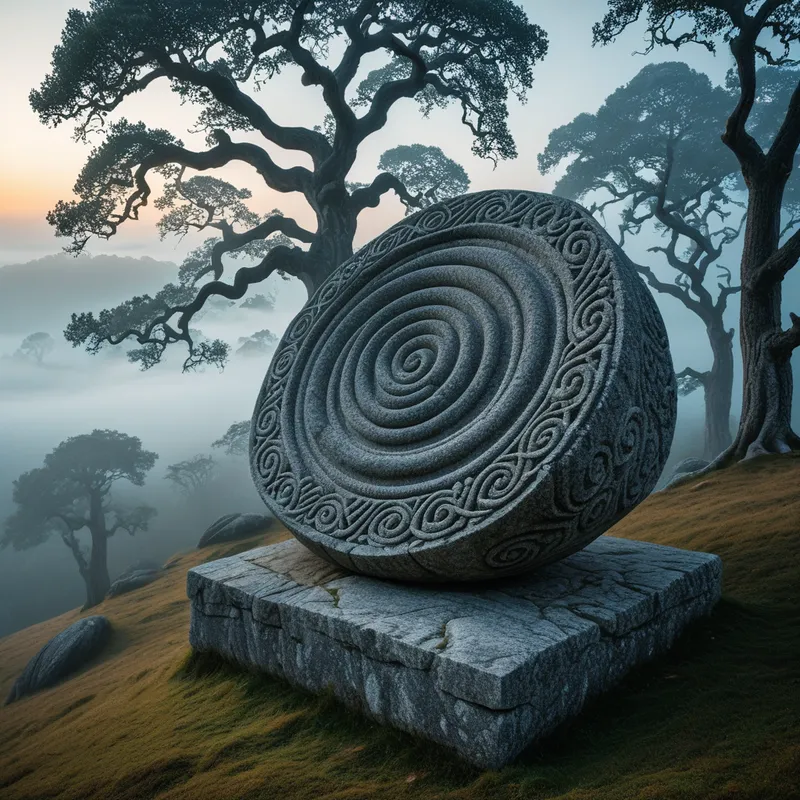
Listen, and let the fire’s glow carry you back, back to a time when the world was younger and the veil between the realms was thin as morning mist. In the land of Éire, there existed a stone of such power that the very fate of the kingdom rested upon its silence. It was not a stone of grand size, but of profound presence—a rough-hewn block of grey dolerite, etched by time and the hands of the Tuatha Dé Danann. They called it the Lia Fáil, and it sat upon the sacred hill of Teamhair.
The land was wounded. The kingship was vacant, and without a true Ard Rí, the seasons faltered. The cattle grew thin, the rivers ran low, and a grey silence fell over the people. The druid and the fili knew the law: only the stone could choose. For the stone was the voice of the land itself, the tongue of the Sovereignty Goddess. It would remain mute for all pretenders, a cold, judgmental slab. But for the one whose blood and spirit were true, whose kingship was not of ambition but of sacred duty, it would cry out—a roar that would shake the hill and echo in the heart of every soul in the five provinces.
Many came. Proud warriors with armies at their backs, cunning lords with gold in their hands. Each laid their palms upon the stone’s weathered surface. Each waited in the biting wind. Only silence answered, a silence deeper than the grave, and they departed in shame, the land groaning under their false step.
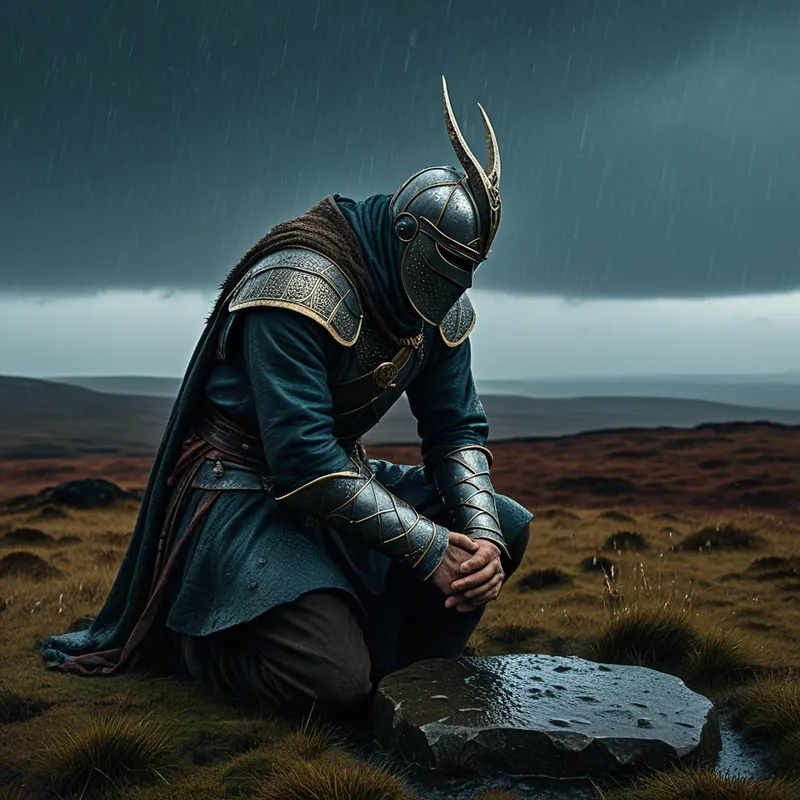
Then came a man named Conn Cétchathach. He came not with an army, but alone. He was weary from a journey of the spirit, marked not by conquest, but by a vision. He had seen the goddess in a dream, her form shifting from a withered hag to a radiant maiden, and she had shown him the parched earth. He approached the Lia Fáil not as a claimant, but as a supplicant. The rain began to fall, a soft, insistent drizzle that soaked his cloak and matted his hair. He did not flinch. He placed his bare hands upon the stone, feeling its ancient cold seep into his bones. He offered no boasts, made no demands. He simply knelt, and in his heart, he made a vow—a vow of service, of marriage to the land itself, a promise to be its protector and its voice.
And then… it stirred. A vibration, low and deep, hummed up from the earth, through the stone, and into his hands. The vibration grew, becoming a resonance, a pulse that matched the drumming of his own heart. Then, from the very core of the granite, a sound erupted—not a mere shout, but a ROAR. A triumphant, earth-shaking roar that rolled across the hills, silencing the wind and the rain. The clouds parted. A single shaft of sunlight struck the stone, and for a moment, Conn and the Lia Fáil were one entity, crowned in light. The land had spoken. The true king was found.
Cultural Origins & Context
The myth of the Lia Fáil is not merely a story of royal succession; it is the foundational political and spiritual charter of early Irish society. It belongs to the corpus of Mythological Cycle and the later kingly tales. This narrative was the sacred charge of the fili, memorized and recited during the feis, the great assembly where a new Ard Rí was proclaimed. Its function was societal and cosmic: to codify the concept of sacred kingship.
In the Celtic world-view, the king was not an absolute ruler but a mediator. His primary duty was a sacred marriage to the Sovereignty Goddess, a personification of the land and its people. The king’s righteousness—his fír flathemon—directly influenced the fertility of the soil, the abundance of the harvest, and the health of the tribe. The roaring stone was the objective, divine mechanism that validated this pact. It removed kingship from the realm of human politics and placed it firmly within the realm of divine ordination and ecological balance. The story was a constant reminder that authority was a sacred trust from the land itself, revocable if that trust was broken.
Symbolic Architecture
At its core, the Stone of Destiny is a symbol of the true self in its relationship to the world. It represents the unshakable, often silent, inner touchstone of authenticity against which all our personas and ambitions must be tested.
The stone does not roar for strength, but for sacrifice; not for the one who wishes to possess the land, but for the one who agrees to be possessed by it.
The stone is the Self (in the Jungian sense), the central archetype of wholeness and the regulating center of the psyche. The many false kings represent the ego in its various inflated states—the warrior, the politician, the merchant—all seeking power for their own ends. Their failure is the failure of the ego to submit to a higher, transpersonal authority. Conn’s success is the success of the ego’s humble alignment with the Self. His kneeling is an act of psychological surrender, the relinquishment of personal will in service of a greater totality—his people, his culture, the anima mundi (the world soul). The resulting “roar” is the psychic energy, the libido, that is released when this alignment is achieved. It is the sound of integration, of the conscious personality finally hearing and being empowered by the voice of the deep unconscious.
The Dreamer’s Resonance
When this myth stirs in the modern dreamscape, it often manifests in periods of profound life transition or identity crisis. To dream of a stone—especially one you are compelled to touch, sit upon, or listen to—signals a deep somatic process of testing one’s own foundation.
You may dream of searching for a cornerstone in a crumbling building, or of placing your hands on a cold monolith in a foggy landscape, waiting for a sign. The somatic experience is key: the coldness of the stone, the weight of expectation, the tension in the body as you await validation or face the terror of silence. This is the psyche’s ritual of inauguration. It asks: Upon what ground do you truly stand? What vow are you willing to make to your own life? The “false kings” in the dream may appear as past versions of yourself, societal expectations, or internal critics—all of whom touch the stone and receive nothing, because they are not aligned with your intrinsic destiny. The dream invites a Conn-like moment: a vulnerable, honest assessment and a commitment to serve the deeper truth of one’s own nature, rather than seeking external crowns.

Alchemical Translation
The myth of the Lia Fáil is a perfect allegory for the alchemical and Jungian process of individuation—the journey toward psychological wholeness. The entire narrative models the conjunctio, the sacred marriage, which is the climax of the alchemical work.
The initial state is the nigredo: the wounded land, the silent stone, the fragmented kingdom. This is the depressive, confused state where the ego feels disconnected from meaning and source. The parade of false kings represents the albedo, the endless whitening or trying on of purified but incomplete identities (the spiritual seeker, the perfect professional, the ideal partner)—all conscious attempts to “fix” the problem that fail because they lack the crucial element of the unconscious.
The alchemical gold is not seized; it is revealed when the leaden weight of the ego submits to the transformative fire of the Self.
Conn’s journey is the rubedo, the reddening. His weariness is the dissolution of egoic striving. His kneeling is the sacrifice of the ego to the Self. Placing his hands on the stone is the act of holding the tension of the opposites—his human vulnerability against the stone’s eternal silence, his conscious intention against the unconscious’s unknown will. This holding is the transformative fire. The resulting roar is the lapis philosophorum, the Philosopher’s Stone itself—the emergence of the integrated personality. The shaft of light is the conscious realization of this union. For the modern individual, the “Stone of Destiny” is that inner, non-negotiable core of values, calling, or truth. The “kingdom” is one’s own fully realized life. The process demands we move from seeking external validation (the applause of the crowd) to seeking the deep, resonant roar of inner truth—a sound that, once heard, irrevocably changes the landscape of the soul and inaugurates a reign of authentic being.
Associated Symbols
Explore related symbols from the CaleaDream lexicon: