
Stick Charts Myth Meaning & Symbolism
A myth of celestial wayfinders who read the ocean's soul, mapping currents and stars not on wood, but within their own awakened consciousness.
The Tale of Stick Charts
Listen. The ocean is not empty. It is a living skin, breathing under the moon’s pull. It sings with the voices of a thousand currents, each with a name, a temperament, a story. In the time before compasses, before maps with fixed lines, the people knew this. They did not conquer the sea; they courted her. They learned her songs.
The great teacher was not a man, but the ocean herself, Moana. She whispered her secrets to those who would listen with more than their ears. The first to truly hear was a figure remembered as Kilo. He did not see himself as separate from the world he sought to understand. He would lie for days in his outrigger, feeling the lift and fall of the swell against his cheek, the shift of the wind in his hair. He watched how the Kākā flew with purpose toward unseen land, and how the Hōkū wheeled in their eternal dance.
The conflict was not against a monster, but against the void—the terrifying, beautiful possibility of becoming forever lost in the world’s greatest expanse. The rising action was a symphony of observation. Kilo saw that the ocean’s swells, refracted around distant islands, created patterns—a subtle, intersecting dance of energy. He saw that clouds gathered differently over land, that the color of the water spoke of depth and the life within it. He learned the language of phosphorescence in a canoe’s wake at night.
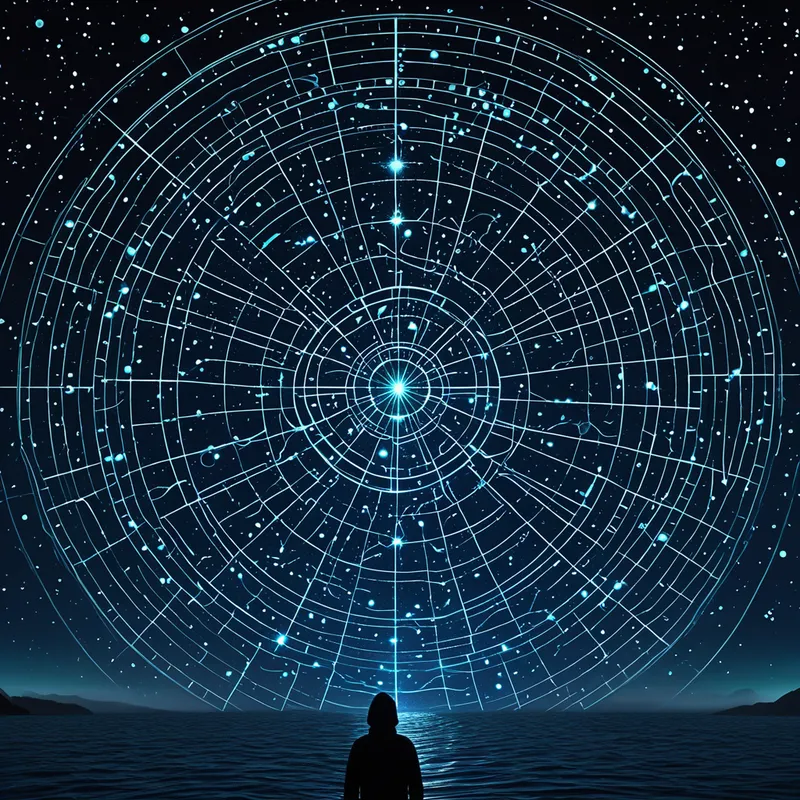
The resolution was not a discovery, but a birth. One night, under a sky dusted with the Maui’s Fishhook, the knowledge crystallized. He took sticks—the midribs of coconut fronds—and began to tie them together. Curved sticks for the sweep of swells. Straight sticks for the paths between stars. Small shells for the islands, not as dots, but as focal points where all these forces met. He did not draw the ocean. He built its sensation. The chart was not a picture to look at, but a matrix to feel, to hold in the hands and, in doing so, hold the dynamic, living ocean in the mind. It was a cradle for memory, a physical poem of wave and wind. With it, the void became a known place. The journey became a conversation.

Cultural Origins & Context
The so-called “stick charts” of the Marshall Islands are not mythical artifacts in the sense of belonging to a single, codified legend. They are the physical manifestation of a living, practical mythology—a cosmology made tactile. Their “myth” is the myth of wayfinding itself, a sacred knowledge system (Mātauranga) passed from master navigator (Pāʻele) to apprentice, often within specific familial lineages.
This knowledge was the ultimate societal power and responsibility. It enabled the settlement of the Pacific, the greatest navigational feat in human history. The charts (Mattang or Rebbelib) were not taken on voyages. They were pedagogical tools, constructed and studied on land. Their abstract, non-literal form was intentional—a security measure to protect vital knowledge from the uninitiated. The “story” was told through the knots and curves, a narrative of interacting forces one must internalize completely. The myth lives in the act of transmission: the elder’s hands guiding the younger, tying a shell to a nexus point, whispering, “Here, the sea bends around the spirit of the island.”
Symbolic Architecture
The stick chart is a profound symbol of consciousness itself. It represents a mode of knowing that is integrative, embodied, and relational, standing in stark contrast to the detached, Cartesian map.
The map says, “Here is the land.” The stick chart whispers, “Here is the relationship between your vessel, the deep swell from the south, the current from the east, and the memory of the north star.”
The ocean represents the unconscious—vast, potent, seemingly chaotic. The islands are not merely destinations but points of consciousness, emergent properties where patterns coalesce into tangible reality (land, self, insight). The navigator symbolizes the ego, but not a conquering ego; rather, an ego in service to a deeper intelligence, trained to perceive the subtle patterns (Kāeo) of the psyche.
The chart’s materials are deeply symbolic: organic, flexible sticks imply that the framework of understanding must be adaptable, not rigid. The knots represent the binding of observation to memory, of sensory data to cognitive structure. The empty space within the lattice is critical—it is the unknown, the mystery, which the structure itself helps to define and navigate.

The Dreamer’s Resonance
To dream of a stick chart, or of navigating by waves and stars without conventional tools, signals a profound somatic and psychological process: the development of inner navigation.
This dream emerges when the dreamer’s conscious mind faces a vast, unstructured challenge—a career shift, a creative block, a period of grief—where external maps (societal expectations, old plans) have failed. The psyche is constructing a new, internal model for orientation. The feeling in the dream is often one of focused calm amidst vastness, or of frustrating struggle to “read” the patterns.
Somatically, this process can feel like a heightened sensitivity to internal “currents”—gut feelings, intuitive pulls, and energetic shifts that logic cannot explain. The dreamer is learning to trust a deeper, more embodied intelligence. The chart in the dream may appear incomplete, shimmering, or impossibly complex, reflecting the nascent state of this internal framework. It is the mind in the act of weaving a personal mythology to navigate its own unexplored seas.
Alchemical Translation
The process of the navigator internalizing the stick chart is a perfect model for Jungian individuation—the psychic transmutation of the self into a more whole, integrated being.
First, the prima materia is the chaotic, overwhelming flow of unconscious content (the ocean). The initial nigredo, or despair, is the feeling of being lost, adrift in one’s own life. The apprentice navigator’s rigorous training represents the conscious effort (Hoʻomaʻamaʻa) to observe these inner patterns—recurrent emotions, dream symbols, synchronicities—without immediately judging or interpreting them.
Individuation is not about reaching a fixed destination (an island), but about mastering the dynamic, living process of navigating the relationships between all the parts of oneself.
The construction of the mental chart is the albedo, the whitening, where patterns become clear. This is the insight phase, where one sees how a childhood wound (a refraction point) bends the swells of one’s adult relationships. The final stage, the rubedo or reddening, is the embodied application. It is not enough to understand the chart intellectually; one must become the chart. The navigator’s body itself becomes the instrument, feeling the swell. In psychological terms, the ego aligns with the guidance of the Self. The conscious mind no longer fights the currents of the unconscious but learns to sail them, using its hard-won, internalized knowledge to journey toward greater wholeness. The goal is not to eliminate the ocean’s vastness, but to find one’s unique and graceful way within it.
Associated Symbols
Explore related symbols from the CaleaDream lexicon: