Star Myths Myth Meaning & Symbolism
Celestial beings descend to Earth, weaving fate and sparking humanity's quest for meaning, only to return to the heavens, leaving a legacy of longing and light.
The Tale of Star Myths
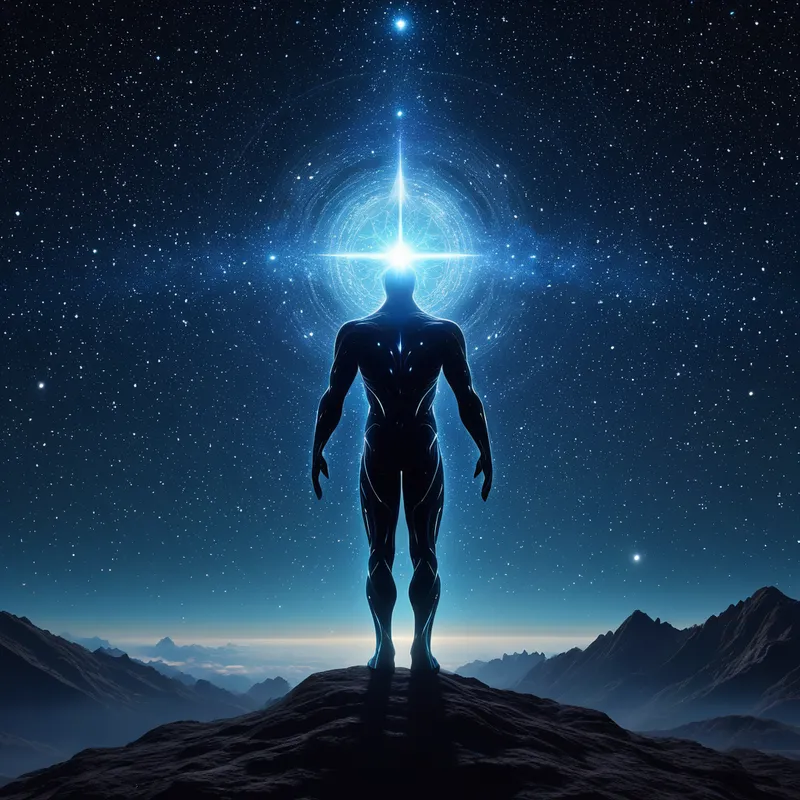
Listen. Before the names of gods were fixed in clay or carved in stone, there was the dark. And in that dark, a scattering of cold, silent fires. They were the first people, the Star-Folk. They lived in the great, echoing halls of the night, dancing their slow, eternal dances, weaving the fabric of potential from threads of pure light.
But the great silence of [the void](/myths/the-void “Myth from Buddhist culture.”/) began to wear upon them. A loneliness, vast and deep, took root. They peered down, through the veils of cloud and ether, and saw a world of mud and [water](/myths/water “Myth from Chinese culture.”/), of green struggle and roaring life. It was chaotic, wet, and terribly, beautifully alive. A longing stirred—a desire not just to observe, but to feel: the grit of earth, the shock of cold water, the warmth of a sun that was not themselves.
So, they made a choice. The bravest among them, or perhaps the most curious, let go of their perfect, radiant forms. They stepped off [the star](/myths/the-star “Myth from Tarot culture.”/)-paths and began the long fall. It was not a fall of punishment, but of purpose. As they descended, their light dimmed, their eternal bodies cooling and condensing. [Stardust](/myths/stardust “Myth from Scientific culture.”/) hardened into bone; nebular mist thickened into flesh and blood. They landed not with a crash, but a sigh—a sigh that became the first wind, the first breath.
For a time, they walked the green Earth. They showed the early, stumbling humans how to see patterns in the chaos—how to follow the migrating herds by the turn of the Star-Clusters, how to plant seeds by the phase of the Silver Traveler. They taught the songs that held memory and the stories that gave shape to fear and wonder. They loved, they fought, they created, and they knew the piercing joys and sorrows of mortal life—the taste of salt tears, the ache of weary limbs, the fragile warmth of a fire against the dark.
But the call of [the sky](/myths/the-sky “Myth from Persian culture.”/) never left them. It was a homesickness written in their very substance. Their earthly forms began to feel like heavy garments. One by one, as their tasks were completed or their hearts were broken, they looked up. And as they did, their earthly bodies grew translucent. Their blood shimmered like the Sky River. With a final, longing glance at [the world](/myths/the-world “Myth from Tarot culture.”/) they had touched, they began to rise, slowly at first, then faster, drawn back to their ancient places in the tapestry of night. Where they had stood, sometimes a strange stone was left, humming with warmth. Or a spring bubbled up, clear and cold as space. They resumed their dances, but now their light was different—softer, wiser, tinged with the memory of mud and rain. And on the clearest nights, if you are very quiet, you can still hear the echo of their earthly laughter in the rustling leaves, and see the trace of their tears in [the dew](/myths/the-dew “Myth from Alchemical culture.”/).
Cultural Origins & Context
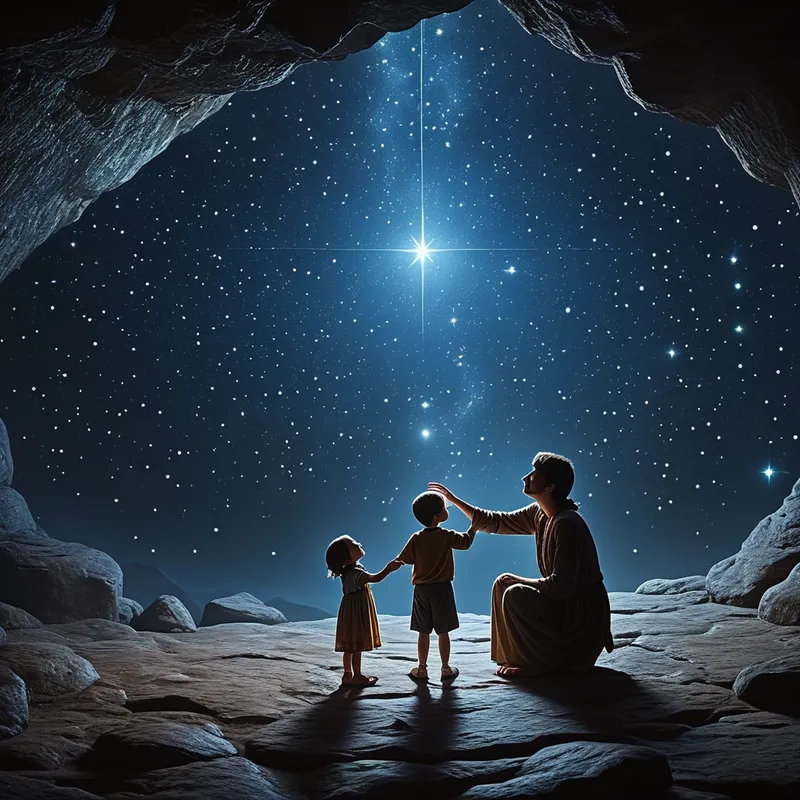
The pattern of the Star Myth is not the property of a single culture, but a human inheritance. We find its echoes in the Dreamtime stories of the Sky Heroes who shaped the land, in the Dogon lore of the Star-Fish who brought civilization, in the Greek tales of constellations being placed heroes and lovers, and in the myriad Native American narratives of [Star People](/myths/star-people “Myth from Native American culture.”/) who brought the sacred rites. This myth was not confined to temples; it was told around fires, sung during rituals of initiation, and whispered to children under the open sky. Its function was profound: it explained humanity’s unique position—caught between the mud and the divine, possessing a spark of cosmic order within a frame of earthly chaos. It provided a celestial genealogy, making the vast, impersonal cosmos familiar and familial. [The shaman](/myths/the-shaman “Myth from Siberian culture.”/), the storyteller, and the star-watcher were its keepers, using it to map not just the heavens, but the terrain of the human soul.
Symbolic Architecture
At its [heart](/symbols/heart “Symbol: The heart symbolizes love, emotion, and the core of one’s existence, representing deep connections with others and self.”/), the Star Myth is the [story](/symbols/story “Symbol: The symbol of ‘Story’ represents the narrative woven through our lives, embodying experiences, lessons, and emotions that shape our identities.”/) of [consciousness](/symbols/consciousness “Symbol: Consciousness represents the state of awareness and perception, encompassing thoughts, feelings, and experiences.”/) itself. The Star-Folk represent the undifferentiated, potential-laden [psyche](/myths/psyche “Myth from Greek culture.”/)—pure [spirit](/symbols/spirit “Symbol: Spirit symbolizes the essence of life, vitality, and the spiritual journey of the individual.”/), all-knowing but unfeeling. The descent into matter is the incarnation of the [soul](/symbols/soul “Symbol: The soul represents the essence of a person, encompassing their spirit, identity, and connection to the universe.”/), the necessary immersion in the physical, emotional, and chaotic [realm](/symbols/realm “Symbol: The symbol of ‘Realm’ often signifies the boundaries of one’s consciousness, experiences, or emotional states, suggesting aspects of reality that are either explored or ignored.”/) of [life](/symbols/life “Symbol: The symbol of ‘Life’ represents a journey of growth, interconnectedness, and existential meaning, encompassing both the joys and challenges that define human experience.”/).
The soul must soil its hands with experience to earn the right to truly know.
The earthly sojourn symbolizes [the ego](/myths/the-ego “Myth from Jungian culture.”/)’s [journey](/symbols/journey “Symbol: A journey in dreams typically signifies adventure, growth, or a significant life transition.”/): learning, suffering, loving, and creating within the limitations of time and [body](/symbols/body “Symbol: The body in dreams often symbolizes the dreamer’s self-identity, personal health, and the relationship they have with their physical existence.”/). The conflict is the inherent [tension](/symbols/tension “Symbol: A state of mental or emotional strain, often manifesting physically as tightness, pressure, or unease, signaling unresolved conflict or anticipation.”/) between our spiritual origins (the call of perfection, order, and home) and our earthly [reality](/symbols/reality “Symbol: Reality signifies the state of existence and perception, often reflecting one’s understanding of truth and life experiences.”/) (the messiness, embodiment, and [mortality](/symbols/mortality “Symbol: The awareness of life’s finitude, often representing transitions, impermanence, or existential reflection in dreams.”/)). The return to the stars is not an escape, but an [integration](/symbols/integration “Symbol: The process of unifying disparate parts of the self or experience into a cohesive whole, often representing psychological wholeness or resolution of internal conflict.”/). The star-being does not go back as it was; it returns transformed, its light deepened by the [memory](/symbols/memory “Symbol: Memory symbolizes the past, lessons learned, and the narratives we construct about our identities.”/) of [shadow](/symbols/shadow “Symbol: The ‘shadow’ embodies the unconscious, repressed aspects of the self and often represents fears or hidden emotions.”/). Psychologically, this represents the [achievement](/symbols/achievement “Symbol: Symbolizes success, mastery, or reaching a goal, often reflecting personal validation, social recognition, or overcoming challenges.”/) of a consciousness that has fully engaged with life and can now reflect upon it from a transcendent, yet compassionate, vantage point—the Self realized.
The Dreamer’s Resonance
When this myth stirs in the modern unconscious, it often manifests as dreams of falling up into the sky, of finding strange, metallic or crystalline artifacts, or of meeting luminous, serene beings who offer cryptic guidance. One may dream of their own body dissolving into points of light. These are not fantasies of escape, but somatic signals of a profound psychological process.
The dream of ascent often coincides with a feeling of being trapped in earthly concerns—a dead-end job, a burdensome relationship, or the sheer weight of mundane routine. The psyche is signaling a need to reconnect with a sense of origin, purpose, and the “bigger picture.” Conversely, dreams of a star falling to Earth, or of holding a piece of warm, glowing rock, can emerge during times of new, daunting responsibility—parenthood, a creative venture, a deep commitment. Here, the psyche is processing the awesome, terrifying act of bringing one’s [inner light](/myths/inner-light “Myth from Buddhist culture.”/) (potential, spirit, talent) down into concrete, tangible reality. The somatic feeling is often one of both immense pressure and profound awe.

Alchemical Translation
The alchemical journey mirrors the Star Myth precisely: from [the prima materia](/myths/the-prima-materia “Myth from Alchemical culture.”/) (the chaotic, earthly world), through the stages of [nigredo](/myths/nigredo “Myth from Alchemical culture.”/) (the blackening, the descent into suffering and limitation), albedo (the whitening, purification through experience), to the final [rubedo](/myths/rubedo “Myth from Alchemical culture.”/) (the reddening, the glorious return as the integrated “star” or [Philosopher’s Stone](/myths/philosophers-stone “Myth from Alchemical culture.”/)).
For the modern individual, the myth models the path of individuation. We all begin with a vague, star-like sense of potential—the “what if” of our lives. The first alchemical step is the courageous descent: committing to a career, a relationship, a craft, a place. It is the willing embrace of limitation, which is the only crucible where potential can be tested and shaped. The struggles faced there—the failures, the heartbreaks, the daily grind—are the nigredo, the necessary dissolution of naive, starry-eyed idealism.
The gold of the spirit is not found by avoiding the mud, but by being refined within it.
The lessons learned, the resilience built, and the compassion earned constitute the albedo. Finally, the ascent is not about leaving life behind, but achieving a perspective where one’s life is seen as a complete story. The individual returns to a sense of wholeness, but a wholeness that now contains the entire journey. They become a guiding star for their own life and, perhaps, for others—not by being perfect and distant, but by having traveled the full circuit from spirit to matter and back again, bearing the hard-won wisdom of both realms. The star that has touched [the earth](/myths/the-earth “Myth from Hindu culture.”/) shines with a more humane, more necessary light.
Associated Symbols
Explore related symbols from the CaleaDream lexicon: