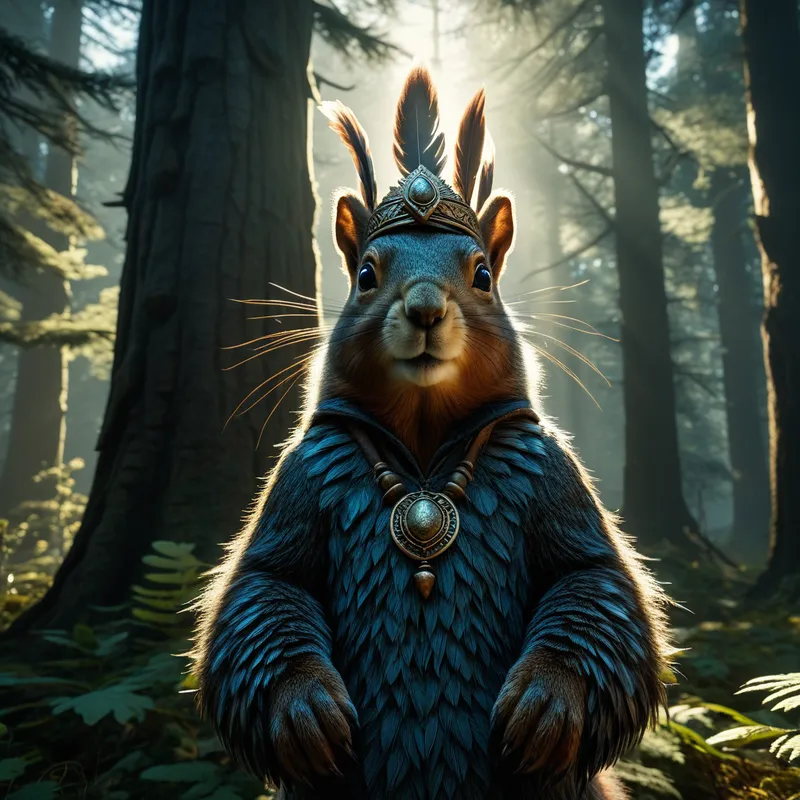
Squirrel as Trickster Myth Meaning & Symbolism
A myth where a small, clever squirrel outwits a mighty bear, teaching that true power lies not in size but in wit and the ability to navigate the world's complexity.
The Tale of Squirrel as Trickster
Listen. In the time before time, when the world was still soft from the dreaming, the great beings walked the earth. There was Bear, whose shadow was a valley and whose breath was the winter wind. He was strength embodied, a mountain that moved. And there were others, like Rabbit and Coyote, who danced at the edges of the firelight, weaving mischief.
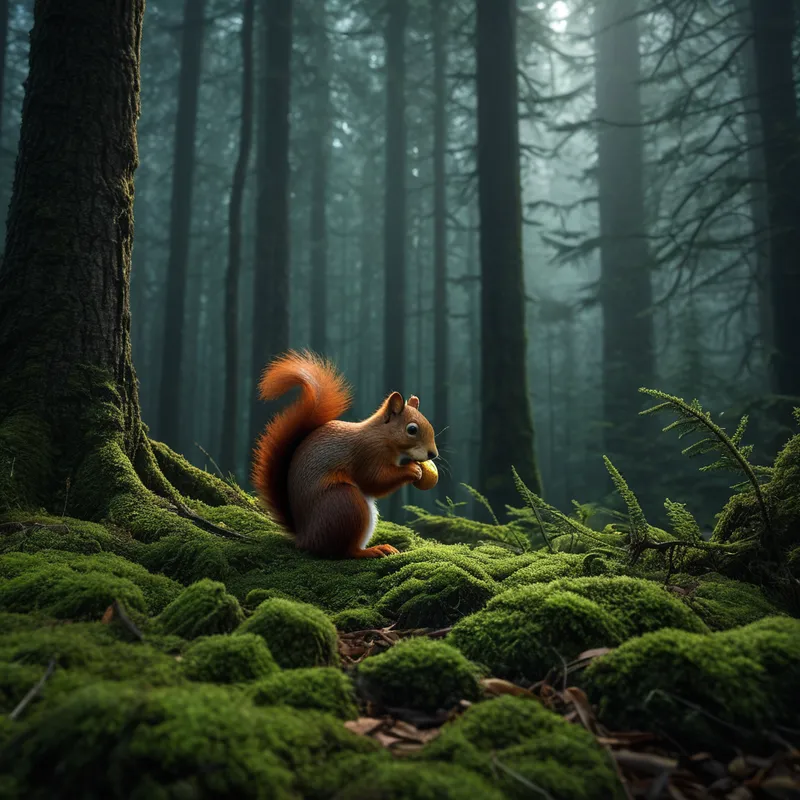
But in the high canopy, where sunbeams pierced the green gloom like golden spears, lived Squirrel. Not a giant, not a warrior. A flicker of russet fur, a scatter of chatter, a creature of frantic, precise movement. To the great ones below, Squirrel was a whisper, a footnote.
That season, the great First Oak had dropped its bounty, and the nuts were fat and sweet. Bear claimed them all. He lay beneath the Oak, a wall of fur and muscle, and declared in a voice that shook the leaves, “All that falls is mine. For I am largest. I am strongest. This is the law.”
The other animals grew thin. Their bellies were hollow drums. They complained, but only in the secret dark. Who could challenge Bear? His law was the law of tooth and claw, and it seemed absolute.
Squirrel watched from a branch, its heart a tiny, furious drum. It saw its stored winter food, buried with meticulous care, now lying in Bear’s claimed domain. It felt not just hunger, but the injustice of a world where only size dictated right. A plan, small and sharp as a pine needle, began to form in its mind.
Not with challenge, but with chaos. Squirrel did not roar. It began to run. It became a russet streak, a blur of purpose. It would dart down the trunk, snatch a single nut from the very edge of Bear’s shadow, and vanish into the labyrinth of branches before the giant could even focus his sleepy eyes. Then, it would appear on the other side, chattering loudly, drawing Bear’s rumbling gaze, while from a third direction, another nut would disappear.
Bear would heave himself up, lumbering toward the sound, but Squirrel was never there. It was a ghost in the daylight, a prankster in the cathedral of the woods. It filled the air with false alarms, with echoes of scraping claws and chitters from empty limbs. Bear spun in slow, confused circles, his great strength useless against this tiny, multiplying nuisance. He swiped at shadows, snorted at rustles. The solemn law of the strong was unraveling into farce.
Finally, exhausted and bewildered, Bear roared, “Enough! You win nothing but my annoyance, little speck! Take your nuts and be silent!” And he heaved himself away to find a quieter, simpler place to sleep.
The forest exhaled. And from that day, the law was amended. The bounty was shared, not by decree, but by the cunning truth that even the smallest thread, pulled with enough clever persistence, can unravel the mightiest cloak.
Cultural Origins & Context
This story finds its roots among various Eastern Woodlands and Southeastern tribes, including but not limited to the Cherokee, Ojibwe, and Shawnee. It belongs to the rich oral tradition of animal tales, told by elders and storytellers around evening fires, not as mere children’s fables, but as sophisticated vehicles for social instruction and philosophical inquiry.
Its primary function was didactic. In societies where community survival depended on a deep understanding of ecology and social balance, the myth served multiple purposes. It reinforced the value of every member of the community, regardless of apparent stature. It taught that brute force has limits and can be outmaneuvered by intelligence and adaptability. Furthermore, it acted as a social pressure valve, a sanctioned narrative that allowed the “small” to critique the “large” through metaphor, reminding leaders that power must be tempered with wisdom and that tyranny is vulnerable to the cleverness of the collective.
Symbolic Architecture
At its core, the Squirrel Trickster is an archetype of the intellect in a world of matter. Bear represents the primal, overwhelming force of the unconscious id or the tyrannical aspect of raw, untransformed power—be it physical, social, or psychological. Squirrel represents the agile, conscious ego, and the ingenious human spirit.
The myth declares that the world is not a simple hierarchy of strength, but a complex ecosystem where different kinds of power must interact.
Squirrel’s power is not of mass, but of motion and strategy. Its domain is the axis mundi of the forest—the tree trunk. It navigates seamlessly between the upper world (the canopy of ideas and perspective) and the lower world (the grounded reality of Bear’s domain). This vertical mobility symbolizes the ability to shift perspectives, to see the bigger picture from above and the granular detail from within. The nuts it steals are not just food, but kernels of potential, seeds of future growth that the stagnant, possessive Bear would merely consume. Squirrel, in its trickery, is ultimately a preserver and a redistributor of life’s resources.
The Dreamer’s Resonance
When this mythic pattern stirs in the modern dreamer, it often manifests as dreams of being small in a world of oversized obstacles—a tiny figure in a cavernous office, a mouse in a house of giants. The somatic feeling is one of frantic energy, a buzzing anxiety, but also a potential for nimble movement. You may dream of intricate escape routes, of hiding in small spaces, or of frustrating a larger, duller opponent through sheer unpredictability.
Psychologically, this signals an encounter with an inner or outer “Bear”: a domineering boss, an oppressive system, a crushing depression, or one’s own inflated and rigid sense of self-importance. The psyche, in its wisdom, is mobilizing the Squirrel. It is a call to stop confronting the problem head-on with inadequate force. Instead, it advises guerrilla tactics of the soul: use your wit, your speed of thought, your ability to gather small resources (“nuts”) and cache them away for the long winter. The dream is an invitation to outmaneuver, not overpower.

Alchemical Translation
The individuation process modeled here is the transmutation of perceived weakness into active cunning. We all have inner Bears—monolithic complexes, heavy depressions, or entrenched habits that seem to claim all our psychic energy. The heroic journey is not to become Bear, but to become fully Squirrel.
The first alchemical stage is observation from the branches. One must retreat from the crushing shadow of the problem (the depressive narrative, the toxic situation) to gain a higher perspective. The second is the nigredo of chaotic action—the seemingly frantic, scattered phase where one tries many small, seemingly insignificant actions. This is not failure, but essential disruption.
The triumph is not in the defeat of the giant, but in the re-writing of the law within one’s own psyche. The new law states: my worth and power are not determined by the mass of my obstacle.
The final stage is distribution. As the inner Squirrel succeeds, it does not hoard the “nuts” of liberation for itself. The psychic energy once claimed by the Bear (anxiety, oppression) is now freed and can be shared—transformed into creativity, resilience, and a more nuanced understanding of power. The individual learns that their true strength lies in their unique capacity to navigate complexity, to store wisdom, and to move with grace between the heights of spirit and the grounded realities of life, forever altering the inner landscape from a tyranny of size to a democracy of clever, interconnected life.
Associated Symbols
Explore related symbols from the CaleaDream lexicon: