
Spilled Salt Myth Meaning & Symbolism
A myth of a sacred covenant sealed in salt, its shattering betrayal, and the long journey to restore what was lost through remembrance and sacrifice.
The Tale of Spilled Salt
Listen, and hear the tale whispered on the dry wind, a story not of water, but of the other crystal—the one that preserves and seasons, the one that seals a promise.
In the days when a man’s word was his bond, and a bond was etched into the very fabric of the world, there was a king. He was a man of the desert, his rule as vast and unforgiving as the sands. To him came a chieftain from the hills, a man with eyes like flint and a heart yearning for peace. Their peoples had warred, a feud as old as the wadis that cut the land. Tired of the blood that salted the earth, they sought an end.
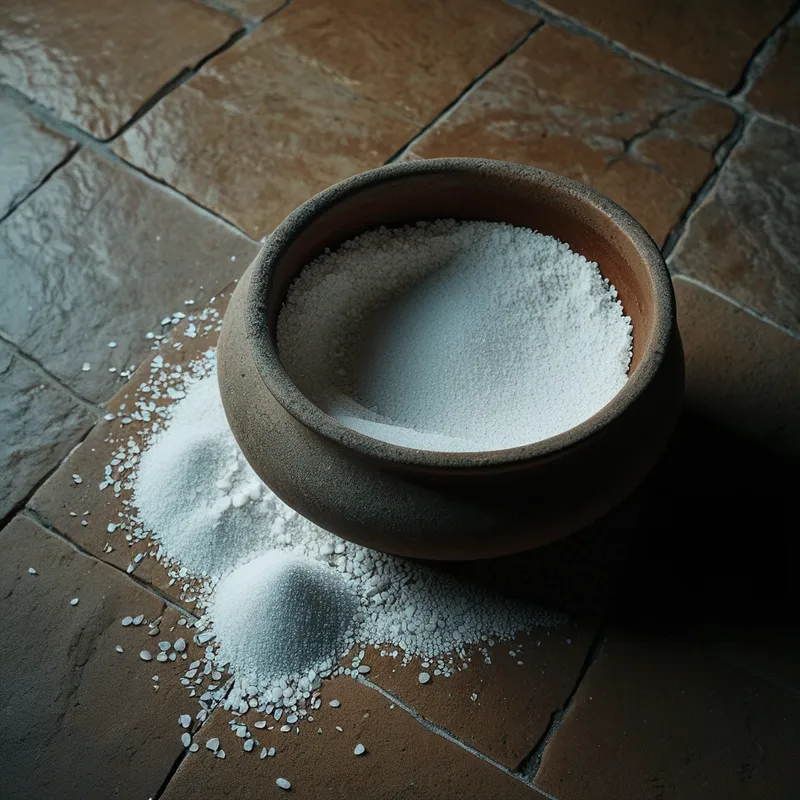
They did not meet in a gilded hall, but under the naked eye of heaven, on a plain of cracked earth. Between them, they placed not a scroll of parchment, but a vessel of fired clay. From it, they poured not ink, but a mound of pure, white salt—harvested from the lifeless sea, a substance of death that gives life. Each man took a handful. The grit bit into their palms, a sharp, clean pain. “As this salt is pure and cannot be made impure,” spoke the king, his voice gravel, “so shall our word be.” “And as it preserves the flesh from decay,” answered the chieftain, “so shall this pact preserve our people from the decay of war.”
They mingled their handfuls back into the common mound, grains from the king’s hand indistinguishable from those of the chieftain. A covenant was made. A pillar of salt was built from the mound, a stark, white monument under the sun. For a generation, peace held. The salt pillar stood, glinting, a testament.
But the king’s son, who had not felt the grit in his own palm, who knew the pact only as a story, grew proud and hungry. He coveted the chieftain’s fertile hills. One night, driven by a whispering greed, he went to the plain. By moonlight, the salt pillar shone like a bone. He struck it with a staff of acacia wood. A crack, sharp as thunder in the silent night. Then another. The pillar shuddered and collapsed inward, not with a roar, but with a sigh—a vast, whispering cascade of white crystals spilling across the dark earth, a ghostly flood catching the moon’s cold light.
The covenant was broken. Not with a shout, but with a spill. The very next dawn, riders were seen on the horizon. War, swift and bitter, returned. The land, it is said, wept tears that evaporated into salt pans, and the memory of that spilled mound haunted the generations. It became a saying, a curse, a shudder in the spine: to spill the salt was to spill the bond, to invite the chaos of a broken word back into the world.
Cultural Origins & Context
This narrative is woven from the threads of ancient Near Eastern covenant rituals, deeply embedded in the cultural consciousness reflected in the Hebrew scriptures. Salt, in this context, was far more than a seasoning; it was a primal symbol of durability, purity, and binding agreement. Archaeological and textual evidence points to the use of “salt covenants” as solemn, unbreakable treaties.
The myth likely circulated in oral tradition, passed down by elders, priests, and storytellers as a foundational parable of social order. Its tellers were not merely entertainers but custodians of ethics, using the visceral image of spilled salt to teach the sacred, tangible weight of one’s word. In a society where community survival depended on reliable alliances, the myth served a critical societal function: it externalized the catastrophic spiritual and social consequences of betrayal into a simple, unforgettable domestic omen. The spilled salt on a family’s table became a microcosm of the shattered pillar on the plain, a daily reminder that trust, once dispersed, is as difficult to gather back as scattered grains.
Symbolic Architecture
At its heart, this myth is an exploration of the substance that binds reality together. Salt represents the essence of the covenant—the immutable, preserving principle of trust and loyalty. It is the crystallized form of relationship.
The covenant is not in the word, but in the substance that makes the word endure.
The act of spilling is, therefore, not an accident but a symbolic disintegration. It represents the moment when selfish desire (the prideful son) fractures communal integrity. The scattered grains symbolize the fragmentation of a unified truth into a thousand conflicting pieces—the chaos of mistrust, the “war” that follows a broken promise. Psychologically, the salt pillar is the persona of the relationship, the visible, stable structure. Its shattering forces a confrontation with the shadow—the greed and treachery that were always present but unintegrated.
Furthermore, salt’s dual nature is key. It comes from the Salt Sea, a place of sterility and death. Yet, it is the essential ingredient for preserving life (food) and seasoning it (giving taste). The myth tells us that the very thing which can ensure life and flavor (a trusted bond) originates from and can revert to a state of barrenness if mishandled.

The Dreamer’s Resonance
When this myth surfaces in the modern dreamscape, it rarely appears as an ancient king. Instead, it manifests as the dreamer spilling a salt shaker at a dinner party, watching granules scatter across a conference table, or seeing a cherished, solid object dissolve into salt and blow away.
This dream signals a profound somatic and psychological process: the felt sense of a rupture in trust. The dreamer is likely experiencing, or subconsciously perceiving, a fracture in a foundational relationship or a core personal value. The “spill” is the moment of recognition—the gut-feeling that a pact, whether with a partner, a friend, a principle, or even with oneself, has been compromised.
The somatic response in the dream—the freeze, the frantic attempt to gather the salt, the overwhelming feeling of stain or waste—mirrors the psyche’s panic at this disintegration. The dream is an alarum from the collective unconscious, using this ancient symbol to say: “Attention. Something sacred has been dispersed. Your inner world is mirroring the broken pillar.” It is an invitation to identify what “covenant” in one’s life feels shattered, and to sit with the barren, salty taste of that betrayal before attempting to sweep it away.

Alchemical Translation
The path of individuation, the process of psychic wholeness, is mirrored not in the unspilled pillar, but in the response to the spill. The initial state is the unconscious covenant—the salt pillar stands intact, but its meaning is taken for granted, its history forgotten by the son. The spill is the necessary nigredo, the blackening, the moment of chaos and despair that forces consciousness.
The alchemy begins not in preserving purity, but in consciously gathering the scattered, impure fragments.
The hero’s journey here is not the king’s, but the journey of those who come after. It is the long, patient work of re-membering. Grain by single grain, the scattered salt must be acknowledged, its loss mourned, and its meaning re-evaluated. This is the albedo, the whitening, the arduous purification. One cannot simply rebuild the old pillar; that would be a facade. The new understanding—the rubedo or reddening—is the realization that the covenant now lives in the conscious, careful act of preservation. The salt is moved from the external monument to the internal shaker, to be used deliberately, sparingly, with full knowledge of its cost.
For the modern individual, this translates to the work of integrating betrayal and broken trust. It is the process of taking the shattered pieces of a promise—be it from childhood, a failed relationship, or a personal compromise—and, without denying their sharp edges, understanding their essential nature. The transformed self is not one who never spills salt, but one who knows its sacred weight, who tends to it consciously, and who understands that every bond, every word given, contains within it both the preserving crystal and the barren sea from which it came. The spilled salt, ultimately, seasons the soul with the wisdom of fragility.
Associated Symbols
Explore related symbols from the CaleaDream lexicon: