Spice Trade Myth Meaning & Symbolism
A Phoenician deity defies celestial law to bring the essence of life—spice—to humanity, navigating cosmic seas and paying a profound personal price.
The Tale of the Spice Trade
Listen, and hear the whisper of salt on the wind, the groan of cedar timbers, the song the stars sing to the deep. Before maps were drawn on parchment, they were etched in the longing of the human heart. The gods kept their treasures close. In the high vaults of the firmament, where Astarte treads on a road of scattered diamonds, they stored the essences of life itself: not gold or silver, but fragrance, warmth, and memory made substance. This was the hoard of spice—the breath of the sun captured in crimson threads, the tears of sacred trees hardened into fragrant resin, the very dust of paradise.
But the world below was pale and silent. Mortals knew only the salt of the sea and the dust of the earth. Their fires had no sweetness, their feasts no delight, their dead no fragrant passage. They lived, but did not taste life.
One among the celestial host watched this with a growing ache. A deity of the liminal space, whose domain was the whispering horizon, the path between known and unknown. Their name is lost, for names are for shores, not for the sea-wanderer. They saw the hollow eyes of the shore-dwellers and heard the silent hunger in their prayers, carried on the west wind. The divine law was absolute: the spices were the perfume of the gods, a boundary between mortal and immortal. To steal them was to unravel the order of things.
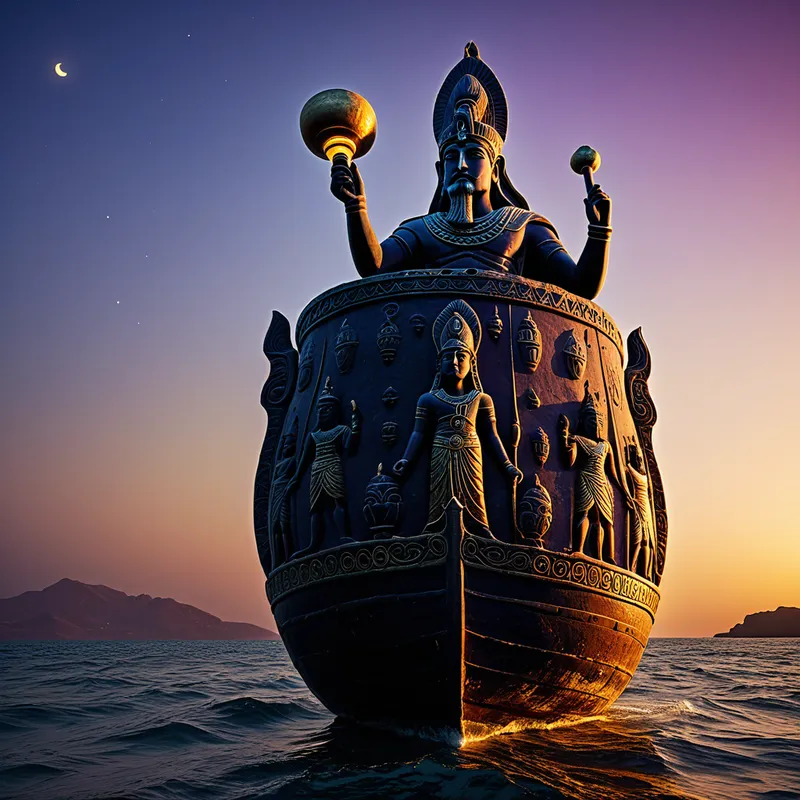
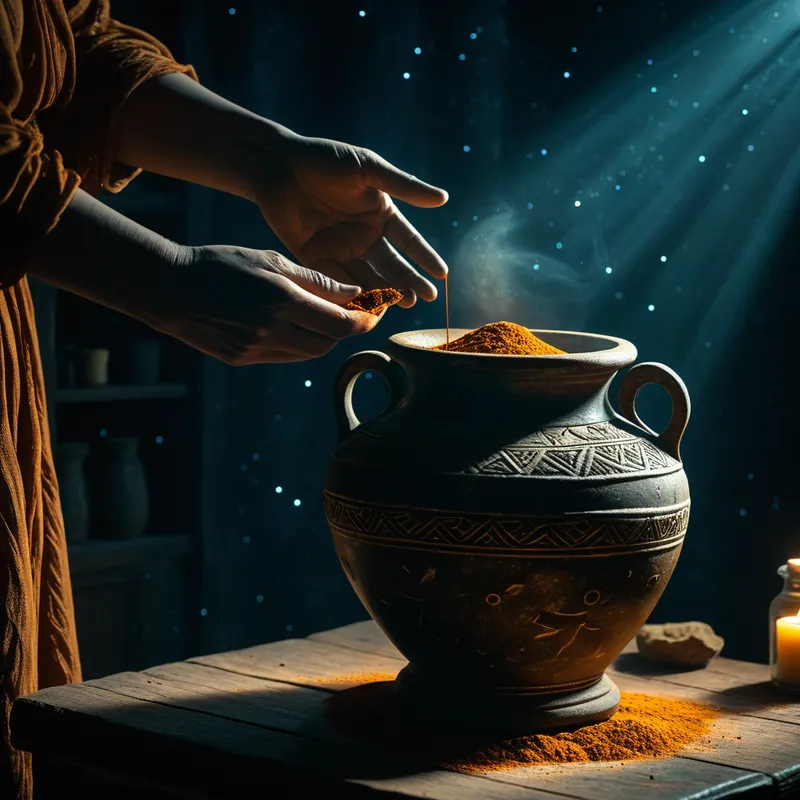
Yet, the deity’s heart became a compass pointing to that human shore. In the dead of the celestial night, when even Astarte’s gaze was turned elsewhere, they acted. Not with violence, but with a sailor’s cunning. They fashioned a vessel not from earthly cedar, but from a captured beam of the waning moon—a ship of faint, cool light. Into this phantom hull, they smuggled a single, perfect amphora, filled not with wine, but with condensed dawn: saffron’s fire, cinnamon’s bark, myrrh’s bitter tears.
The journey was the theft. To descend was to cross a sea of divine wrath. The stars, guardians of the vault, became hostile eyes. The winds, once allies, now shrieked with the voice of betrayed law. The moon-ship bucked and shuddered, its light guttering. The deity was no longer a ruler of horizons but a fugitive upon them, clinging to the stolen warmth within the jar as cosmic frost threatened to seal their fate. They navigated by a new star—the desperate, collective yearning of humanity—a faint, trembling beacon in the vast dark.
When the first grey hint of the mortal world appeared, the deity was no longer radiant. They were scorched by stellar cold, worn thin by the journey, the price of transgression etched into their very form. The ship of moonlight dissolved into sea foam as it touched the water of our world. Wading ashore at the place we now call Tyre, the deity, diminished yet resolute, presented the amphora to the first humans who dared approach. They did not speak a blessing. They simply broke the seal.
The air, once flat, suddenly had depth. The world, once mute, began to sing a song of scent. The crimson threads dissolved into the wind, promising courage. The bark melted into the earth, promising warmth. The bitter resin soaked into the soil, promising sacred memory. The people wept, for they understood both the gift and its cost. The deity did not stay to be worshipped. As the first spices took root in human imagination, they turned and walked back into the surf, returning to the horizon from whence they came, forever marked by the journey, forever bound to the boundary they had blurred.
Cultural Origins & Context
This myth did not reside in grand temples inscribed on stone, but in the very rhythm of Phoenician life. It was a story told on the decks of gauloi by firelight, in the murmur of spice markets in Byblos and Sidon, and in the instructions a master navigator gave to his apprentice. It was not a state religion, but a mercantile and maritime soul-theology. The Phoenicians, the great intermediaries of the ancient world, saw their own identity in this tale. They were the horizon-walkers, the ones who dared the unknown sea (the Tehom) to bring back the intangible treasures that enriched life.
The myth served multiple societal functions. It sacralized the trader’s perilous profession, framing it not as mere greed, but as a divine, if transgressive, calling. It explained the origin of the spices that were the bedrock of their economy and their reputation. Most importantly, it codified a core cultural value: that true value lies not in hoarding, but in the dangerous, transformative journey of exchange. The story was a narrative compass, teaching that progress requires leaving the safety of the known shore, facing the wrath of the elements (and the gods), and being fundamentally changed by the voyage.
Symbolic Architecture
At its heart, this is not a myth about commerce, but about the transmission of essence from a guarded, static realm (the divine/conscious) to a needy, dynamic one (the mortal/unconscious, or vice-versa). The stolen spice is individuation itself—the vital, flavorful complexity that makes a life uniquely resonant.
The god who becomes a smuggler is the part of the Self that must break its own rules to become whole.
The celestial vault represents the ordered, but sterile, conscious ego. It has all the treasures but no risk, no life. The mortal shore is the unconscious, fertile but undeveloped, yearning for animation. The deity is the mediating psychopomp, the ego that must risk its own privileged stability to retrieve the vitalizing contents of the unconscious (the spices) and bring them to light. The perilous sea journey is the terrifying, isolating process of confronting the shadow and the unknown within. The transformation of the deity—from radiant ruler to scarred wanderer—symbolizes the inevitable cost of growth: we cannot integrate new depths without sacrificing our old, simpler form.

The Dreamer’s Resonance
When this myth stirs in the modern dreamer, it often manifests as dreams of clandestine journeys, of carrying a precious, fragile, or forbidden cargo. One might dream of smuggling a glowing gem or a rare plant through checkpoints, of navigating a small boat through a terrifying night storm toward a distant, welcoming light, or of being pursued for possessing a secret knowledge that feels vital.
Somatically, this can correlate with a feeling of tightness in the chest (the hidden cargo) coupled with restless legs or a sense of motion (the journey). Psychologically, it signals that the psyche is engaged in a critical retrieval operation. The “spice” is a repressed talent, a buried emotion, a new value, or a creative impulse that the conscious mind has deemed “too much,” “too risky,” or “not allowed.” The dream is the psyche launching the expedition. The anxiety in the dream is the natural resistance—the “wrath of the stars”—the internalized laws and fears that say, “Stay in port. Do not disturb the hoard.”

Alchemical Translation
The alchemical process mirrored here is solutio and coagulatio—dissolution and coagulation. The deity’s fixed celestial identity is dissolved in the chaotic sea of the journey. They are stripped of their divine prerogative, becoming fluid, adaptable, and vulnerable. This is the necessary death of the old self.
The voyage across the Tehom is the ego’s dissolution in the waters of the unconscious, the only way to retrieve the gold hidden in the dark.
The retrieval of the spice is the discovery of the lapis philosophorum, the philosopher’s stone—not a physical object, but the transformative principle. Finally, the offering of the spice to humanity is the coagulatio: the reintegration of this newfound essence into a renewed life. The deity does not return to the vault; they become the horizon itself, the living boundary. For the individual, this translates to the act of bringing a once-forbidden insight into daily life. It is the introvert sharing their deep reflection, the artist risking sentimentality, the leader showing vulnerability. The “spice” loses its illicit, hidden quality and becomes the very flavor of one’s authentic presence in the world. The journey’s cost—the scars, the weariness—is not pathology, but the mark of a consciousness that has expanded to hold more shadow and more light, forever altered by the fragrant, perilous trade with the deep.
Associated Symbols
Explore related symbols from the CaleaDream lexicon: