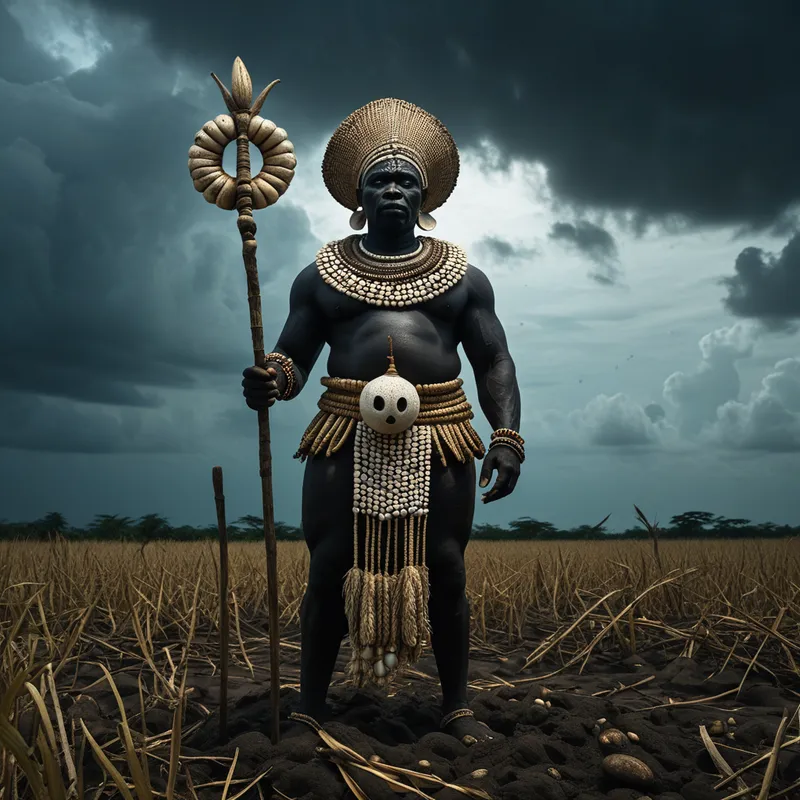
Sopona Myth Meaning & Symbolism
The myth of Sopona, a powerful deity of pestilence, reveals the terrifying yet sacred nature of disease and the complex path to healing and societal balance.
The Tale of Sopona
Listen, and hear the tale that walks on heated feet, a story carried on a wind that withers the green shoot and silences the marketplace. It begins not in the bright court of [Olodumare](/myths/olodumare “Myth from Yoruba culture.”/), but in the simmering, unseen places where life and decay share a single root.
There was a power, a presence, named Sopona. He was not born of laughter or gentle rain, but of a necessary, terrible truth. His domain was the heat beneath the skin, the sudden fire in the blood, the silent bloom that marked the flesh. He walked unseen, a lord of transformation whose touch was feared above all others. His messengers were not drums or songs, but the quiet, creeping fever and the dreaded spots that spread like a dark constellation across the body.
The people, in their terror, named him a bringer of mere suffering. They saw only the ravaged face, the trembling limb, the empty stool where a vibrant soul once sat. They did not see the sacred purpose in his wrath. They forgot that the fiercest fire also purifies. So, they turned their backs. They whispered curses. They refused the offerings, denied the respect due to such a formidable force of nature.
And Sopona, scorned and dishonored, grew wrathful. His heat, once a contained, sacred force, became a wildfire of vengeance. He stalked the land not as a disciplined deity, but as a raging epidemic. Whole villages fell into a silence broken only by moans. The air grew thick with the scent of fear and decay. The healers’ herbs were useless; the priests’ prayers seemed to fall on deaf ears. The world was in the grip of a divine punishment, a lesson delivered through unbearable suffering.
The crisis reached its peak. The people, desperate, finally understood. This was not random malice, but a demand for recognition. A profound sacrifice was needed—not of goats or yams, but of understanding. The order of the world had been offended. A pact had to be remade.
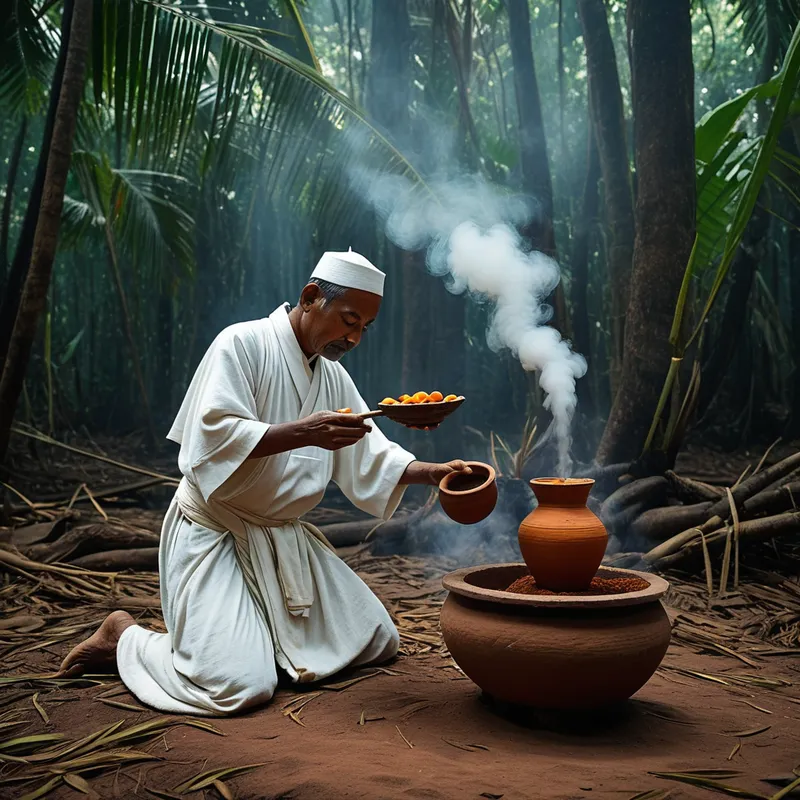
So, the elders and the most courageous priests undertook a solemn mission. They ventured to the wild, liminal spaces, to the groves where Sopona’s power was strongest. There, they built a shrine not of grandeur, but of stark simplicity: a dedicated space, a clay pot, symbols of his realm. They offered not pleas for mercy, but acknowledgments of his power—palm oil, bitter kola, the humility of their presence. They did not seek to destroy him, but to house him, to give his fearsome energy a proper place in the order of things.
And in that act of supreme respect, the frenzy ceased. Sopona’s wild, untamed wrath was channeled. He became not an enemy to be defeated, but a power to be managed, a sacred force whose terrible potential was now balanced by ritual, reverence, and the brave custodianship of his priests. The healing could begin, but it was a healing forever marked by the memory of the sacred scourge.
Cultural Origins & Context
The myth of Sopona is deeply woven into the historical fabric of Yoruba life, arising from a very real and terrifying encounter with smallpox. This was not a story of distant gods, but a narrative framework for understanding a devastating, inexplicable natural force. In a world without germ theory, disease, especially one as virulent and scarring as smallpox, was perceived as a spiritual attack, a divine retribution, or the work of a powerful, capricious entity.
The myth was transmitted orally, likely by priests (Babalawo with specific knowledge) and elders within the secretive guilds dedicated to Sopona’s worship. These custodians were not just healers in a medical sense; they were diplomats to a dangerous god, intermediaries who understood the protocols of this sacred wrath. The myth served a critical societal function: it explained catastrophe, provided a ritual framework for response (isolation, specific offerings, dedicated priesthoods), and ultimately reinforced social cohesion by defining how to collectively address a supreme threat. It transformed a random tragedy into a narrative with cause, effect, and a prescribed path to resolution.
Symbolic Architecture
At its core, Sopona represents the [archetype](/symbols/archetype “Symbol: A universal, primordial pattern or prototype in the collective unconscious that shapes human experience, behavior, and creative expression.”/) of the Sacred [Shadow](/symbols/shadow “Symbol: The ‘shadow’ embodies the unconscious, repressed aspects of the self and often represents fears or hidden emotions.”/). He is the embodiment of necessary destruction, the [aspect](/symbols/aspect “Symbol: A distinct feature, quality, or perspective of something, often representing a partial view of a larger whole.”/) of [reality](/symbols/reality “Symbol: Reality signifies the state of existence and perception, often reflecting one’s understanding of truth and life experiences.”/) we fear, reject, and attempt to [exile](/symbols/exile “Symbol: Forced separation from one’s homeland or community, representing loss of belonging, punishment, or profound isolation.”/), yet which holds immense transformative power.
The wound that does not kill you does not make you stronger; it transforms you. The myth of Sopona insists that the transformative agent itself must be honored, not just the outcome.
Sopona is the unintegrated shadow of the [community](/symbols/community “Symbol: Community in dreams symbolizes connection, support, and the need for belonging.”/) and the individual—the repressed rage, the festering [injustice](/symbols/injustice “Symbol: A perceived violation of fairness, rights, or moral order, often evoking a sense of imbalance or ethical breach.”/), the ignored [imbalance](/symbols/imbalance “Symbol: A state of disharmony where opposing forces are unequal, often representing internal conflict or external instability.”/) that, when denied, erupts as [chaos](/symbols/chaos “Symbol: In Arts & Music, chaos represents raw creative potential, uncontrolled expression, and the breakdown of order to forge new artistic forms.”/) and sickness. The pustules of the [disease](/symbols/disease “Symbol: Disease represents turmoil, issues of control, or unresolved personal conflicts manifesting as physical or emotional suffering.”/) are symbolic of a [truth](/symbols/truth “Symbol: Truth represents authenticity, honesty, and the quest for knowledge beyond mere appearances.”/) “coming to a head,” a poisonous content forcing its way to the surface of [consciousness](/symbols/consciousness “Symbol: Consciousness represents the state of awareness and perception, encompassing thoughts, feelings, and experiences.”/). The myth’s [resolution](/symbols/resolution “Symbol: In arts and music, resolution refers to the movement from dissonance to consonance, creating a sense of completion, release, or finality in a composition.”/) is not victory over this force, but sacred containment. The [shrine](/symbols/shrine “Symbol: A sacred structure for worship, offering, or remembrance, representing connection to the divine, ancestors, or spiritual forces.”/) and the priesthood symbolize the conscious ego creating a [vessel](/symbols/vessel “Symbol: A container or structure that holds, transports, or protects something essential, representing the self, emotions, or life journey.”/)—a psychological [structure](/symbols/structure “Symbol: Structure in dreams often symbolizes stability, organization, and the framework of one’s life, reflecting how one perceives their environment and personal life.”/)—to hold and relate to this terrifying aspect of the psyche, thereby robbing it of its autonomous, destructive power.

The Dreamer’s Resonance
When the pattern of the Sopona myth stirs in modern dreams, it signals a profound somatic and psychological process: the eruption of the personal or collective shadow. This is not about literal disease, but a psychic “infection” or “inflammation.”
One might dream of skin breaking out in strange patterns, of burning fevers, or of being pursued by a silent, heat-radiating presence. These dreams point to a content—a repressed emotion, a denied truth, a festering resentment or shame—that is demanding to be acknowledged. The body in the dream becomes the landscape of the psyche, with symptoms symbolizing what is trying to be expelled or made conscious. The process is one of psychic purging. The dreamer is in the crisis phase of the myth, experiencing the chaotic, painful eruption of what has been buried. The task, as in the myth, is not to panic and further repress, but to ask: What sacred, terrifying truth is forcing its way to the surface? What have I refused to honor?

Alchemical Translation
The alchemical journey modeled by Sopona is the nigredo—the blackening, the putrefaction—seen not as a mistake but as the essential first stage of transmutation. For the modern individual seeking individuation, the myth provides a map for navigating profound inner crisis.
The individuation process often begins with a sacred illness, a visitation from one’s own personal Sopona, whose terrible gift is the disintegration of the inauthentic self.
First, we experience the Eruption: the old, adapted personality structure “falls sick.” A life crisis, depression, or explosive anger reveals the foundational cracks. This is Sopona’s wrath, the shadow’s rebellion against being ignored. The instinct is to fight it, to cure it immediately, to return to the previous “health” (which was actually a state of unconsciousness).
The myth instructs us to move to the second stage: Recognition and Sacrifice. This is the brave work of the elders and priests. We must sacrifice our denial, our self-image, our hope for a painless return. We must consciously acknowledge the power of this disruptive force within us. We build an inner “shrine”—perhaps through therapy, journaling, or active imagination—where we can consciously engage with this shadow content, not as an enemy, but as a formidable, sacred part of our totality.
Finally, we achieve Sacred Containment and Integration. The wild, autonomous complex (Sopona) is not destroyed; its energy is transmuted. The fever becomes focused passion. The destructive rage becomes the capacity for necessary boundaries. The scarring becomes a mark of initiation, a testament to survival and depth. The individual emerges not “healed” in the sense of being unmarked, but whole, having integrated a terrifying power into a more complete and resilient self. The priest of Sopona within is born—the part of us that can respectfully manage our own destructive potentials without being consumed by them.
Associated Symbols
Explore related symbols from the CaleaDream lexicon:
- Fire — Represents the divine wrath and purifying heat of Sopona, the fever that consumes the body to transform the spirit, a force of both destruction and necessary cleansing.
- Wound — Symbolizes the physical and psychic lesions caused by the ignored shadow, the opening through which poison exits and through which a new, more conscious awareness can enter.
- Sacrifice — Denotes the essential offering of egoic denial and comfort required to appease and integrate a powerful shadow force, as seen in the community’s ritual acknowledgment of Sopona.
- Healing — In this context, healing is not a return to a prior state of ignorance, but the complex, scarred integration of a traumatic force into a new, more whole equilibrium.
- Shadow — The direct psychological counterpart to Sopona, representing the totality of the unconscious aspects of the personality that are feared, rejected, and which possess transformative power.
- Ritual — The structured, conscious practice (like building the shrine) that contains raw, chaotic psychic energy, transforming autonomous suffering into a meaningful process.
- Fear — The primary human response to Sopona’s power, which must be confronted and moved through to achieve the reverence necessary for integration.
- Death — Symbolizes the necessary end of an old way of being, a state of innocence, or a rigid identity, which is the prerequisite for the transformation Sopona brings.
- Rebirth — The potential outcome on the other side of the crisis, where the individual or community is reconstituted, marked by the ordeal but fundamentally renewed.
- Spirit — Represents the divine, non-material essence of Sopona himself, a force of nature that transcends mere physical illness and operates on a cosmological and psychological plane.