Sophie's Choice Myth Meaning & Symbolism
A mortal woman's tragic choice between her children, forced by the gods as the price for a glimpse of divine, world-altering truth.
The Tale of Sophie’s Choice
Hear now the tale whispered by the cypress trees and carried on the salt-sting of the Aegean wind. It is the story of Sophie, whose name meant Wisdom, yet who learned that wisdom is not a gentle teacher, but a thief in the night.
In the days when the gods walked closer to [the earth](/myths/the-earth “Myth from Hindu culture.”/), in [the shadow](/myths/the-shadow “Myth from Jungian culture.”/) of [Mount Olympus](/myths/mount-olympus “Myth from Global/Universal culture.”/), there lived a woman of keen mind and profound spirit. She was not a queen or a warrior, but a thinker, a ponderer of deep waters and star-paths. Her life was her twin children, Noos and Thumos, a boy and a girl, who were to her not merely offspring but the dual emanations of her own soul—one of brilliant, questioning intellect, the other of fierce, boundless compassion.
Sophie’s crime was a quiet one: an insatiable hunger. She sought to understand the [Logos](/myths/logos “Myth from Christian culture.”/), the secret architecture behind creation itself. She prayed not for riches or long life, but for a single, clear glimpse of [the world](/myths/the-world “Myth from Tarot culture.”/) as the gods see it. The Sky-Father heard her. In a voice that was the rumble of distant thunder, he offered a bargain. “The vision you seek is not for mortal eyes. To hold it, you must pay a price measured not in gold, but in the substance of your own being. You may see the truth, but to bear it, you must choose which half of your soul will be sacrificed to make room for it.”
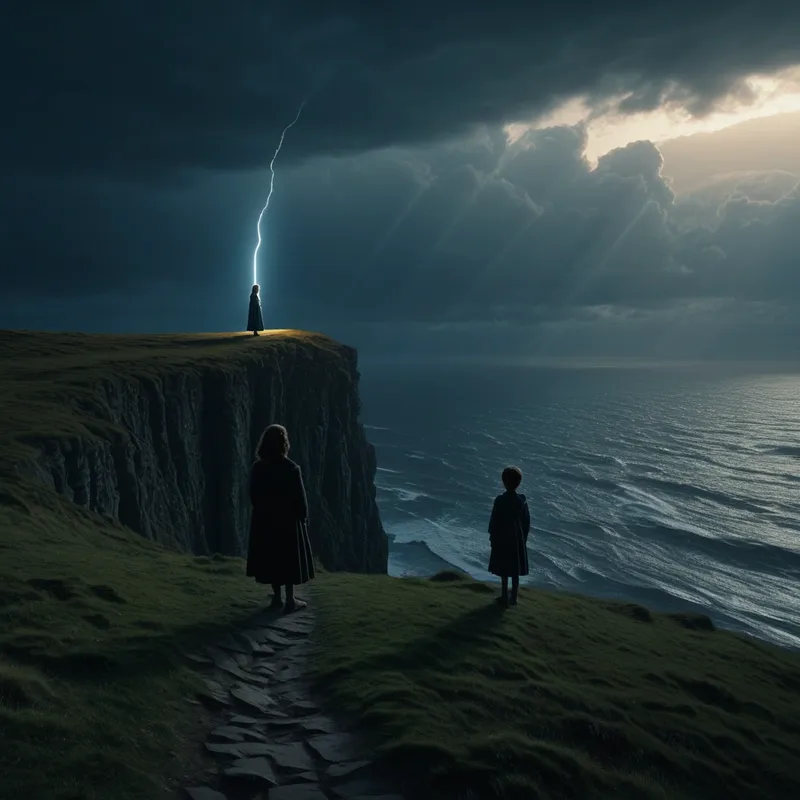
The setting was a barren, sacred cleft in the mountains, a place between places. The air grew still and heavy. Before Sophie appeared a vision of the Cosmos in its terrifying, beautiful totality—every thread of fate, every cause and effect, a radiant and interconnected web of light. And beside this vision stood her children. Noos, with eyes like polished obsidian, reflecting the cold light of stars. Thumos, with a countenance warm as hearth-fire, radiating palpable love.
The command was absolute. “Choose one to remain with you in the world of light and knowledge. The other must pass into the realm of [Lethe](/myths/lethe “Myth from Greek culture.”/), to be as if they never were, remembered only as a phantom limb of your soul.”
Sophie did not choose quickly. The moment stretched into an eternity of agony. She looked at Noos, the mind, the tool with which she sought understanding. To lose him would be to become a feeling creature without navigation, adrift in a sea of sensation. She looked at Thumos, the heart, the wellspring of all connection and meaning. To lose her would be to become a cold, calculating engine, a sterile observer of a living world. Her choice was not between a good child and a bad, but between the very pillars of her humanity. With a sound that was less a cry and more the tearing of the world’s fabric, she made her decision. The chosen child remained, solid and weeping. The other dissolved into a shower of golden dust, carried away on a sigh of wind, leaving behind only a scent of rain on dry earth and an emptiness that echoed louder than any sound.

Cultural Origins & Context
The myth of Sophie’s Choice is not found in the canonical works of [Homer](/myths/homer “Myth from Greek culture.”/) or Hesiod, but belongs to the body of paregoric myths—moral and philosophical tales told by philosophers and tragedians to illustrate profound existential dilemmas. It likely emerged in the late Classical or early Hellenistic period, a time of increasing intellectual complexity where the individual’s relationship to fate, knowledge, and the divine was under intense scrutiny.
It was a story recounted in symposia and philosophical schools, a narrative thought-experiment that gave form to a terrifying question: What is the true cost of ultimate understanding? In a culture that venerated both Athena (reason) and Dionysus (passion), Sophie’s tragedy dramatized the apparent incompatibility of these two divine forces within a single, mortal vessel. The myth served as a cautionary tale about the limits of human aspiration and the inherent fragmentation of the soul that seeks to transcend its station.
Symbolic Architecture
At its core, the myth is not about a [mother](/symbols/mother “Symbol: The symbol of ‘Mother’ represents nurturing, protection, and the foundational aspect of one’s emotional being, often associated with comfort and unconditional love.”/) and children, but about the [soul](/symbols/soul “Symbol: The soul represents the essence of a person, encompassing their spirit, identity, and connection to the universe.”/)’s constitutive parts facing an annihilating dilemma. Sophie represents the conscious ego, standing at the [crossroads](/symbols/crossroads “Symbol: A powerful spiritual symbol representing a critical decision point where paths diverge, often associated with fate, transformation, and life-altering choices.”/) of development. Noos and Thumos are the archetypal fragments of intellect and [emotion](/symbols/emotion “Symbol: Emotion symbolizes our inner feelings and responses to experiences, often guiding our actions and choices.”/), reason and [empathy](/symbols/empathy “Symbol: The capacity to understand and share the feelings of others, often manifesting as emotional resonance or intuitive connection in dreams.”/), yang and yin.
The choice is never between good and evil, but between two essential goods. To become whole in one direction is to become irrevocably maimed in another.
The gods’ bargain symbolizes [the law](/symbols/the-law “Symbol: Represents external rules, societal order, moral boundaries, and the tension between personal freedom and collective structure.”/) of enantiodromia—that any [movement](/symbols/movement “Symbol: Movement symbolizes change, progress, and the dynamics of personal growth, reflecting an individual’s desire or need to transform their circumstances.”/) toward an extreme inevitably generates its opposite. To grasp the unified field (the [vision](/symbols/vision “Symbol: Vision reflects perception, insight, and clarity — often signifying the ability to foresee or understand deeper truths.”/) of the [Cosmos](/symbols/cosmos “Symbol: The entire universe as an ordered, harmonious system, often representing the totality of existence, spiritual connection, and the unknown.”/)), the [psyche](/myths/psyche “Myth from Greek culture.”/) must first accept a fundamental disunity within itself. The lost [child](/symbols/child “Symbol: The child symbolizes innocence, vulnerability, and potential growth, often representing the dreamer’s inner child or unresolved issues from childhood.”/) is not destroyed but relegated to the unconscious, becoming a complex of [grief](/symbols/grief “Symbol: A profound emotional response to loss, often manifesting as deep sorrow, yearning, and a sense of emptiness.”/) and longing that will forever haunt the periphery of [awareness](/symbols/awareness “Symbol: Conscious perception of self, surroundings, or internal states. Often signifies awakening, insight, or heightened sensitivity.”/). The chosen [child](/symbols/child “Symbol: The child symbolizes innocence, vulnerability, and potential growth, often representing the dreamer’s inner child or unresolved issues from childhood.”/) becomes the dominant, guiding principle, but is forever shadowed by the ghost of its twin.
The Dreamer’s Resonance
When this myth pattern erupts in the modern dreamscape, it rarely appears as a literal mother with children. Instead, the dreamer finds themselves in a sterile, high-pressure chamber—a laboratory, a tribunal, a blank room with two doors. They are forced to choose between two careers, two lovers, two core identities, or two paths of healing. The somatic experience is one of paralytic dread, a tightening in the chest and a hollowing in the gut.
This is the psyche signaling an impending, necessary, and tragic differentiation. The dreamer is at a threshold where a part of their potential self must be consciously relinquished to allow another part to fully incarnate. The agony of the dream mirrors [the ego](/myths/the-ego “Myth from Jungian culture.”/)’s resistance to this self-mutilation, which feels like a betrayal of one’s own wholeness. The dream is not prescribing the choice, but forcing the dreamer to feel the weight of the existential calculus that true growth requires.

Alchemical Translation
The alchemical process mirrored here is the [nigredo](/myths/nigredo “Myth from Alchemical culture.”/), the blackening, the deepest despair of the soul confronted with its impossible contradictions. Sophie’s ordeal is the furnace.
Individuation is not an act of gathering all lost parts, but often a sacred, sorrowful act of choosing which parts you will carry, and mourning those you must leave at the crossroads.
The myth models the brutal truth of psychic transmutation: we do not simply integrate opposites to become a harmonious whole. Often, we must make a sacrificial election. We choose to develop the thinker, and the pure, untamed emotional self becomes an inner orphan, a wistful ghost in our creative life. We choose to develop the lover, and the sharp, analytical self becomes a critical phantom, a voice of cold reason in moments of passion. The “vision of the Cosmos” gained is the hard-won awareness of this very mechanism—the understanding that our consciousness is built upon a foundational loss. The alchemical gold is not a state of perfect balance, but the mature capacity to hold the memory of that loss with compassion, to honor the sacrificed self as the sacred price paid for the person we have become. In this light, Sophie is not merely a tragic victim, but the ultimate orphan archetype, who, through her devastating choice, births a new and sorrowful form of wisdom—a wisdom that knows its own cost.
Associated Symbols
Explore related symbols from the CaleaDream lexicon: