Solve et Coagula Myth Meaning & Symbolism
The eternal alchemical cycle of dissolution and coagulation, where the prima materia is broken down to its essence and reconstituted into the perfected philosopher's stone.
The Tale of Solve et Coagula
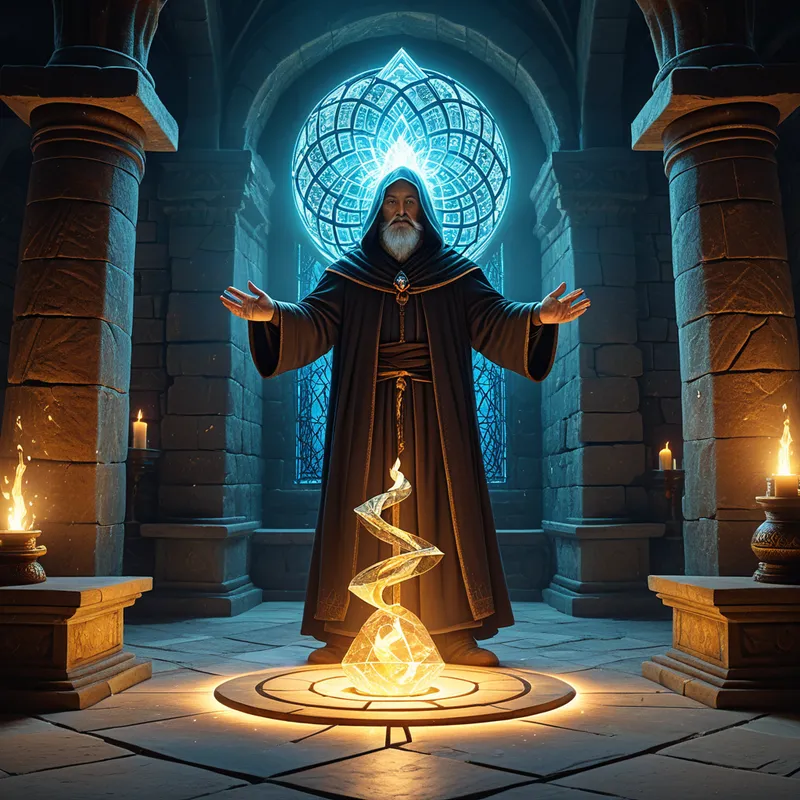
Listen, and I will tell you of the First Operation, the breath of the cosmos made manifest in the vessel. It does not begin with a hero, but with a sigh—the sigh of the Prima Materia, the world-egg, dreaming of what it might become. It is a sleeping giant of potential, dark and dense, containing all things and yet no thing in particular.
Into this dreaming chaos comes the Artifex, not as a conqueror, but as a midwife to the soul of the world. Their laboratory is not merely a room of glass and flame, but a sacred vas, a microcosm of the universe itself. The Artifex places the rough, leaden Prima Materia within the vessel, a heart of dull metal in a womb of glass. The first fire is lit—not a fire of destruction, but of longing.
And so begins the Great Sorrow, the Solve. The fire speaks in a whisper that becomes a roar. The solid matter weeps. It sweats a black, bitter dew—the Nigredo. It cracks, it groans, it sublimes into a mercurial spirit that flees to the top of the vessel, a ghost of its former self. The once-proud form dissolves into a swirling, chaotic mist of colors—the Cauda Pavonis. All identity is lost. All structure is undone. The vessel holds a storm of essence, a lamentation of separated parts: soul from body, spirit from matter, sulfur from salt. It is the universe remembering its birth in fire and chaos.
But the Artifex does not despair. They have faith in the secret order within the chaos. With a gentle, cooling breath—the second fire of contemplation—they initiate the Coagula. The mercurial spirit, now purified by its journey, descends like a gentle rain. It seeks out the salt, it embraces the sulfur. In the quiet darkness of the vessel, a new marriage is consecrated. The scattered colors begin to spiral inward, drawn by a silent, gravitational love.
A white light dawns—the Albedo. Then, fed by a renewed and gentle heat, it blushes with a rose-red warmth—the Rubedo. From the formless mist, a new body coalesces. It is not the leaden lump of before, but a radiant, translucent stone. It pulses with an inner sun, a captured star. It is the Lapis Philosophorum, the child of Solve and Coagula. The Artifex opens the vessel, and the light within does not blind, but illuminates the very soul. The operation is complete, and yet, it has only just begun, for the stone now holds the secret of the eternal cycle within its heart.

Cultural Origins & Context
The mythos of Solve et Coagula is not the provenance of a single culture, but the whispered secret of a transnational fraternity of seekers that spanned from Hellenistic Egypt through the Islamic Golden Age and into the Renaissance courts of Europe. Its primary “texts” were not epics, but cryptic, heavily illustrated manuscripts like the Emerald Tablet and the Mutus Liber. These were often encoded, using the language of chemistry (distillation, sublimation) and Christian mysticism (death and resurrection) as a veil for a profound psycho-spiritual doctrine.
It was passed down in a master-apprentice lineage, through oral teaching and symbolic art more than explicit dogma. Its societal function was dual. Exoterically, it promised the literal transmutation of base metals into gold and the creation of an elixir of life. Esoterically, and more importantly, it served as a precise map for the individuation of the practitioner. The laboratory was the psyche; the metals were the contents of the soul. The myth provided a container for the terrifying yet necessary process of inner death and rebirth, a process too volatile to be approached directly without a guiding symbolic framework.
Symbolic Architecture
At its core, Solve et Coagula is the archetypal blueprint for all transformation. It is the inhalation and exhalation of the cosmos, the rhythm of the tides, the cycle of the seasons internalized.
Solve is the courage to deconstruct. It is the death of the persona, the dissolution of rigid ego structures, and the willing descent into the chaotic waters of the unconscious. It represents analysis, criticism, and the breaking apart of complexes.
The Nigredo is not mere failure, but the fertile black soil of the soul. It is the necessary depression, the dark night, where old certainties rot away to make space for new life. The swirling Cauda Pavonis symbolizes the emergence of previously unconscious psychic content—memories, talents, shadows—now floating freely, awaiting a new synthesis.
Coagula is the art of reconstruction. It is the integration of those freed elements into a new, more conscious order. It requires the heat of Eros (relationship, feeling) and the discipline of Logos (order, understanding).
The final stone, the Lapis, symbolizes the Self—a psychic center that is both solid and luminous, personal and transpersonal. It is not a state of static perfection, but a dynamic, living wholeness that contains the entire process within itself.
The Dreamer’s Resonance
When this myth stirs in the modern dreamer, it announces a period of profound psychic restructuring. Dreams of Solve might manifest as terrifying yet fascinating imagery: the dreamer’s house crumbling, their teeth falling out, or their body melting into water or sand. There is a somatic quality of liquefaction, of losing one’s footing. These are not prophecies of literal disaster, but symbolic representations of an ego-structure that is being—or needs to be—dissolved for growth to occur.
Conversely, dreams of Coagula might involve finding a precious jewel in the mud, assembling a beautiful mosaic from broken pieces, or watching scattered lights coalesce into a guiding star. There is a feeling of gathering, of integration, of a new center forming from the chaos. The body in the dream may feel more solid, more real, or may be depicted as radiant or golden. These dreams mark the culmination of a difficult inner process, where insights and experiences are finally being woven into a coherent new sense of identity and purpose.

Alchemical Translation
For the individual navigating the complexities of modern life, the myth of Solve et Coagula is an indispensable guide to psychic transmutation. Our culture prizes Coagula—productivity, identity, solidity—while often pathologizing the necessary Solutio. We fear the breakdown, the midlife crisis, the depressive episode. Yet, this myth teaches that dissolution is not the enemy of the self, but its crucible.
The first step is to consciously engage in one’s own Nigredo. This means turning toward, not away from, the shadow—the rejected parts of ourselves, the grief we have not processed, the anger we have suppressed. It is the “solving” of our compulsive narratives and defensive identities.
The true Artifex is the observing consciousness that can hold the tension of the opposites—the chaos of Solve and the order of Coagula—without fleeing to one pole or the other.
From this container, the spontaneous Albedo can emerge: a moment of clarity, a flash of self-forgiveness, a cooling insight. Finally, with sustained attention and the warmth of conscious living, the Rubedo is achieved. This is not an end, but a new mode of being. The individual becomes their own Lapis—not a fixed, perfect entity, but a being capable of containing their own contradictions, of dissolving and reforming with wisdom, carrying the secret of their own transformation within. They become, in essence, both the vessel and the stone, the process and the product, forever engaged in the sacred, cyclical work of becoming whole.
Associated Symbols
Explore related symbols from the CaleaDream lexicon:
- Mix
- Operation
- Steam
- Jellyfish Sandwich
- Digging Hole
- Tearing Paper
- Iodine Mist
- Volatile Chlorine
- Mixed Media Piece
- Revising Drafts
- Recycling Bin
- Phoenix Pliers
- Jumbo Size Whisk
- Grater
- Food Processor
- Garlic Press
- Eraser Fantasy
- Document Shredder
- Cognitive Dissonance
- Mobius Strip
- Fragmented Puzzle
- Fizzing Bubble
- Atmospheric Friction
- Ionization
- Evaporation
- Reanalysis
- Debug
- Regression
- Diffusion
- Dissolution
- Corrosion
- Adhesion
- Reduction
- Discharge
- Granulation
- Analysis
- Shattering
- Astringent