Solutio Myth Meaning & Symbolism
The myth of the primal matter dissolving in the universal solvent, losing form to be purified and reborn into a higher state of being.
The Tale of Solutio
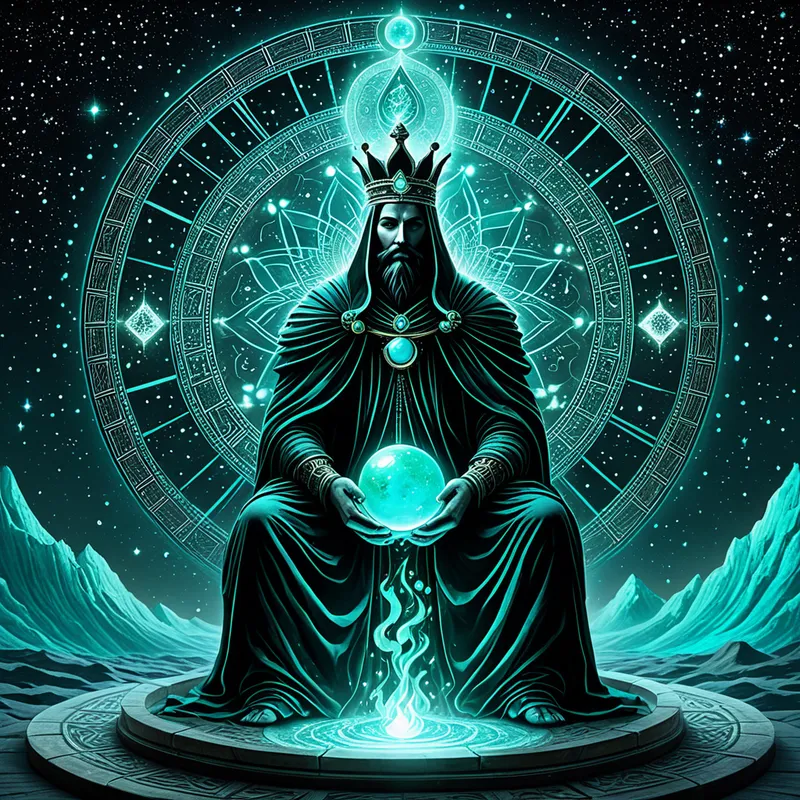
Listen, and hear the tale whispered in the steam of the alembic and sighed in the bubbles of the retort. It begins not with a hero, but with a sovereign in chains. The Prima Materia was a king, but a king of leaden weight, a ruler of dense, dark matter. He sat upon a throne of fixed salt, clutching a scepter of rigid sulfur, crowned with the cold mercury of a stagnant mind. His kingdom was the vessel, the sealed glass womb of the cosmos, and it was a prison of perfect, unchanging form.
A longing stirred in the deep places of the world—a call from the Aqua Permanens, the eternal water. It was not a river, but the potential of all rivers; not an ocean, but the memory of the ocean before land was born. It seeped into the vessel, not as a flood, but as a rising mist, a dew that condensed on the cold walls of the king’s certainty. At first, he resisted. His scepter repelled the droplets. His crown defied the humidity. But the Aqua Permanens is patient. It is the solvent of time itself.
The mist became a film, the film a pool at his feet. It touched the hem of his robe, and the dense fabric began to soften, its threads unraveling into vague, colorful strands. The king cried out, but his voice was swallowed by the gathering liquid. The pool rose. It touched his skin, and a terrible, wonderful melting began. He felt his boundaries—the very idea of here and there, of self and other—begin to waver. His scepter drooped like wax, its symbolic power flowing into the solution. His crown liquefied, the jewels becoming nothing but points of colored light swimming in the brew.
This was not death by drowning, but unmaking by embrace. The rigid salt of his body sighed and dissolved. The fiery, defiant sulfur of his spirit was quenched and carried away. The mercurial quickness of his thought dispersed into a million shimmering motes. The king fought, but his struggles only hastened the mixing. He was no longer a figure, but a cloud in water, a swirl of pigment in wine. All distinct form was lost. The vessel held only a swirling, chaotic, yet homogeneous Nigredo—a profound and fertile darkness where all previous identities were annulled.
And in that total surrender, in that absolute loss, a strange peace descended. The conflict was over. The resistance ended. The sovereign was gone, but the substance remained, now humbled, fluid, and utterly open. The Aqua Permanens had done its work. The solution was complete, holding in its murky depths the latent promise of all that was, and all that could be.
Cultural Origins & Context
The myth of Solutio is not a narrative passed down by bards, but a technical instruction encoded in the cryptic texts of medieval and Renaissance alchemists. It was a core operation in the Magnum Opus, detailed in works like the Rosarium Philosophorum and the writings of figures such as Hermes Trismegistus. Its tellers were not entertainers but adepts, working in secret laboratories, interpreting the "book of nature" through their retorts and flasks.
Its societal function was esoteric and initiatory. It served as a metaphorical blueprint for a spiritual and psychological process, disguised as a chemical recipe to avoid persecution. The myth was acted out in the laboratory: the alchemist would take a solid matter (often a metal or mineral symbolizing the unrefined soul) and subject it to a solvent (like aqua fortis or aqua regia). The dramatic dissolution of the solid was observed not just as a physical change, but as a sacred drama, a necessary death of the old, fixed state. It was a myth performed in real-time, teaching that to create the new, the old must first lose all form.
Symbolic Architecture
Psychologically, Solutio represents the complete breakdown of conscious structures. The Prima Materia king is the entrenched ego-complex—our rigid identity, our defended opinions, our calcified ways of being. He is the "fixed" state, comfortable in its sovereignty but isolated and sterile.
The solvent is not an enemy, but the psyche's own deepest truth, returning to wash away the fortifications of a life built in fear.
The Aqua Permanens is the unconscious itself, particularly the fluid, feminine, and transformative power of the soul (the Anima in Jungian terms). It is emotion, intuition, and the flow of psychic life that our conscious "king" often tries to rule with logic and will. The conflict is the ego's terror of being overwhelmed by what it cannot control. The dissolution is the inevitable, often crisis-driven, process where life circumstances or inner turmoil flood these defenses.
The resulting Nigredo is not mere depression, though it may feel like it. It is the fertile void, the massa confusa, where all previously separated elements—thoughts, feelings, memories, potentials—swim together in possibility. It is the essential precondition for recombination. The king must drown so that the philosopher's stone can be conceived.

The Dreamer's Resonance
When this myth stirs in the modern dreamer, it announces a profound somatic and psychological process of de-structuring. Dreams of floods, tidal waves, or being submerged in pools or oceans are its clearest signatures. So too are dreams of melting buildings, dissolving faces in mirrors, or watching cherished objects turn to liquid. The body may echo this in feelings of being "ungrounded," fatigued, or in a state of fluid emotional lability.
This is the psyche's opus in action. The dreamer is not breaking down, but being dissolved. The ego is being invited, or forced, to surrender its rigid control. The process feels like a loss of identity because it is. One is swimming in the Aqua Permanens of the unconscious, where the clear labels of waking life no longer hold. The anxiety in such dreams is the king's final resistance. The peace that can sometimes follow in the dream is the acceptance of the Nigredo, the dark night where one is nothing, and thus potentially everything.

Alchemical Translation
For the modern individual seeking wholeness, the myth of Solutio models the non-negotiable first step of psychic transmutation: surrender. Our culture prizes building, fortifying, and defining the self. Alchemy, and depth psychology, insist that the path to the true Self (the Self) requires an opposite movement.
Individuation begins not with addition, but with subtraction; not with construction, but with dissolution.
We must allow our conscious attitudes, our persona, our treasured self-concepts—the "king" we have worked so hard to become—to be dissolved by the waters of our own unexplored depths. This is the meaning of the "dark night of the soul," the midlife crisis, or any profound life transition that strips us of former roles. It is a terrifying, humbling, yet sacred process. We are not being destroyed; we are being returned to our essential, fluid state, where the elements of our being can finally mingle freely.
The goal is not to remain dissolved, but to endure the solution so that a new, more authentic coagulation can occur. From the Nigredo emerges the Albedo. The fluid soul, having washed away the dross, is now prepared to receive a new form, one that integrates both the consciousness of the king and the fluidity of the solvent. To refuse this dissolution is to remain a king of lead, solid but base. To undergo it is to offer oneself as the raw material for gold.
Associated Symbols
Explore related symbols from the CaleaDream lexicon: