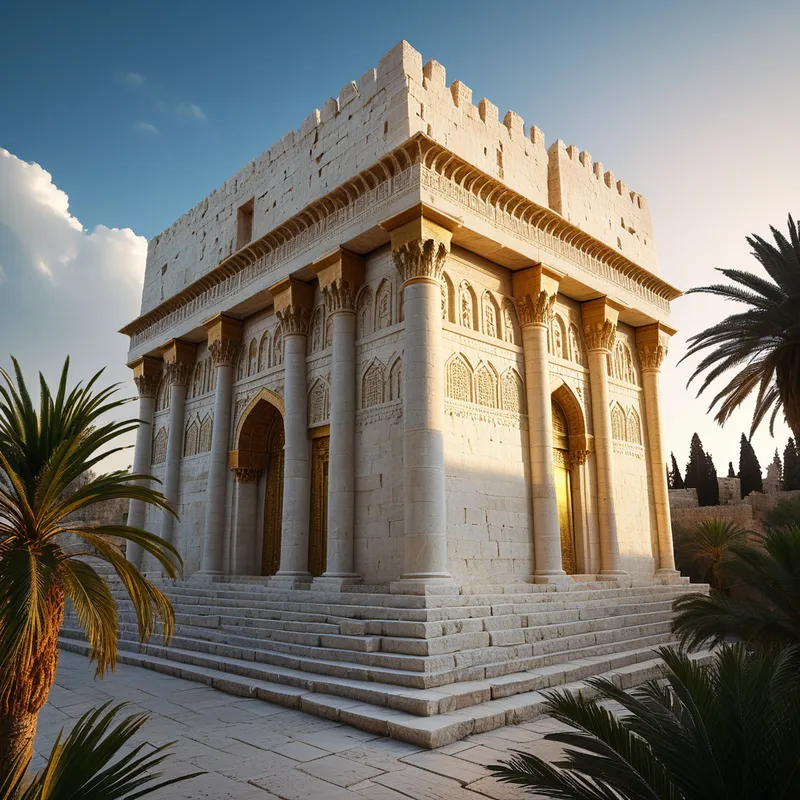
Solomon's Temple Myth Meaning & Symbolism
A king builds a house for the divine, a perfect structure of stone and gold, to contain the uncontainable and anchor heaven to earth.
The Tale of Solomon’s Temple
Hear now the tale of the House, not built for a king, but for a King.
In the days when the kingdom was a lion at rest, its claws sheathed in peace, there arose a king whose wisdom was a deep well from which nations drank. [Solomon](/myths/solomon “Myth from Biblical culture.”/) sat upon the throne of his father David, but a holy unrest stirred in his spirit. His father, a man of blood and battle, had been forbidden by the divine voice to build a house for the Name. The promise, however, remained: Your son, he shall build the house for my name.
And so [the word](/myths/the-word “Myth from Biblical culture.”/) came to Solomon: “Build.” Not a fortress, not a palace of vanity, but a dwelling. A fixed point where the wandering glory of the YHWH might condense, where the formless might touch form.
The call went out across the known world. From the quarries of [Jerusalem](/myths/jerusalem “Myth from Biblical culture.”/), the groan of stone being parted from stone echoed like a giant’s heartbeat. From the forests of Lebanon, great trunks of cedar and cypress, fragrant and enduring, were felled and floated down the coast. Hiram of Tyre, a man filled with wisdom and understanding, worked in bronze until it flowed like [water](/myths/water “Myth from Chinese culture.”/), casting pillars named Jachin and Boaz that stood as silent sentinels at the porch.
For seven years, the mountain was a hive of sacred industry. The air smelled of sawdust, molten metal, and incense yet to be burned. Stones were shaped in silence at the quarry, so that no hammer’s blow would be heard on the holy mount. Gold, beaten and refined until it was like liquid light, sheathed the inner sanctum.
Then came the day of the great bringing-in. The heart of [the wilderness](/myths/the-wilderness “Myth from Biblical culture.”/) journey, the Ark of the Covenant, was carried by priests through the courts. As it passed into the utter darkness of the Holy of Holies, a cloud filled the house—a thick, palpable presence that forced the priests to retreat, blind and trembling. It was the [Shekinah](/myths/shekinah “Myth from Christian culture.”/), the glory that had led Israel by fire and cloud, now entering its resting place.
And Solomon stood before all the people, spread his hands to the heavens, and spoke the impossible truth: “But will God indeed dwell on [the earth](/myths/the-earth “Myth from Hindu culture.”/)? Behold, heaven and the highest heaven cannot contain you; how much less this house that I have built!” The House was complete. A perfect vessel of geometry and devotion, standing at the navel of [the world](/myths/the-world “Myth from Tarot culture.”/), a prayer made solid in stone and gold.
Cultural Origins & Context
The myth of Solomon’s Temple is not merely a historical account from the Torah and the books of Kings and Chronicles. It is the foundational architectural myth of ancient Israel, a narrative that crystallized during and after the Babylonian Exile. It served a critical societal function: to explain the presence (and later, the catastrophic absence) of God in the midst of the people, and to establish Jerusalem as [the axis mundi](/myths/the-axis-mundi “Myth from Chinese culture.”/), the spiritual center of the cosmos.
Passed down by priests, scribes, and storytellers, the tale was a map of cosmic order. The meticulous details of its construction—the precise measurements, the specific materials, the ritual purity required—were not just building codes. They were a sacred technology, a set of instructions for creating a microcosm where divine law (Torah) and earthly order met. [The Temple](/myths/the-temple “Myth from Jewish culture.”/) was the ultimate symbol of the Covenant made tangible, a guarantee of stability and blessing for a nation whose identity was forged in wilderness wandering.
Symbolic Architecture
Psychologically, the [Temple](/symbols/temple “Symbol: A temple often symbolizes spirituality, sanctuary, and a deep connection to the sacred aspects of life.”/) is the [archetype](/symbols/archetype “Symbol: A universal, primordial pattern or prototype in the collective unconscious that shapes human experience, behavior, and creative expression.”/) of the constructed Self. It represents the lifelong [human](/symbols/human “Symbol: The symbol of a human represents individuality, complexity of emotions, and social relationships.”/) project of building a coherent, sacred, and ordered [psyche](/myths/psyche “Myth from Greek culture.”/)—a [temenos](/myths/temenos “Myth from Greek culture.”/) or protected [space](/symbols/space “Symbol: Dreaming of ‘Space’ often symbolizes the vastness of potential, personal freedom, or feelings of isolation and exploration in one’s life.”/)—within which the numinous, the transcendent [aspect](/symbols/aspect “Symbol: A distinct feature, quality, or perspective of something, often representing a partial view of a larger whole.”/) of the [soul](/symbols/soul “Symbol: The soul represents the essence of a person, encompassing their spirit, identity, and connection to the universe.”/), can reside.
The Temple is not where God is kept, but where the human soul learns to be still enough to perceive that which fills all space.
The threefold [structure](/symbols/structure “Symbol: Structure in dreams often symbolizes stability, organization, and the framework of one’s life, reflecting how one perceives their environment and personal life.”/)—the Outer Court, the Holy Place, and [the Holy of Holies](/myths/the-holy-of-holies “Myth from Biblical culture.”/)—maps the [journey](/symbols/journey “Symbol: A journey in dreams typically signifies adventure, growth, or a significant life transition.”/) of [consciousness](/symbols/consciousness “Symbol: Consciousness represents the state of awareness and perception, encompassing thoughts, feelings, and experiences.”/) from the external and public, through the [interior](/symbols/interior “Symbol: The interior symbolizes one’s inner self, thoughts, and emotions, often reflecting personal growth, vulnerabilities, and secrets.”/) and ritualistic, to the innermost, ineffable core of being. The silent preparation of the stones signifies the often-hidden, unconscious work of [integration](/symbols/integration “Symbol: The process of unifying disparate parts of the self or experience into a cohesive whole, often representing psychological wholeness or resolution of internal conflict.”/) that must occur before wholeness can be assembled. The Jachin and Boaz represent the foundational polarities of existence ([strength](/symbols/strength “Symbol: ‘Strength’ symbolizes resilience, courage, and the ability to overcome challenges.”/) and establishment, mercy and judgment) that must be held in balance at the [gateway](/symbols/gateway “Symbol: A threshold between states, representing transition, opportunity, or initiation into new phases of life or consciousness.”/) to the sacred.
Most profoundly, the Holy of Holies, a perfect cube of darkness housing the Ark, symbolizes the ultimate [mystery](/symbols/mystery “Symbol: An enigmatic, unresolved element that invites curiosity and exploration, often representing the unknown or hidden aspects of existence.”/) at the center of the psyche. It is the seat of the Self in Jungian terms. This [chamber](/symbols/chamber “Symbol: A private, enclosed space representing the inner self, hidden aspects, or a specific stage in life’s journey.”/) was empty but for the Ark; God was not seen, but present. This is the [paradox](/symbols/paradox “Symbol: A contradictory yet true concept that challenges logic and perception, often representing unresolved tensions or profound truths.”/) of inner work: we build a structure of discipline, understanding, and [virtue](/symbols/virtue “Symbol: A moral excellence or quality considered good, often representing inner character, ethical principles, or spiritual ideals in dreams.”/) not to capture [the divine spark](/myths/the-divine-spark “Myth from Gnostic culture.”/), but to create a [vessel](/symbols/vessel “Symbol: A container or structure that holds, transports, or protects something essential, representing the self, emotions, or life journey.”/) worthy of its indwelling—an indwelling that remains forever mysterious and unpossessed.
The Dreamer’s Resonance
When the motif of Solomon’s Temple appears in modern dreams, it seldom manifests as a pristine, tourist-postcard image. More often, the dreamer encounters a temple in a state of process or poignant symbolism.
- Dreaming of building or repairing a temple suggests a conscious, active phase of psychic integration. The dreamer is engaged in the hard, detailed work of ordering their inner world, perhaps after a period of chaos or fragmentation.
- A ruined or desecrated temple points to a profound feeling that one’s inner sanctum—one’s values, integrity, or sense of the sacred—has been violated or neglected. This can correlate with experiences of betrayal, trauma, or a deep spiritual crisis.
- Being lost in a vast, empty temple complex speaks to the somatic experience of alienation within one’s own psyche. The structure is there, but it feels hollow, echoing, and devoid of the animating presence. This is a dream of spiritual aridity, calling for a reconnection with the inner Shekinah.
- Finding a hidden, inner chamber is a powerful dream of discovery, indicating that the dreamer is accessing a previously unknown or protected layer of their own depth, a revelation of [the Self](/myths/the-self “Myth from Jungian culture.”/).
Alchemical Translation
The myth of Solomon’s Temple is a master blueprint for the alchemical process of individuation. It models the transmutation of the base, scattered materials of the personality ([prima materia](/myths/prima-materia “Myth from Alchemical culture.”/)) into the sacred, golden vessel of the integrated Self ([lapis philosophorum](/myths/lapis-philosophorum “Myth from Alchemical culture.”/)).
[The first stage](/myths/the-first-stage “Myth from Alchemical culture.”/), [Nigredo](/myths/nigredo “Myth from Alchemical culture.”/), is found in the dark quarry and the unshaped timber—the raw, unconscious material of one’s nature, full of potential but unformed. The Albedo, the washing and purifying, is the silent shaping of the stones away from the site, the careful selection of gold and bronze—the conscious work of analysis, refinement, and purification of one’s instincts and complexes.
The sacred plan is not imposed from without, but remembered from within; building the Temple is the act of recalling one’s own divine geometry.
The Citrinatio and [Rubedo](/myths/rubedo “Myth from Alchemical culture.”/), the yellowing and reddening, are the assembly itself, the fiery work of bringing these purified elements into a living, functioning order. This is the challenging, often fiery process of living one’s insights, forging relationships between opposing parts of the psyche (the two pillars), and creating a stable structure that can withstand the pressures of life.
Finally, the descent of the cloud into the completed Temple represents the coniunctio, [the sacred marriage](/myths/the-sacred-marriage “Myth from Various culture.”/). It is the moment when [the ego](/myths/the-ego “Myth from Jungian culture.”/)’s labor of construction is met by the grace of the unconscious, when the ordered vessel is filled with the un-ordered, living presence. The individual does not become God, but becomes a true vessel, able to hold the tension of the opposites, and in that sacred, inner darkness, know the peace that comes from being a dwelling place for something infinitely greater than oneself. The Temple stands, then, not as a monument to a king, but as an eternal symbol of the soul’s highest vocation: to build a house where heaven and earth may meet.
Associated Symbols
Explore related symbols from the CaleaDream lexicon: