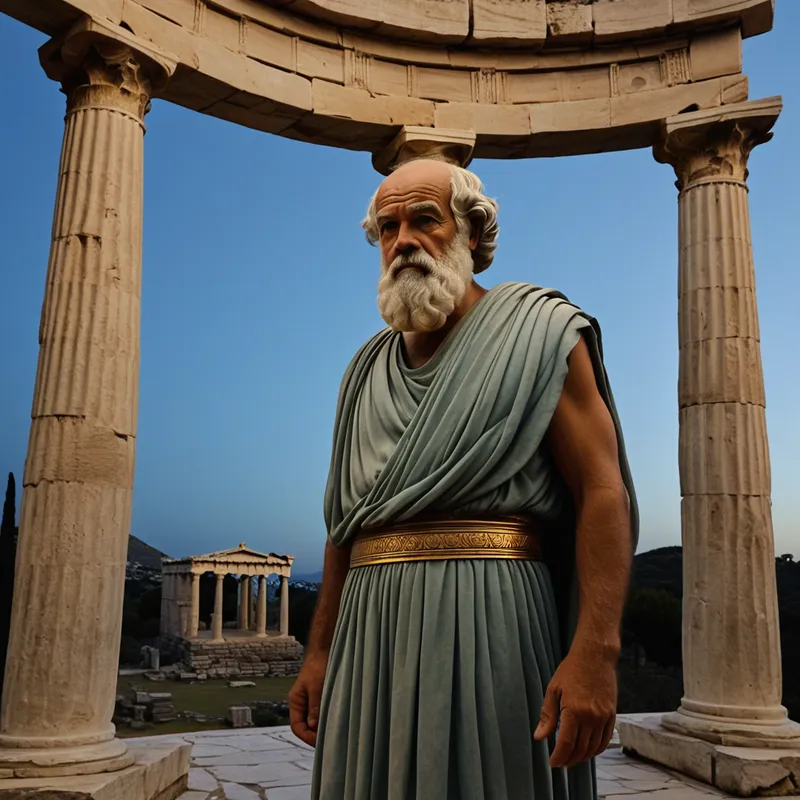
Socrates Myth Meaning & Symbolism
The story of a man who questioned everything, was condemned by the state, and chose death to preserve the integrity of his soul's quest.
The Tale of Socrates
The sun beat down on the agora of Athens, but the heat was not from [Helios](/myths/helios “Myth from Greek culture.”/) alone. It came from the man in the threadbare cloak. His name was Socrates, and he carried a chill wind of inquiry into the warm, settled corners of men’s minds.
He was not handsome, this son of a stonemason. His face was like a satyr’s, broad and pug-nosed, his eyes bulging with a terrible, gentle curiosity. He did not lecture from a steps. He wandered. He engaged. A general, proud of his courage, would find himself unraveling his own definition of bravery. A politician, certain of [justice](/myths/justice “Myth from Tarot culture.”/), would be led into a [labyrinth](/myths/labyrinth “Myth from Various culture.”/) of his own contradictions, until he stood silent, knowing only that he knew nothing. Socrates called this his “art of midwifery”—not implanting knowledge, but helping others birth the truths already within them. His tool was the relentless question, his method a dialogue that was a kind of loving combat.
Yet this man, who harmed no one and took no coin, began to cast a long shadow. To the young, he was a magnet; they followed him, intoxicated by this freedom of thought. To the powerful, he became a corrosive. After the city’s humiliation in the Peloponnesian War, a fragile democracy sought scapegoats. Three citizens brought charges against Socrates: corrupting the youth and impiety—not believing in the city’s gods, and introducing new divine beings.
The trial was not in a hushed chamber, but before a jury of 501 Athenian citizens. Socrates did not beg. He did not flatter. He defended not his life, but his way of life. He spoke of his daimonion, the inner voice that guided him, a sign of his unique piety. He declared that the unexamined life was not worth living. The vote was close, but guilty.
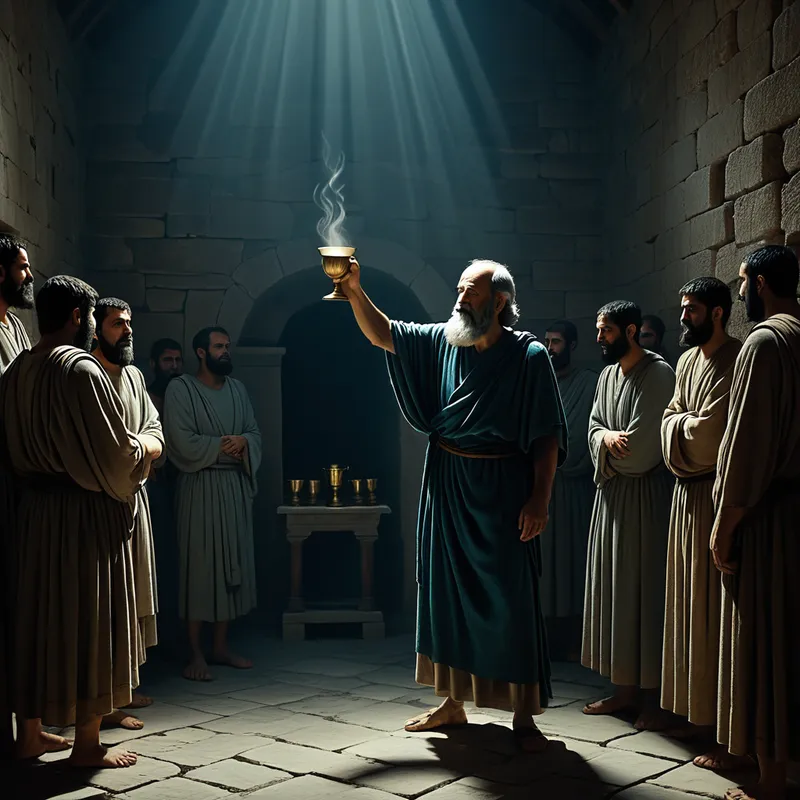
Given the chance to propose his own penalty, he suggested the city reward him as a public benefactor. Enraged, the jury condemned him to death by drinking a brew of poison hemlock. In his cell, as the sacred ship to Delos delayed the execution, his friends pleaded with him to escape. He refused. To flee would be to betray the Laws of Athens, the very social contract he had spent his life examining. He would not commit an injustice to avoid one suffered.
When the hour came, he took the cup calmly. He walked until his legs grew heavy, then lay down. A cold numbness crept from his feet upward. His last words were a reminder to his friend Crito: “We owe a cock to Asclepius. Please, don’t forget to pay the debt.” The poison reached his heart. The man was gone. The myth was born.
Cultural Origins & Context
This is not a myth of the age of heroes, but of the dawn of the individual. The story of Socrates is a historical event, meticulously shaped into myth by his students, primarily Plato. It exists in the liminal space between recorded history and foundational narrative. It was passed down not by anonymous bards, but through philosophical dialogues—stylized, dramatic scripts where Socrates is the unwavering protagonist.
Its societal function was dual and paradoxical. For the Athenian polis, his condemnation was a tragic attempt to restore unity and traditional piety after the trauma of war and tyranny. For the emerging Western mind, however, his death became the supreme martyrdom for intellectual freedom and personal conscience. The myth served as the primal scene of philosophy itself: the moment the individual’s pursuit of truth collided with the collective’s need for order, resulting in a sacrifice that forever sanctified the question.
Symbolic Architecture
Socrates represents the archetypal activation of conscious [awareness](/symbols/awareness “Symbol: Conscious perception of self, surroundings, or internal states. Often signifies awakening, insight, or heightened sensitivity.”/) within the [psyche](/myths/psyche “Myth from Greek culture.”/). He is not the answer, but the eternal question. His physical unattractiveness symbolizes the irrelevance of the [persona](/symbols/persona “Symbol: The social mask or outward identity one presents to the world, often concealing the true self.”/); the [truth](/symbols/truth “Symbol: Truth represents authenticity, honesty, and the quest for knowledge beyond mere appearances.”/) he seeks is not a beautiful surface, but an often-ugly, bedrock [reality](/symbols/reality “Symbol: Reality signifies the state of existence and perception, often reflecting one’s understanding of truth and life experiences.”/).
The gadfly does not seek to destroy the horse, but to awaken it from its stupor. So the questioning spirit does not seek to annihilate the psyche, but to stir it from its dogmatic slumber.
His daimonion is a critical [symbol](/symbols/symbol “Symbol: A symbol can represent an idea, concept, or belief, serving as a powerful tool for communication and understanding.”/)—the inner divine, the intuitive moral compass that supersedes external dogma. It represents the nascent [connection](/symbols/connection “Symbol: Connection symbolizes relationships, communication, and bonds among individuals.”/) to [the Self](/myths/the-self “Myth from Jungian culture.”/), the central [archetype](/symbols/archetype “Symbol: A universal, primordial pattern or prototype in the collective unconscious that shapes human experience, behavior, and creative expression.”/) of wholeness in Jungian terms. The charges against him—corrupting the [youth](/symbols/youth “Symbol: Youth symbolizes vitality, potential, and the phase of life associated with growth and exploration.”/) and impiety—are the classic accusations of the collective (nomos) against the individuating [spirit](/symbols/spirit “Symbol: Spirit symbolizes the essence of life, vitality, and the spiritual journey of the individual.”/). The [youth](/symbols/youth “Symbol: Youth symbolizes vitality, potential, and the phase of life associated with growth and exploration.”/) symbolize the psyche’s own evolving, impressionable potential, which the [status](/symbols/status “Symbol: Represents one’s social position, rank, or standing within a group, often tied to achievement, power, or recognition.”/) quo fears losing control over.
His refusal to escape and his calm [acceptance](/symbols/acceptance “Symbol: The experience of being welcomed, approved, or integrated into a group or situation, often involving validation of one’s identity or actions.”/) of the hemlock transmute physical [death](/symbols/death “Symbol: Symbolizes transformation, endings, and new beginnings; often associated with fear of the unknown.”/) into a philosophical and psychological [triumph](/myths/triumph “Myth from Roman culture.”/). It symbolizes the ultimate integrity: the conscious ego’s [agreement](/symbols/agreement “Symbol: A harmonious arrangement in artistic collaboration, symbolizing unity, shared vision, and creative consensus.”/) to submit to a transpersonal principle (Justice, [the Law](/symbols/the-law “Symbol: Represents external rules, societal order, moral boundaries, and the tension between personal freedom and collective structure.”/)) even at the cost of its own [dissolution](/symbols/dissolution “Symbol: The process of breaking down, dispersing, or losing form, often representing transformation, release, or the end of a state of being.”/).

The Dreamer’s Resonance
To dream of a Socrates figure is to experience the psyche’s own inquisition. You may dream of an unassuming but relentless questioner who dismantles your cherished beliefs. You may be on trial in a grand, ancient court for a “crime” you feel is essential to your nature. The somatic sensation is often one of exposure, a chilling clarity, coupled with a strange, elevated calm.
This dream pattern signals a profound psychological process: the deconstruction of a complex. A long-held identity—the “good citizen,” the “expert,” the “pious believer”—is being interrogated by the Self. The feeling of corruption is the old structure decaying. The dreamer is not being destroyed, but invited to drink the cup of their own limited identity, to let the numbness of familiar lies give way to the painful, quickening truth of a more authentic existence. It is the psyche’s daimonion asserting itself against inner tyranny.
Alchemical Translation
The Socratic myth is a perfect map of the alchemical mortificatio and albedo, applied to the soul. [The first stage](/myths/the-first-stage “Myth from Alchemical culture.”/) is the [nigredo](/myths/nigredo “Myth from Alchemical culture.”/): the darkening of reputation, the public accusation, the confrontation with [the shadow](/myths/the-shadow “Myth from Jungian culture.”/) of the state and one’s own ignorance. The trial is the [separatio](/myths/separatio “Myth from Alchemical culture.”/), where the individual spirit is consciously divided from the collective mass.
The hemlock is the alchemical solvent. It does not kill the spirit; it dissolves the leaden attachments of the ego to safety, reputation, and biological imperative, leaving behind the gold of pure principle.
The acceptance of the cup is the supreme mortificatio—the death of [the ego](/myths/the-ego “Myth from Jungian culture.”/)-bound identity. The calm discussion of philosophy as the poison takes hold is the albedo, the whitening, the emergence of a luminous, detached consciousness purified of fear. The final request—to pay a debt to Asclepius, god of healing—is the key. In antiquity, one offered a cock to Asclepius after being healed of an illness. Socrates implies his death is a healing, a cure for the sickness of an unexamined life. The psychic transmutation is complete: the death of the ignorant self is the birth of the liberated soul. For the modern individual, the myth demands not martyrdom, but the courage to consistently “drink the hemlock” of our own uncomfortable truths, to let our provisional identities die, so that a consciousness of greater integrity may be born.
Associated Symbols
Explore related symbols from the CaleaDream lexicon: