Snow White's Stepmother Myth Meaning & Symbolism
A queen's consuming vanity births a deadly rivalry with her stepdaughter, a conflict of beauty, poison, and the shadow self that demands a symbolic death.
The Tale of Snow White’s Stepmother
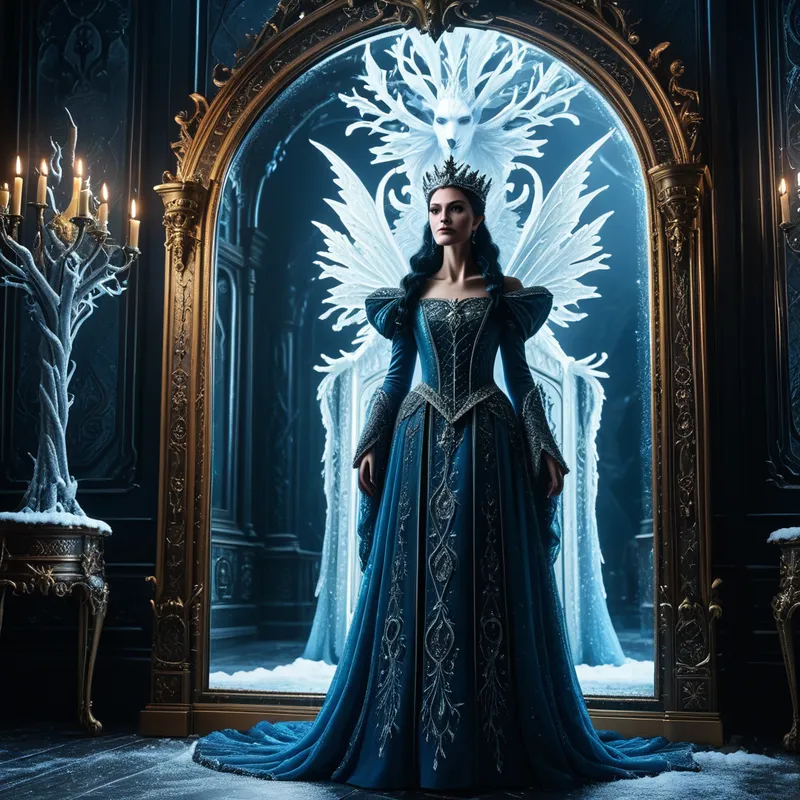
In a kingdom carved from mountain stone and veiled in perpetual winter’s breath, there reigned a queen of such chilling beauty it was said the very stars paused in their tracks to gaze upon her. Her heart was a vault of ice, and her sole companion was a mirror, a talking mirror framed in obsidian and silver, whose voice was the whisper of forgotten caverns. To it, each dawn and dusk, she would pose her sacred question: “Mirror, mirror on the wall, who is the fairest one of all?”
And for years untold, [the mirror](/myths/the-mirror “Myth from Various culture.”/)’s cold truth echoed her desire. “You, my Queen, are fairest of all.”
But time, the silent hunter, moves even in frozen halls. The king perished, leaving behind a daughter from his first spring—a girl named Snow White, whose beauty was not of ice, but of living things: skin like fresh snow, lips like spilled wine, hair like a [raven](/myths/raven “Myth from Haida culture.”/)’s wing. She grew, and with her grew a shadow in the queen’s heart. The day came when the queen stood before her dark glass and asked her fateful question. The mirror’s voice did not hesitate. “You, my Queen, are fair, it is true. But Snow White is a thousand times fairer than you.”
A silence fell, deeper than any winter. The queen’s perfect features did not crack, but something behind her eyes shattered. From that shattering grew a terrible purpose. She summoned a huntsman, a man of the wild woods. “Take [the child](/myths/the-child “Myth from Alchemy culture.”/) into the forest,” she commanded, her voice smooth as poisoned honey. “Kill her, and as proof, bring me her heart in this box of iron.” The huntsman, bound by oath, led the innocent girl deep into the ancient, sighing woods. But when he raised his knife, he saw her tears, like diamonds on snow, and his own heart rebelled. He let her flee into [the wilderness](/myths/the-wilderness “Myth from Biblical culture.”/) and returned to the queen with the heart of a wild boar.
Believing her rival dead, the queen returned to her mirror. But the mirror knew. “Snow White still lives, beyond the seven mountains, with the seven dwarfs. There, she is the fairest.”
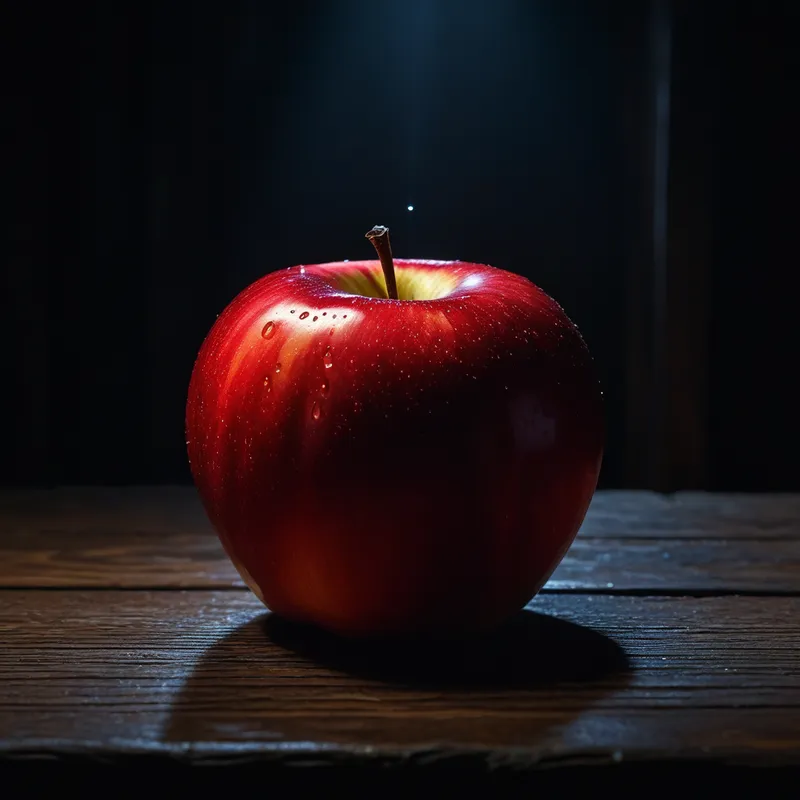
Fury, now, had a color: the venomous green of envy. The queen, mistress of disguises, descended into her secret chambers—a place of alembics and arcane dust. There, she performed a dark craft. She took a perfect apple, one side blushing red, the other pale as death, and steeped it in a sleeping death so profound it mimicked the end of all things. Disguised as a peddler crone, she crossed the seven mountains and found the dwarfs’ cottage. With cunning words, she offered the gift. Snow White, whose innocence was her only flaw, took a single bite of the rosy cheek of the apple and fell down as if dead.
The dwarfs, returning, could not wake her. They placed her in a crystal coffin, and there she lay, a perfect, untouchable effigy of beauty. Time passed. A prince, riding through the forest, saw her and was stricken. He begged the dwarfs for her coffin. As his servants carried it, they stumbled. The jolt dislodged the poisoned bite from Snow White’s throat. She awoke.
In the high castle, the queen, triumphant, went once more to her mirror. “Now, surely, I am the fairest?” The mirror replied, “You, my Queen, are fair, it is true. But the young queen is a thousand times fairer than you.” The queen understood then the totality of her defeat. At the wedding feast of Snow White and the prince, an invitation of iron was delivered. Forced to attend, the queen was presented with a pair of iron slippers, heated red-hot in the fire. She was made to dance in them until she fell down dead, and the story found its terrible, just end.
Cultural Origins & Context
This tale, in its most familiar form, was codified by the Brothers Grimm in 1812, though its roots sink deep into the loam of European folklore. It is a story told by [the hearth](/myths/the-hearth “Myth from Norse culture.”/), a warning and a lesson passed from mother to daughter, from nurse to child, in the long nights of a pre-industrial world. Its primary societal function was didactic, operating on multiple levels. For the community, it reinforced the peril of unchecked pride (hubris) and the ultimate [triumph](/myths/triumph “Myth from Roman culture.”/) of innocence and communal [justice](/myths/justice “Myth from Tarot culture.”/). For the individual listener, especially the young woman, it was a complex map of female rivalry, the dangers of the outside world (the forest, [the stranger](/myths/the-stranger “Myth from Biblical culture.”/)), and the precarious transition from maidenhood to maturity. The stepmother figure, often a narrative substitute for the biological mother in these oral traditions, embodies the dark side of maternal authority—not nurturing, but consuming. The tale was not mere entertainment; it was a psychic tool for processing fears of abandonment, envy, and the terrifying, beautiful power of maturation.
Symbolic Architecture
The myth is a pristine [blueprint](/symbols/blueprint “Symbol: A blueprint represents the foundational plan or design for something, often symbolizing potential, structure, and the mapping of one’s inner self or future.”/) of the [psyche](/myths/psyche “Myth from Greek culture.”/) in conflict. The [Queen](/symbols/queen “Symbol: A queen represents authority, power, nurturing, and femininity, often embodying leadership and responsibility.”/) is not merely a [villain](/symbols/villain “Symbol: A character representing opposition, moral corruption, or suppressed aspects of self, often embodying fears, conflicts, or societal threats.”/); she is the incarnate [Shadow](/symbols/shadow “Symbol: The ‘shadow’ embodies the unconscious, repressed aspects of the self and often represents fears or hidden emotions.”/) of the idealized feminine. She represents the part of the [psyche](/myths/psyche “Myth from Greek culture.”/) that cannot tolerate a successor, that seeks to eternalize a single phase of [life](/symbols/life “Symbol: The symbol of ‘Life’ represents a journey of growth, interconnectedness, and existential meaning, encompassing both the joys and challenges that define human experience.”/)—here, the phase of supreme, untouchable [beauty](/symbols/beauty “Symbol: This symbol embodies aesthetics, harmony, and the appreciation of life’s finer qualities.”/) and power.
The mirror does not lie; it reveals the soul’s deepest, most uncomfortable truth. To ask it “who is the fairest” is to ask “who has worth,” and to base that worth entirely on a fading external reflection is the original sin of the psyche.
The poisoned [apple](/symbols/apple “Symbol: An apple symbolizes knowledge, temptation, and the duality of good and evil, often representing the pursuit of wisdom with potential consequences.”/) is the central [artifact](/symbols/artifact “Symbol: An object from the past carrying historical, cultural, or personal significance, often representing legacy, memory, or hidden knowledge.”/) of this shadow’s [strategy](/symbols/strategy “Symbol: A plan of action designed to achieve a long-term or overall aim, often involving competition, resource management, and foresight.”/). It is not a [weapon](/symbols/weapon “Symbol: A weapon in dreams often symbolizes power, aggression, and the need for protection or defense.”/) of blunt force, but of seduction. It offers the fulfillment of a natural desire (nourishment, beauty, a gift) but contains within it a state of [suspended animation](/symbols/suspended-animation “Symbol: A state where biological processes are halted or slowed dramatically, often used in science fiction for space travel or medical preservation.”/)—a symbolic [death](/symbols/death “Symbol: Symbolizes transformation, endings, and new beginnings; often associated with fear of the unknown.”/). Snow White’s bite is a necessary [initiation](/symbols/initiation “Symbol: A symbolic beginning or transition into a new phase, status, or awareness, often involving tests, rituals, or profound personal change.”/). She must “die” as the innocent [child](/symbols/child “Symbol: The child symbolizes innocence, vulnerability, and potential growth, often representing the dreamer’s inner child or unresolved issues from childhood.”/) in the dwarfs’ cottage (a [symbol](/symbols/symbol “Symbol: A symbol can represent an idea, concept, or belief, serving as a powerful tool for communication and understanding.”/) of a safe, immature, and masculine-structured psyche) to be reborn as a queen capable of partnership (the [Prince](/symbols/prince “Symbol: A prince symbolizes nobility, leadership, and aspiration, often representing potential or personal authority.”/)).
The seven dwarfs are the helpful but limited functions of the conscious ego. They can protect and provide, but they cannot break the spell of the unconscious (the poison). Only the intervention of the Prince—the destined other—can catalyze the final transformation, the dislodging of the poisoned fragment.
The Dreamer’s Resonance
When this myth stirs in modern dreams, it signals a profound interior crisis of comparison and succession. To dream of a jealous, powerful female figure (who may not be a literal stepmother) is to encounter one’s own internal Queen. The dreamer may be undergoing a life transition where an old identity (the “fairest” professional, the “fairest” caregiver, the “fairest” in any domain) feels threatened by a emerging new self or by an external rival. The somatic feeling is often one of cold dread, of being watched and judged.
Dreaming of the mirror speaks to a painful moment of self-assessment, where [the ego](/myths/the-ego “Myth from Jungian culture.”/)’s flattering self-image is shattered by a more objective, often brutal, truth from the unconscious. [The poisoned apple](/myths/the-poisoned-apple “Myth from Various culture.”/) in a dream might appear as a too-good-to-be-true job offer, a seductive but destructive relationship, or any alluring path that promises fulfillment but leads to a feeling of being frozen, stuck, or “asleep” in one’s own life. The dreamwork here is the psyche’s attempt to navigate the poison—to recognize [the shadow](/myths/the-shadow “Myth from Jungian culture.”/)’s attempt to preserve an old order through deceptive means, and to move toward the inevitable jolt that will lead to awakening.

Alchemical Translation
The myth models the alchemical process of [nigredo](/myths/nigredo “Myth from Alchemical culture.”/) and individuation. The Queen’s envy is the initial blackening, the recognition of a flaw in the psychic structure (her beauty is not absolute). Her entire subsequent action is a misguided, literalized attempt to solve a symbolic problem—to kill the new life rather than integrate it.
The transformation occurs not when the shadow is destroyed, but when it is forced to wear its own consequences. The iron slippers are the embodiment of the Queen’s own cold, rigid, and burning obsession turned back upon her.
For the modern individual, the “alchemical translation” is this: the part of you that cannot bear to be surpassed, that is obsessed with its own primacy in some arena, must be confronted. This is not an enemy to be assassinated in the woods, but a energy to be understood and transformed. The “Snow White” within is the nascent potential, the new consciousness that threatens the old regime. The “bite of the apple” is the necessary, often painful, engagement with a shadowy complex that temporarily paralyzes us. The “crystal coffin” is a period of incubation, where the old life is seen as dead and the new one has not yet begun.
The culmination—the prince’s arrival, the stumble, the awakening—is the intervention of a transcendent function, often arriving unexpectedly (as grace or synchronicity), which integrates the lost piece. The final feast, where the shadow is confronted with its failure and dances itself to death, represents the conscious, ritualized end of an outdated psychic pattern. The individual does not become Snow White or the Prince alone; they become the sovereign of a kingdom that has integrated both the innocent maiden and the dark queen, ruling a self that knows both the poison and the antidote.
Associated Symbols
Explore related symbols from the CaleaDream lexicon: