Snow White's Magic Mirror Myth Meaning & Symbolism
A queen's obsession with a mirror's verdict leads to a deadly rivalry with her stepdaughter, revealing the shadow of vanity and the price of true beauty.
The Tale of Snow White’s Magic Mirror
In a kingdom carved from shadow and snow, there lived a queen whose beauty was a weapon sheathed in silk. Her throne was not of oak or gold, but of a single, terrible question, repeated each day as the pale sun crested the black spires of her castle.
“Mirror, mirror, on the wall, who in this land is fairest of all?”
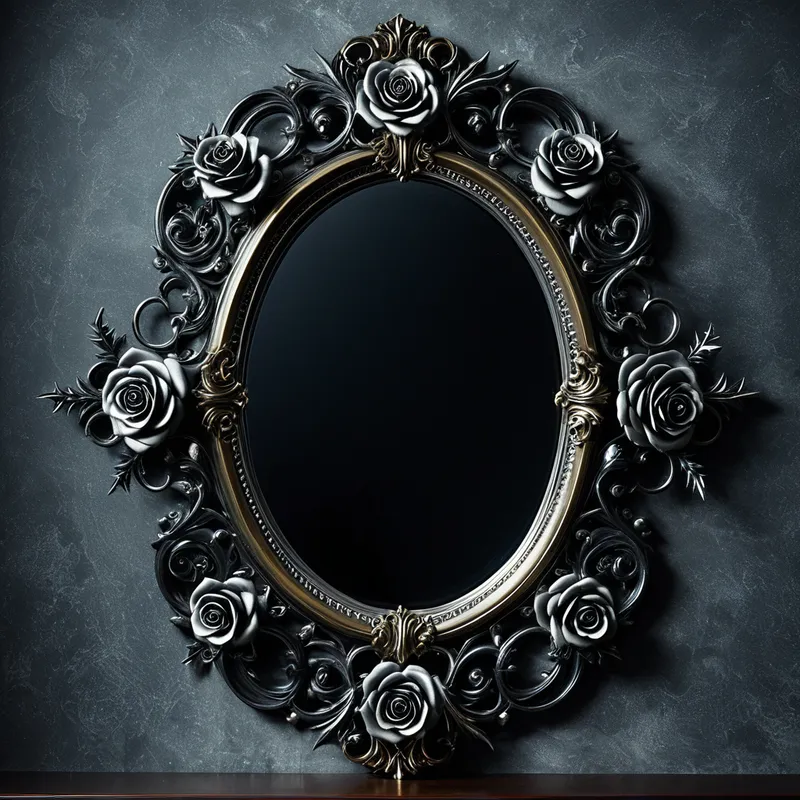
And from the depths of the glass, a voice like frozen honey would answer, “You, my queen, are the fairest in the land.” The words were her sustenance, the foundation of her world. [The mirror](/myths/the-mirror “Myth from Various culture.”/), an artifact of polished obsidian and silver filigree, was no mere household object. It was an oracle, a confessor, a god of vanity enthroned in her private chamber. Its surface did not show the room behind her, but a shifting, starless void from which the truth—her only truth—would emerge.
But kingdoms turn, and seasons change. The queen’s stepdaughter, Snow White, grew. Her beauty was not the sharp, cultivated beauty of the court, but the wild, untamed beauty of the forest itself—roses in her cheeks, [raven](/myths/raven “Myth from Haida culture.”/) hair, and a spirit as clear as a mountain spring. The day the mirror’s verdict changed, the very stones of the castle grew cold.
“You, my queen, are fair; it is true. But Snow White is a thousand times fairer than you.”
The queen’s world shattered. The nourishing truth became a poison. Her beauty, her power, her very identity was usurped by a reflection she could not control. From that moment, the queen was no longer a ruler, but a hunter, and the object of her hunt was her own reflection, made flesh in the girl. She commanded a huntsman to bring her Snow White’s heart, a brutal, literal attempt to reclaim the title by consuming the rival’s essence. But the heart delivered to her was that of a boar, and the mirror’s cold voice remained unchanged.
Thus began the queen’s descent into a dark alchemy. Disguising herself three times—as a peddler, a comb-seller, and finally, as a crone with a poisoned apple—she crossed the boundary of the civilized world into the deep, animistic forest where Snow White had found refuge with seven dwarfs. Each disguise was a layer of her own denied ugliness, her shadow made flesh. With the apple, a fruit of perfect, deadly red, she achieved her aim. Snow White fell into a sleep like death, preserved in a crystal coffin, a beautiful, frozen reflection.
Yet the tale turns on the axis of a prince’s gaze—not a look of comparison, but one of recognition and love. His arrival dislodges the poisoned bite, and Snow White awakens. At that very moment, in her distant castle, the queen stands once more before her god. “Mirror, mirror, on the wall,” she demands, her voice now the rasp of desperation. And the mirror, forever truthful, names the awakened bride as fairest.
The queen’s fury is a final, self-consuming fire. Invited to the wedding feast, she is presented with iron shoes, heated glowing in the flames. Forced to dance in them, she dances until she falls, her obsession literally burning her up from the ground she sought to rule. The mirror, we presume, falls silent, its purpose fulfilled in the destruction of the one who could not bear its truth.
Cultural Origins & Context
The tale, as collected by the Brothers Grimm in 19th-century Germany, is a refined amalgam of much older oral traditions. These stories were not children’s fare in their earliest forms, but stark, moral narratives told by [the hearth](/myths/the-hearth “Myth from Norse culture.”/), often by women, to encode societal warnings and psychological truths. The “Fairy Tale” culture from which it springs is a European folkloric stratum concerned with the perils of the domestic and the wild, the stepmother as a figure of displaced maternal ambivalence, and the stark transition from girlhood to womanhood.
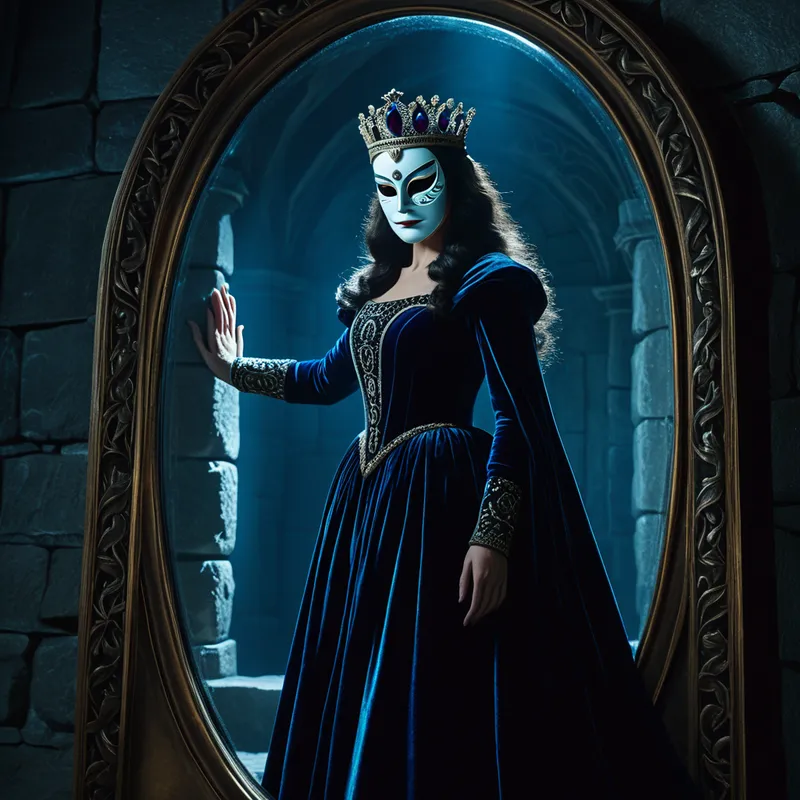
[The magic mirror](/myths/the-magic-mirror “Myth from Fairy Tale culture.”/) is a folkloric motif that externalizes an internal process. In a pre-psychological age, the voice from the glass gave form to the unspeakable: self-doubt, obsessive comparison, and the terror of aging and replacement. The story functioned as a cautionary tale about the dangers of vanity and envy, particularly among women in closed, hierarchical systems where beauty and youth were primary currency. It also served as a initiation story for the young, illustrating the deadly jealousy of the established order (the queen/stepmother) towards burgeoning new life (Snow White), and the necessity of finding refuge and aid in the primal, earthy realm (the dwarfs/forest) before a true integration (the prince) can occur.
Symbolic Architecture
The myth’s power lies in its perfect symbolic economy. The Snow White figure represents the pure, unconscious Self in its potential state—the [anima](/symbols/anima “Symbol: The feminine archetype within the male unconscious, representing soul, creativity, and connection to the inner world.”/) in its innocent form. She is [life](/symbols/life “Symbol: The symbol of ‘Life’ represents a journey of growth, interconnectedness, and existential meaning, encompassing both the joys and challenges that define human experience.”/) itself, natural and unselfconscious.
The [Queen](/symbols/queen “Symbol: A queen represents authority, power, nurturing, and femininity, often embodying leadership and responsibility.”/) is the ruling [consciousness](/symbols/consciousness “Symbol: Consciousness represents the state of awareness and perception, encompassing thoughts, feelings, and experiences.”/), but one that has become pathological. Her [identity](/symbols/identity “Symbol: Identity represents the sense of self, encompassing personal beliefs, cultural background, and social roles.”/) is entirely dependent on an external validation of her surface [image](/symbols/image “Symbol: An image represents perception, memories, and the visual narratives we create in our minds.”/). She is [the ego](/myths/the-ego “Myth from Jungian culture.”/) inflated by a [persona](/symbols/persona “Symbol: The social mask or outward identity one presents to the world, often concealing the true self.”/) of perfection, yet utterly fragile.
The Magic Mirror is the function of discrimination turned monstrous. It is truth without compassion, consciousness without conscience.
It represents the cold, objective voice of comparison itself—the internal critic that measures [the self](/myths/the-self “Myth from Jungian culture.”/) against an impossible ideal or a perceived rival. It is not evil, but neutral; it simply speaks what is. The evil arises from the queen’s [relationship](/symbols/relationship “Symbol: A representation of connections we have with others in our lives, often reflecting our emotional state.”/) to its [verdict](/symbols/verdict “Symbol: A formal judgment or decision, often legal or moral, representing closure, accountability, and societal evaluation.”/). She conflates its judgment of “fairest” with her entire worth and right to exist.
The Huntsman, the [Forest](/symbols/forest “Symbol: The forest symbolizes a complex domain of the unconscious mind, representing both mystery and potential for personal growth.”/), the Dwarfs, and the Poisoned [Apple](/symbols/apple “Symbol: An apple symbolizes knowledge, temptation, and the duality of good and evil, often representing the pursuit of wisdom with potential consequences.”/) are all stages of the [psyche](/myths/psyche “Myth from Greek culture.”/)’s attempt to resolve this conflict. The huntsman represents a nascent conscience that spares the innocent Self. The forest and dwarfs symbolize the protective, nurturing, and practical aspects of the unconscious that shelter the developing psyche. [The poisoned apple](/myths/the-poisoned-apple “Myth from Various culture.”/) is the ultimate [shadow](/symbols/shadow “Symbol: The ‘shadow’ embodies the unconscious, repressed aspects of the self and often represents fears or hidden emotions.”/) gift—the tempting, beautiful object that contains the queen’s own psychic poison, the envy that seeks to put the vibrant, threatening life of the Self into a state of [suspended animation](/symbols/suspended-animation “Symbol: A state where biological processes are halted or slowed dramatically, often used in science fiction for space travel or medical preservation.”/).
The Dreamer’s Resonance
When this mythic pattern stirs in the modern dreamer, it signals a critical engagement with the Shadow of comparison and a brittle self-image. To dream of a talking mirror is to encounter the objective, often cruel, voice of one’s own self-assessment. To dream of being the queen, frantically demanding a verdict, points to a deep anxiety about one’s value, attractiveness, or position being usurped—by a younger colleague, a new partner, or simply by time itself.
The somatic experience is often one of cold dread, a tightening in the chest, or a feeling of being visually exposed and judged. Psychologically, the dreamer is in a process of confronting what they have exiled. The “Snow White” within may be their own neglected innocence, creativity, or natural vitality that the “queen” ego-complex has tried to suppress or kill off because it threatens the ego’s controlled self-definition. The dream is a signal that the ruling attitude of the psyche is at war with the authentic Self, and the mirror is reporting the inevitable, painful truth: the authentic Self is “fairer,” more vital, and will ultimately demand its place.

Alchemical Translation
The myth models the alchemical process of individuation through the metaphor of the [nigredo](/myths/nigredo “Myth from Alchemical culture.”/)—the blackening, the descent into darkness. The queen’s obsession is the initial, necessary fixation on a single, flawed aspect of the personality (the [persona](/myths/persona “Myth from Greek culture.”/) of “fairest”). Her disintegration represents the painful but essential death of this inflated ego-identity.
The queen must dance in the iron shoes until she falls. The ego, hardened and heated by its own obsessive fire, must be worn out and destroyed for the new psychic structure to emerge.
Snow White’s journey is the parallel process. Her “death” by the apple is not an end, but a necessary incubation in the crystal coffin—a state of psychic suspension where the poison of [the shadow](/myths/the-shadow “Myth from Jungian culture.”/) (the queen’s envy) is slowly neutralized. This is the albedo, the whitening, a purification. Her awakening by the prince is the coniunctio, [the sacred marriage](/myths/the-sacred-marriage “Myth from Various culture.”/). This is not a romantic cliché, but a symbol of the ego (now represented by the conscious, seeking prince) finally recognizing, loving, and integrating the once-repressed Self (Snow White).
The ultimate transmutation is not Snow White’s alone, nor the queen’s destruction. It is the integration of the mirror’s function. In the healed psyche, the mirror is no longer an external oracle of brutal comparison. It becomes a tool of true self-reflection—a means to see oneself clearly, without inflation or denial, capable of holding both beauty and flaw, youth and age, self and other, in a single, compassionate gaze. The throne is no longer founded on a question, but on the silent, sovereign knowledge of a whole being.
Associated Symbols
Explore related symbols from the CaleaDream lexicon: