Snow White's Glass Coffin Myth Meaning & Symbolism
A tale of a poisoned princess, suspended in a glass coffin, awaiting the dislodging of a poisoned truth to catalyze her return to life.
The Tale of Snow White’s Glass Coffin
Listen, and let the old forest breathe its tale. In a kingdom where vanity cast a longer shadow than any tower, there lived a queen whose beauty was a cold, polished mirror. But from that mirror spoke a truth she could not bear: that her stepdaughter, Snow White, had surpassed her. The queen’s heart, once a chamber, became a tomb, and from it she fashioned a plan—a huntsman, a deep wood, and a command to return with the girl’s heart.
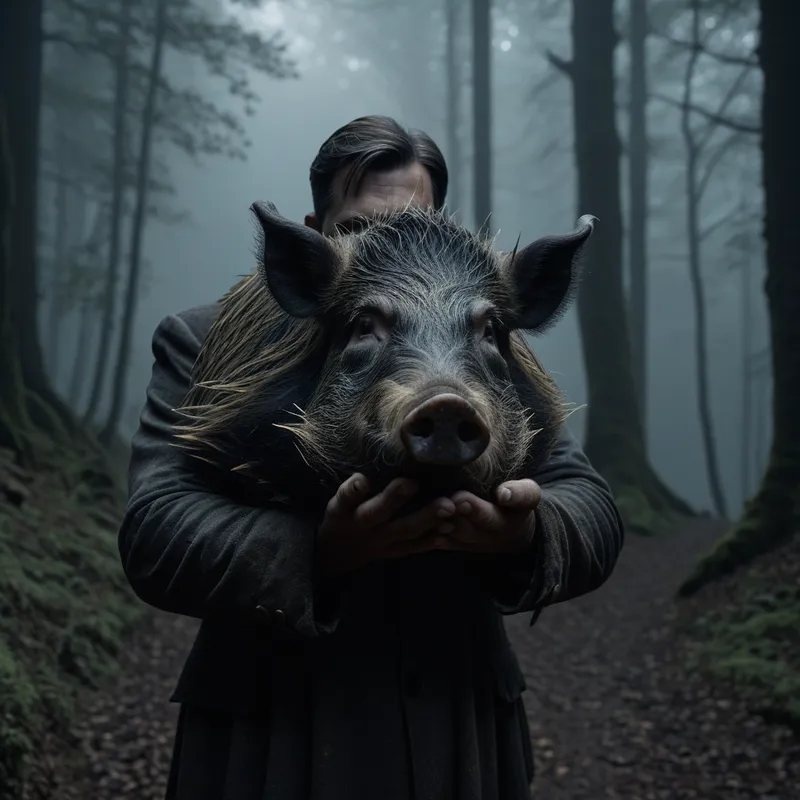
But the huntsman, his own heart pierced by the sight of the maiden’s uncomprehending innocence, let the forest swallow her and brought back the heart of a boar instead. Snow White fled, a white dove in a world of bark and thorn, until she found a cottage, small as a child’s dream, belonging to seven miners of [the earth](/myths/the-earth “Myth from Hindu culture.”/). She kept their home, and for a time, the scent of soup and the warmth of simple kindness were a shield.
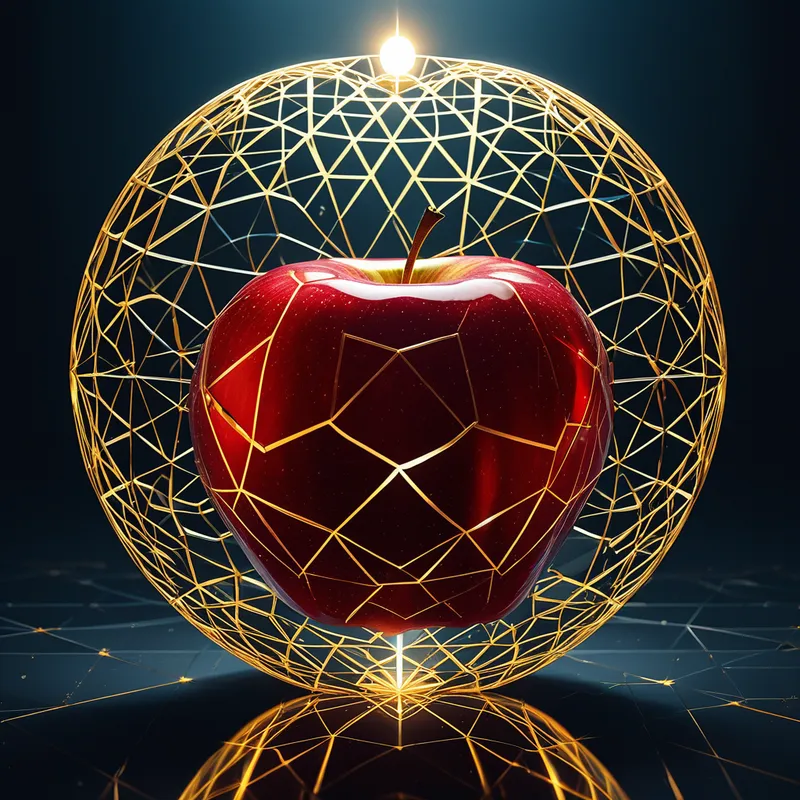
The queen, learning of her survival from her whispering mirror, descended into a darker magic. She transformed herself—first a peddler of laces, binding the girl tight until breath failed, but the miners returned and loosened the noose. Then a comb, its teeth poisoned, which slid into the girl’s hair and sent her sinking down, only to be plucked out again. Finally, the queen crafted her masterpiece: an apple, radiant red on one side, poisoned white on the other. “A wishing apple,” she crooned. And Snow White, her trust not yet broken, took a bite of the crimson side.
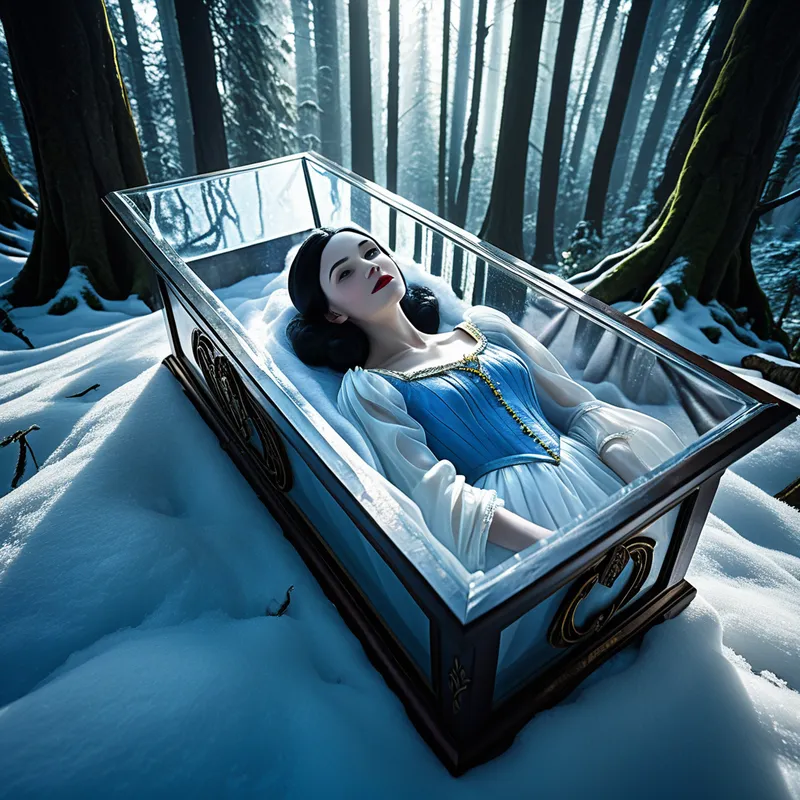
The poison did not bring thrashing or cries. It was a silent thief. It stole not her form, which remained flawlessly beautiful, but the animating spark within. She fell into a sleep that was the cousin of death. The miners, returning to find their heart’s keeper stilled, could not bear to bury her in the dark earth. So they fashioned a coffin of clear glass, that the light might always find her, and placed her upon a mountain ledge, where she became a legend—a sleeping princess in a crystal tomb, watched over by creatures of the wood and the steadfast dwarfs.
Years passed. A prince, riding through that realm, heard the tale and sought the glass tomb. Seeing her, a love—or perhaps a profound recognition—stirred in him. He begged the dwarfs for the coffin, to carry her to a place of honor. As his servants lifted it, they stumbled. The jolt shook the coffin, and from Snow White’s lips flew the lodged piece of poisoned apple. Her eyes, the color of a waking sky, opened. The sleep was broken. The glass, having served its purpose, was opened, and she rose, not as a child of the forest, but as a woman ready to step into a new world.
Cultural Origins & Context
The tale, as we know it, was crystallized in the 19th century by the Brothers Grimm, who collected it from oral traditions among German Volk storytellers. Its roots, however, sink much deeper, intertwining with widespread Indo-European motifs of death-like sleep, jealous stepmothers, and helper figures. [The glass coffin](/myths/the-glass-coffin “Myth from Fairy Tale culture.”/) itself is a distinctive Northern European variant; other traditions might use crystal, amber, or simply a guarded chamber. This was a story told by [the hearth](/myths/the-hearth “Myth from Norse culture.”/), often by women, to children. Its function was multifaceted: a cautionary tale about strangers and temptation, a narrative framework for the terrifying transition from childhood innocence to adult sexuality (the poisoned sleep), and a profound reassurance that even the deepest “death” imposed by malice or misfortune could be temporary, if one’s essential purity was preserved and witnessed.
Symbolic Architecture
The myth is a perfect map of a psychic catastrophe and its [resolution](/symbols/resolution “Symbol: In arts and music, resolution refers to the movement from dissonance to consonance, creating a sense of completion, release, or finality in a composition.”/). Snow White represents the nascent, undeveloped Self—the natural [psyche](/myths/psyche “Myth from Greek culture.”/) in its original state of potential. The [Queen](/symbols/queen “Symbol: A queen represents authority, power, nurturing, and femininity, often embodying leadership and responsibility.”/) is the possessive, aging ego-complex, terrified of being rendered obsolete by new [life](/symbols/life “Symbol: The symbol of ‘Life’ represents a journey of growth, interconnectedness, and existential meaning, encompassing both the joys and challenges that define human experience.”/). Her mirror is [the ego](/myths/the-ego “Myth from Jungian culture.”/)’s distorted [feedback](/symbols/feedback “Symbol: Feedback symbolizes the information and responses we receive from our environment and relationships, indicating how our actions and feelings are perceived.”/) [loop](/symbols/loop “Symbol: The loop symbolizes cycles, repetition, and the possibility of closure or a return to beginnings in one’s life experiences.”/), measuring worth only in comparison.
The glass coffin is not a prison, but a sanctuary of suspended animation. It is the psyche’s emergency protocol when integration is impossible.
The poison [apple](/symbols/apple “Symbol: An apple symbolizes knowledge, temptation, and the duality of good and evil, often representing the pursuit of wisdom with potential consequences.”/) is the toxic introject—a [piece](/symbols/piece “Symbol: A ‘piece’ in dreams often symbolizes a fragment of the self or a situation that requires integration, reflection, or understanding.”/) of “[knowledge](/symbols/knowledge “Symbol: Knowledge symbolizes learning, understanding, and wisdom, embodying the acquisition of information and enlightenment.”/)” or a complex (often related to trust, [betrayal](/symbols/betrayal “Symbol: A profound violation of trust in artistic or musical contexts, often representing broken creative partnerships or artistic integrity compromised.”/), or sexuality) that the immature [consciousness](/symbols/consciousness “Symbol: Consciousness represents the state of awareness and perception, encompassing thoughts, feelings, and experiences.”/) cannot digest. It paralyzes further development. The [glass](/symbols/glass “Symbol: Glass in dreams often symbolizes clarity, transparency, fragility, and the need for introspection.”/) [coffin](/symbols/coffin “Symbol: A coffin represents endings, transitions, or significant changes, often associated with fears surrounding mortality and letting go.”/) is the resulting state of psychic stagnation. [The Self](/myths/the-self “Myth from Jungian culture.”/) is not dead; it is preserved in perfect, inaccessible [stasis](/symbols/stasis “Symbol: A state of inactivity, equilibrium, or suspension where no change or progress occurs, often representing psychological or existential paralysis.”/), visible to all but unreachable. The dwarfs, as [earth](/symbols/earth “Symbol: The symbol of Earth often represents grounding, stability, and the physical realm, embodying a connection to nature and the innate support it provides.”/)-diggers, represent the instinctual, earthy functions of the psyche that continue to work and provide a vigil, but cannot themselves effect the cure. The [prince](/symbols/prince “Symbol: A prince symbolizes nobility, leadership, and aspiration, often representing potential or personal authority.”/) is the arriving Self [archetype](/symbols/archetype “Symbol: A universal, primordial pattern or prototype in the collective unconscious that shapes human experience, behavior, and creative expression.”/) or an external catalytic [event](/symbols/event “Symbol: An event within dreams often signifies significant life changes, transitions, or emotional milestones.”/). Crucially, he does not kiss her awake. The awakening is caused by the dislodging of the poison (the [apple](/symbols/apple “Symbol: An apple symbolizes knowledge, temptation, and the duality of good and evil, often representing the pursuit of wisdom with potential consequences.”/) [piece](/symbols/piece “Symbol: A ‘piece’ in dreams often symbolizes a fragment of the self or a situation that requires integration, reflection, or understanding.”/)) through a [jolt](/symbols/jolt “Symbol: A sudden, sharp movement or shock that interrupts continuity, often signaling an abrupt transition, awakening, or unexpected change in life’s journey.”/). The love (the [prince](/symbols/prince “Symbol: A prince symbolizes nobility, leadership, and aspiration, often representing potential or personal authority.”/)’s desire to honor her) creates the [condition](/symbols/condition “Symbol: Condition reflects the state of being, often focusing on physical, emotional, or situational aspects of life.”/), but the healing is an internal mechanical release.
The Dreamer’s Resonance
To dream of being in a glass coffin is to experience a profound somatic metaphor for a state of psychological suspension. The dreamer may feel utterly seen yet completely trapped, peaceful yet not alive. It speaks to a situation where one’s true nature or potential is on display, perhaps in a job, relationship, or social role, but the inner life-force is frozen. There is no agony, only a numb, beautiful stasis. This often occurs after a psychological “poisoning”—a betrayal, a failure, a trauma that one has swallowed but cannot process. The dream is a diagnostic image from the unconscious: “You are preserved, but you are not moving. The poison is still inside.” The dream may also feature figures looking in (the dwarfs, the prince), representing parts of the self or external relationships that are witnessing the condition but cannot, by themselves, initiate the awakening.

Alchemical Translation
The myth models the individuation process specifically through the stage of mortificatio—the alchemical dying or puttingrefaction. Here, however, it is a mortificatio in clear sight, a death that is not decay but preservation.
The alchemical vessel must be transparent so the operator can witness the transformation within. So too must the ego become a glass coffin, holding the suspended Self without interference, allowing the light of consciousness to fall upon it.
The struggle is the ego’s (Queen’s) refusal to relinquish centrality. The [triumph](/myths/triumph “Myth from Roman culture.”/) is the ego’s eventual defeat, allowing the Self to enter its necessary period of hibernation. For the modern individual, this translates to those periods where forward progress halts. A career stalls, a creative project dies, a relationship becomes static. The instinct is to force movement, to break the glass. But the myth advises a sacred patience. One must allow the Self to be placed in that transparent vessel of acceptance, to be witnessed in one’s stuckness without shame. The work continues underground (the dwarfs mining). Then, one must be open to the “jolt”—the unexpected event, the stumbled-upon insight, the dislodging force of a new perspective (the prince’s arrival and the stumble). This force does not come from willful striving, but from a kind of fateful love that seeks to honor the sleeping Self. The final transmutation is not of lead to gold, but of suspended animation to awakened vitality, where the poison itself becomes the remembered lesson, not the defining truth.
Associated Symbols
Explore related symbols from the CaleaDream lexicon: