Snow White's Evil Queen Myth Meaning & Symbolism
A queen's obsession with being the fairest leads to a deadly hunt for her stepdaughter, a tale of vanity, shadow, and poisoned redemption.
The Tale of Snow White’s Evil Queen
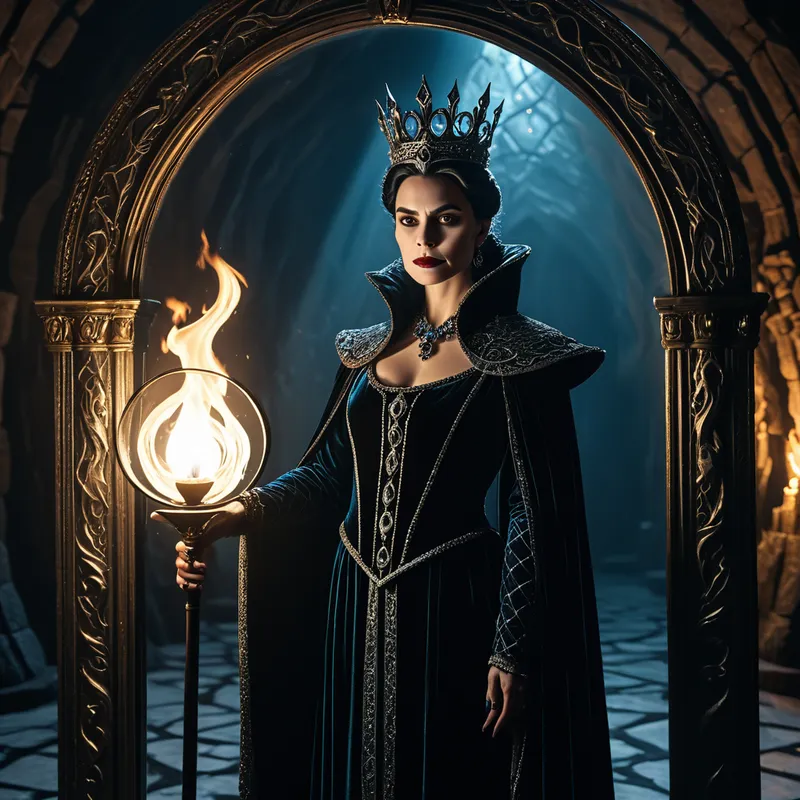
Listen, and hear a tale spun from the dark threads of the heart. In a kingdom of high mountains and deeper woods, there ruled a queen of such chilling beauty it was said winter lingered in her gaze. Her name is lost, remembered only by her title and her terror: the Queen. Her power was absolute, her vanity more so. In the heart of her castle of cold stone lay her sanctum, and in that sanctum hung her oracle: a Mirror of Speaking Truth.
Each day, as the first pale light touched the highest tower, she would stand before it, a statue of velvet and ice, and whisper the incantation of her soul: “Mirror, mirror on the wall, who is the fairest one of all?” For years, the glassy voice echoed her own glory back to her. Until the day it did not.
For in the shadows of the castle, a girl had blossomed. Snow White, the king’s daughter, with skin like settled snow, lips like a wound, and hair like a [raven](/myths/raven “Myth from Haida culture.”/)’s wing. [The mirror](/myths/the-mirror “Myth from Various culture.”/) spoke her name. The Queen’s heart, once a frozen lake, cracked with a sound only she could hear, and from the fissure poured a jealousy as black and hot as pitch.
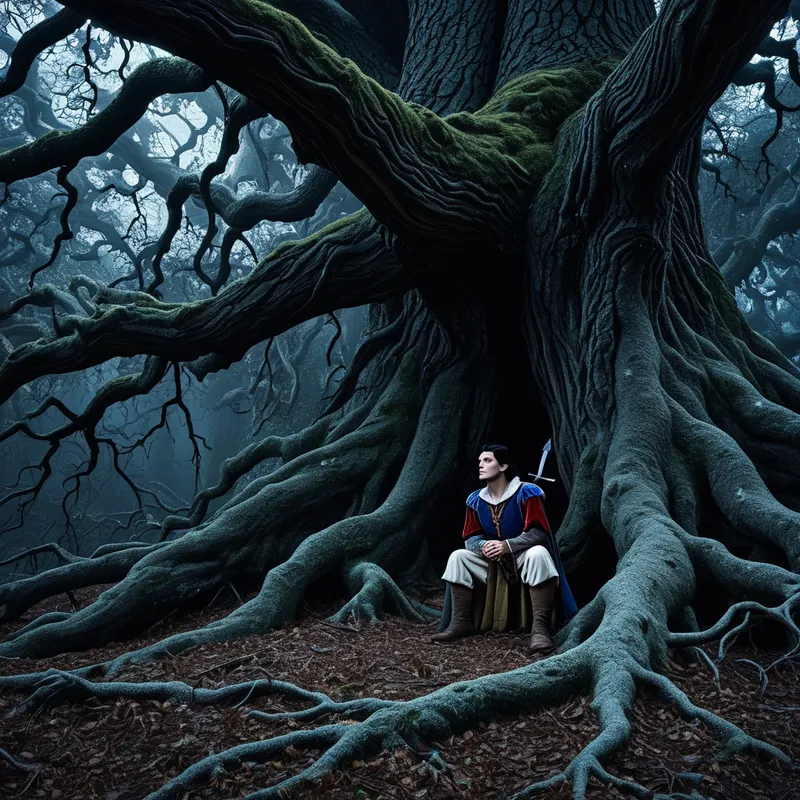
She summoned her Huntsman, a man of the forest with eyes the color of weathered bark. “Take [the child](/myths/the-child “Myth from Alchemy culture.”/) into the woods,” she commanded, her voice sweet with poison, “and bring me her heart in this box of ebony.” The woods were ancient, a cathedral of sighing pines and watchful oaks. But when the Huntsman raised his knife, he saw not a threat to the realm, but innocence asleep on a bed of moss. His own heart rebelled. He let her flee into the green deep, and placed the heart of a wild boar in the dark box.
When the Queen received her prize, she asked her mirror again. And again, it spoke of Snow White, alive among the Seven Dwarves in their cottage carved from a hillside root. Fury became calculation. The Queen descended into a hidden chamber beneath the castle, a place of alembics and arcane dust. There, she performed a dark alchemy, weaving malice into matter. She crafted an apple, one side a radiant, tempting red, the other a pallid, poisoned white.
Disguised as a peddler crone, she crossed the mountains and found the girl. “A bite for luck, dear child,” she crooned. Snow White, whose heart knew no guile, bit the crimson side. The poison, swift and cold, sealed her in a living death, a beauty trapped in crystal breath.
[The dwarves](/myths/the-dwarves “Myth from Norse culture.”/), returning from their diggings in [the earth](/myths/the-earth “Myth from Hindu culture.”/)’s heart, could not bury one so fair. They fashioned a Coffin of Crystal and set it upon a hill, where she became a wonder of the forest. And here, fate’s wheel turned. A prince from a distant land, passing through, saw her. In his grief, he moved the coffin, and the lodged piece of apple fell from her lips.
Life returned in a gasp. But what of the Queen? At her wedding feast, the mirror finally told her a new truth: that another was now fairest. In her rage, she demanded to see this usurper. She was led to the great hall, where Snow White stood radiant beside her prince. The Queen beheld her own undoing. And for her crimes, a punishment was devised—not by axe or rope, but by poetic [justice](/myths/justice “Myth from Tarot culture.”/). They forced upon her a pair of Iron Shoes of Fire, and she was made to dance upon them until she fell dead, her beauty consumed by the very heat of her malice.
Cultural Origins & Context
This myth, in its myriad forms, is a bedrock story of the European oral tradition, collected and codified by the Brothers Grimm in the 19th century. It belongs to the vast “Fairy Tale” culture, a body of stories told not primarily to children, but around hearths by adults, serving as communal containers for deep-seated fears, social codes, and psychological truths. The tellers were often women—spinners, weavers, caregivers—passing narratives down through generations, subtly shaping them to reflect the pressures and perils of their world.
Societally, the tale functioned as a stark warning about the dangers of unchecked vanity and the toxic potential of the stepmother dynamic, a common reality in eras of high maternal mortality. It reinforced the supreme value of feminine innocence (Snow White) and the horrific fate awaiting transgressive, autonomous female power (the Queen). The story was a map of female roles: the maiden, the mother (absent or malevolent), the crones (the disguised Queen, the dwarves in a communal masculine form), and the rescuing prince. It taught lessons about obedience, the perils of strangers, and the belief that virtue, however passive, would be miraculously preserved and rewarded.
Symbolic Architecture
The myth is not a simple moral fable but a dense symbolic [drama](/symbols/drama “Symbol: Drama signifies narratives, emotional expression, and the exploration of human experiences.”/) of the [psyche](/myths/psyche “Myth from Greek culture.”/). The [Queen](/symbols/queen “Symbol: A queen represents authority, power, nurturing, and femininity, often embodying leadership and responsibility.”/) is not merely a [villain](/symbols/villain “Symbol: A character representing opposition, moral corruption, or suppressed aspects of self, often embodying fears, conflicts, or societal threats.”/); she is the incarnate [Shadow](/symbols/shadow “Symbol: The ‘shadow’ embodies the unconscious, repressed aspects of the self and often represents fears or hidden emotions.”/) of the idealized feminine. She represents the part of [the self](/myths/the-self “Myth from Jungian culture.”/) that is ambitious, jealous, aging, and terrified of losing power and recognition.
The mirror does not lie, but it only answers the question it is asked. It is the voice of a merciless, literal truth, devoid of compassion or context.
The Queen’s daily [ritual](/symbols/ritual “Symbol: Rituals signify structured, meaningful actions carried out regularly, reflecting cultural beliefs and emotional needs.”/) is a profound [metaphor](/symbols/metaphor “Symbol: A figure of speech where one thing represents another, often revealing hidden connections and deeper truths through symbolic comparison.”/) for ego-[inflation](/symbols/inflation “Symbol: A dream symbol representing feelings of diminishing value, loss of control, or expansion beyond sustainable limits in one’s life or psyche.”/), the fragile self that must be constantly validated by external [reflection](/symbols/reflection “Symbol: Reflection signifies self-examination, awareness, and the search for truth within oneself.”/). Snow White is her Innocent counterpart, but also her successor—the new [life](/symbols/life “Symbol: The symbol of ‘Life’ represents a journey of growth, interconnectedness, and existential meaning, encompassing both the joys and challenges that define human experience.”/) that inevitably displaces the old. The Huntsman represents the awakening conscience, the [capacity](/symbols/capacity “Symbol: A measure of one’s potential, limits, or ability to contain, process, or achieve something, often reflecting self-assessment or external demands.”/) for mercy that exists even in the service of shadow. The dark [forest](/symbols/forest “Symbol: The forest symbolizes a complex domain of the unconscious mind, representing both mystery and potential for personal growth.”/) is the unconscious itself, a place of [danger](/symbols/danger “Symbol: The symbol of ‘Danger’ often indicates a sense of threat or instability, calling for caution and awareness.”/) but also refuge and transformation. The dwarves symbolize the earthy, practical, and communal functions of the psyche that care for the dormant Self.
The poisoned [apple](/symbols/apple “Symbol: An apple symbolizes knowledge, temptation, and the duality of good and evil, often representing the pursuit of wisdom with potential consequences.”/) is the ultimate [symbol](/symbols/symbol “Symbol: A symbol can represent an idea, concept, or belief, serving as a powerful tool for communication and understanding.”/) of corrupted [knowledge](/symbols/knowledge “Symbol: Knowledge symbolizes learning, understanding, and wisdom, embodying the acquisition of information and enlightenment.”/) and temptation. It is the [Prima Materia](/myths/prima-materia “Myth from Alchemical culture.”/) of the Queen’s [soul](/symbols/soul “Symbol: The soul represents the essence of a person, encompassing their spirit, identity, and connection to the universe.”/)—her [beauty](/symbols/beauty “Symbol: This symbol embodies aesthetics, harmony, and the appreciation of life’s finer qualities.”/) and her [venom](/symbols/venom “Symbol: Venom represents a potent, often hidden, toxic influence that can cause harm or transformation. It symbolizes both danger and potential healing.”/) fused into a single, irresistible object. The [glass](/symbols/glass “Symbol: Glass in dreams often symbolizes clarity, transparency, fragility, and the need for introspection.”/) [coffin](/symbols/coffin “Symbol: A coffin represents endings, transitions, or significant changes, often associated with fears surrounding mortality and letting go.”/) is the state of psychic [suspension](/symbols/suspension “Symbol: A state of being held in limbo, neither progressing nor regressing, often representing unresolved tension or transitional phases in life.”/), where a complex (here, the innocent Self) is preserved but isolated, waiting for the right catalyst—the [prince](/symbols/prince “Symbol: A prince symbolizes nobility, leadership, and aspiration, often representing potential or personal authority.”/), symbolizing an animating, unifying [consciousness](/symbols/consciousness “Symbol: Consciousness represents the state of awareness and perception, encompassing thoughts, feelings, and experiences.”/)—to initiate [integration](/symbols/integration “Symbol: The process of unifying disparate parts of the self or experience into a cohesive whole, often representing psychological wholeness or resolution of internal conflict.”/).
The Dreamer’s Resonance
When this myth stirs in modern dreams, it signals a profound confrontation with [the Shadow](/myths/the-shadow “Myth from Jungian culture.”/)-Ruler archetype within. To dream of being the Queen, staring into a mirror that shows a hated rival or a decaying face, points to a crisis of identity, value, and power. The somatic experience is often one of cold dread, tightening in the chest, or a feeling of being trapped. It speaks to a deep fear of irrelevance, of being superseded—in career, relationship, or by one’s own younger self.
Dreaming of being pursued by a dark feminine figure through a forest indicates the psyche is in a state of flight from its own denied power and rage. The dreamer may be avoiding acknowledging their own ambition, jealousy, or capacity for ruthlessness, projecting it onto a monstrous “other.” Conversely, dreaming of finding or being Snow White in [the glass coffin](/myths/the-glass-coffin “Myth from Fairy Tale culture.”/) suggests a feeling of being psychically frozen, beautiful perhaps on the outside, but unable to live one’s own life, waiting for an external rescue that keeps the core Self passive.

Alchemical Translation
The myth models the brutal but necessary process of psychic transmutation, or individuation. The Queen’s journey is the shadow-side of this process. Her initial state is one of identification with the [persona](/myths/persona “Myth from Greek culture.”/)—the “Fairest Queen.” The mirror’s truth is [the first stage](/myths/the-first-stage “Myth from Alchemical culture.”/) of the [Nigredo](/myths/nigredo “Myth from Alchemical culture.”/), the blackening. It shatters her identification, plunging her into the chaos of envy and rage.
Individuation does not always look like heroic integration; sometimes it looks like the Shadow consuming itself in its own fiery shoes.
Her attempts to kill Snow White are misguided attempts to eliminate the new psychic content that threatens her old order. This is [the ego](/myths/the-ego “Myth from Jungian culture.”/)’s resistance to change. Her final transformation into the peddler crone is significant—it is the shadow adopting the guise of the Wise Woman. She uses cunning, a form of twisted wisdom, to achieve her end.
The true alchemical work, however, is performed by the psyche as a whole. The poisoning is a necessary death. Snow White’s innocence must be “killed” by an encounter with the Shadow’s poison (the apple) to move beyond naive passivity. Her time in the glass coffin is the Albedo, a period of lunar reflection and purification. The prince’s intervention is not a rescue by an external other, but symbolically represents the arrival of a new, unifying psychic principle—the Animus as liberator—that can integrate the experience and re-animate the Self.
The Queen’s fate in the iron shoes is the ultimate, tragic transmutation. It is the shadow, having failed to integrate, being destroyed by its own elemental nature—its fiery, metallic, unyielding rage. For the modern individual, the myth warns that the energies of the Ruler archetype—the need for control, recognition, and sovereignty—must be tempered with humility and acceptance of life’s cycles. To cling solely to the mirror’s verdict is to dance on one’s own destruction. The path to wholeness requires letting the “fairest” part of oneself die, be preserved, and be reborn through an encounter with both the darkness of the forest and the focused consciousness that can finally remove the poison.
Associated Symbols
Explore related symbols from the CaleaDream lexicon: